
YOUR QUESTION. A CLEARER NEXT STEP.
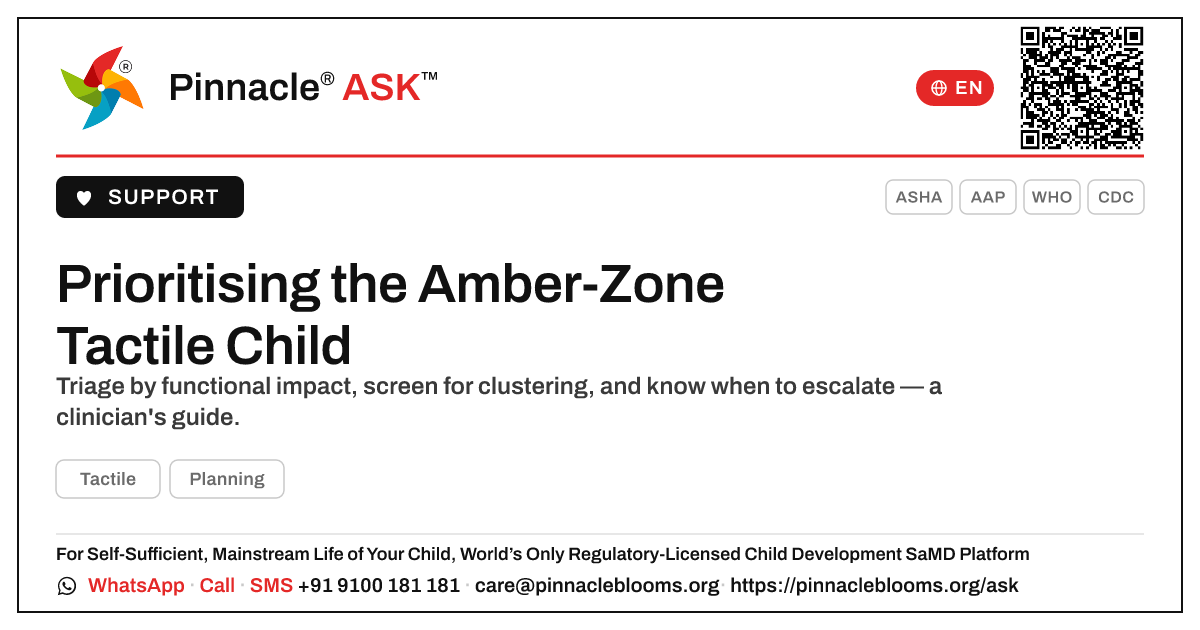
Prioritising a child in the amber zone for Tactile
A child in the amber zone for Tactile should be prioritised by functional impact — how far touch responses disrupt feeding, dressing, hygiene and participation — placing them in an active-monitoring-plus-targeted-intervention tier, with escalation to red if there is nutritional risk, distress, rapid decline or multi-domain clustering. Lead with occupational therapy and caregiver coaching, set short-cycle functional goals, and re-rate at defined intervals. AbilityScore® is part of Pinnacle’s developmental assessment. Diagnosis, where needed, requires an appropriately qualified healthcare professional.
In this answer 5 sections
When a child sits in the amber zone for tactile processing, it's a signal to watch closely and act early — not to wait for it to slip into red.
In short
An amber zone on the Tactile domain means a child shows emerging or sub-threshold differences in tactile processing — touch over- or under-responsivity, tactile discrimination weaknesses, or defensive reactions — that warrant proactive, structured support rather than a watchful pause. Prioritise based on functional impact: how far tactile responses are disrupting feeding, dressing, hygiene, social participation and self-regulation. Amber children typically slot into the active monitoring plus targeted intervention tier — earlier than red on acuity, but ahead of green on surveillance frequency.
How to prioritise within the amber zone
- Triage by functional interference, not score alone. A child whose tactile defensiveness blocks tooth-brushing, eating textured foods or tolerating clothing is higher priority than one with isolated, low-impact sensitivities. Map the amber finding onto daily-living and participation goals.
- Check co-occurrence and clustering. Tactile rarely sits alone — screen for concurrent amber/red in proprioception, vestibular, auditory and regulation domains. Multi-domain amber raises priority and reshapes the plan toward a regulation-first sensory approach.
- Weigh trajectory and modifiability. Recent decline, or differences that are escalating distress and avoidance, justify earlier and more intensive scheduling. Stable, mild presentations can be managed with lighter-touch parent-coached strategies.
- Set short-cycle goals and review. Begin with 1–2 functional targets (e.g. tolerating a textured food group, or hand-messy play), embed a graded sensory diet, coach the caregiver, and re-rate at a defined interval to confirm movement toward green or escalation to red.
- Use occupational therapy as the lead intervention, with caregiver coaching so desensitisation and graded exposure continue in real-world routines between sessions.
When to escalate
Move an amber tactile child toward red-tier priority if tactile responses are driving feeding refusal with nutritional risk, significant distress or self-injury, rapid functional decline, or if they sit within a cluster of multi-domain sensory and regulation difficulties. Conversely, de-escalate toward routine surveillance once functional targets are met and responses stabilise.
The Pinnacle way
AbilityScore® is part of Pinnacle’s developmental assessment. Diagnosis, where needed, requires an appropriately qualified healthcare professional — the amber/green/red banding is a clinician-administered structured indicator, not a self-scored or app-generated label. Explore how the AbilityScore® is structured, how occupational therapy leads tactile support, and the wider Pinnacle network and approach.
Trusted sources
ASHA and AAP guidance on sensory processing and participation-based intervention; WHO ICD-11 framing of sensory-related functioning; CDC developmental monitoring principles — all paraphrased for clinical use.
Next step — Confirm the tactile profile and intervention tier with a structured clinician-led assessment. Refer the child for a Pinnacle occupational therapy review.
This is general information, not a diagnosis — individual assessment and diagnosis require an appropriately qualified healthcare professional.
CONNECT THE ANSWER TO YOUR CHILD’S DAY
Something to notice. Something to discuss.
What to notice
Watch for tactile differences disrupting feeding, tooth-brushing, dressing or messy play; escalating avoidance or distress; and concurrent amber/red findings in proprioception, vestibular or regulation domains.
In everyday life
Coach caregivers to embed graded, playful tactile exposure into daily routines — varied food textures, hand-messy play and clothing choices — so desensitisation continues between sessions.
Bring your observations and questions to your child’s professional. Choose activities that suit your child’s comfort, abilities and agreed plan.
Bring your questions to a first visitQuestions families ask
Does an amber tactile zone mean the child needs immediate intensive therapy?
Not necessarily — amber signals proactive targeted support and active monitoring rather than emergency intervention. Prioritise by functional interference: a child whose tactile responses block feeding, hygiene or participation moves higher in the queue than one with isolated, low-impact sensitivities.
When should amber be escalated to red?
Escalate when tactile responses drive feeding refusal with nutritional risk, marked distress or self-injury, rapid functional decline, or when amber clusters with red findings in other sensory or regulation domains.
Which therapy leads tactile support?
Occupational therapy is the lead intervention, using graded exposure and a sensory diet, with caregiver coaching so strategies continue in everyday routines between sessions.
How often should an amber tactile rating be reviewed?
Set short-cycle functional goals and re-rate at a defined interval to confirm movement toward green or the need to escalate. Banding is always confirmed through clinician-administered assessment at a Pinnacle centre.
FOLLOW THE SOURCE
References behind this answer.
- Organisation website · further readingASHA — sensory and participation-based intervention guidance
- Organisation website · further readingAmerican Academy of Pediatrics — developmental support
- Organisation website · further readingWHO ICD-11 — sensory-related functioning framing
- Organisation website · further readingCDC — developmental monitoring principles
References are supplied with this answer. An organisation homepage offers further reading; it does not establish an independent review of this page.
Content attribution: SETU Consortium · Pinnacle Blooms Network.
PEOPLE, TOPICS & DEVELOPMENT
See the connections.
Browse the wider question collections connected with this answer’s audience, developmental area and stage.
FROM UNDERSTANDING TO PURPOSEFUL SUPPORT
One question. Your child’s whole life.
Your child’s self-sufficient, mainstream-included life is the purpose from the beginning. At Pinnacle, that purpose shapes what we understand, the goals we choose, the people we bring together, everyday practice and review.
Connect this question with the right support.
Start with your child’s strengths, your observations and what you want everyday life to become.
Make the next conversation useful.
Bring the situations you notice at home or school. We’ll explain a suitable service, centre and first visit, including availability and fees, before you decide.
How PinnacleAI® connects the journeyExplore the seven stages
- 1Understand abilities
A starting picture of your child’s capabilities.
- 2Choose meaningful goals
Readiness and a plan shaped around the child.
- 3Bring the right support together
Suitable therapies and people for those goals.
- 4Carry practice into everyday life
Guidance for family, home and school.
- 5Track and correct
Use observations to adjust the plan.
- 6Reassess and review
Decide what to continue, change or do next.
- 7Grow independence and participation
The child’s life gives each step its purpose.
Explore the whole PinnacleAI® system → · Participation at school and in the community →
PINNACLE’S EVIDENCE, OPEN TO YOU
Look at the evidence behind our work.
Read our research, inspect the original regulatory documents and check what each institutional measure means.
General information supports a conversation with an appropriately qualified professional. Advice, goals and support depend on the individual child.