
YOUR QUESTION. A CLEARER NEXT STEP.
How much screen time is healthy for a young child?
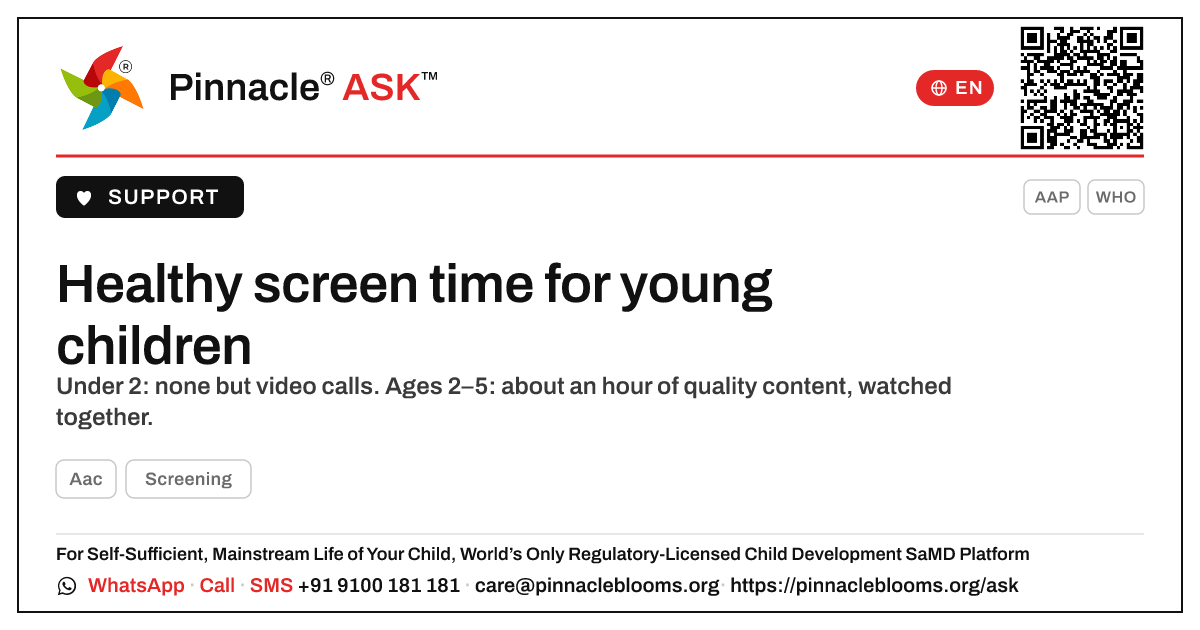
Children under 2 do best with no screen time apart from video calls; ages 2 to 5 are healthiest at about one hour a day of quality content watched with a parent. The goal is protecting talk, play, movement and sleep. AAC devices are a child's voice, not screen time, and should be available all day.
In this answer 5 sections
Every parent wonders the same thing as the tablet lights up: how much is too much?
In short
For children under 2, the healthiest amount of screen time is essentially none — apart from live video calls with family. From ages 2 to 5, keep it to about one hour a day of high-quality content, ideally watched with you so you can talk about what you both see. The real goal isn't a strict number — it's protecting the time your child needs for talking, playing, moving and sleeping, because those are what build a young brain.
Why this matters for development
Young children learn language and connection from back-and-forth interaction with people, not screens. In the early years, every real conversation, shared book and bit of floor play is wiring the brain for communication. Too much passive screen time can crowd out that talk and play, and it's linked to later sleep and attention concerns. Quality and company matter as much as quantity: a parent watching alongside, naming things and asking questions, turns watching into learning. Avoid screens in the hour before bed, keep meals and bedrooms screen-free, and choose slow, simple content over fast, flashy clips.
For children who use AAC (Augmentative and Alternative Communication) — picture boards, speech-generating apps or communication devices — it's worth saying clearly: that is not "screen time" in the worrying sense. An AAC device is your child's voice, a communication tool, and should be available all day, just as speech is for any other child.
When to check in
Screen habits aren't usually a developmental concern on their own. But if your child shows little interest in people, isn't babbling, pointing or using words as expected for their age, or seems to prefer screens over interaction, that's worth a friendly developmental check — not because of the screen, but because of what it may be telling you.
The Pinnacle way
AbilityScore® is part of Pinnacle’s developmental assessment. Diagnosis, where needed, requires an appropriately qualified healthcare professional — never from a screen-time worry alone. If you'd like to understand where your child's communication stands today, we can help. Explore our speech and language support, learn what the AbilityScore® is and how it's established, or start at our home for families.
Trusted sources
American Academy of Pediatrics guidance on media use for young children (healthychildren.org); WHO recommendations on physical activity, sedentary behaviour and sleep for children under 5.
Next step — Worried screens are crowding out talk and play? Book a developmental check with a Pinnacle clinician.
This is general information, not a diagnosis — individual assessment and diagnosis require an appropriately qualified healthcare professional.
CONNECT THE ANSWER TO YOUR CHILD’S DAY
Something to notice. Something to discuss.
What to notice
Watch whether your child still shows strong interest in people, babbles or talks for their age, points and shares attention, and sleeps well. Concern is less about minutes on a screen and more about screens crowding out talk, play and connection.
In everyday life
Watch together and narrate — name what you see and ask simple questions. Co-viewing turns passive watching into shared language practice, which is what young brains actually grow on.
Bring your observations and questions to your child’s professional. Choose activities that suit your child’s comfort, abilities and agreed plan.
Bring your questions to a first visitQuestions families ask
Is any screen time safe for a baby under 2?
Apart from live video calls with family, the healthiest amount is essentially none. Babies under 2 learn language and connection from real interaction, not screens, so floor play, talking and shared books matter far more at this stage.
How much screen time is okay for a 3-year-old?
About one hour a day of high-quality content is a reasonable guide for ages 2 to 5. Watching alongside your child and talking about what you see makes that time far more valuable, and keeping screens away from meals and bedtime protects sleep.
Does my child's AAC device count as screen time?
No. An AAC (Augmentative and Alternative Communication) device is your child's voice and a communication tool, not entertainment screen time. It should be available throughout the day, just as speech is available to any other child.
Is screen time a cause of speech delay?
Excess screen time can crowd out the talk and play that build language, but it is rarely the sole cause of a delay. If your child isn't babbling, pointing or using words as expected for their age, a developmental check is the right next step.
FOLLOW THE SOURCE
References behind this answer.
- Organisation website · further readingAAP healthychildren.org — media use for young children
- Organisation website · further readingWHO — activity, sedentary behaviour and sleep for under-5s
References are supplied with this answer. An organisation homepage offers further reading; it does not establish an independent review of this page.
Content attribution: SETU Consortium · Pinnacle Blooms Network.
PEOPLE, TOPICS & DEVELOPMENT
See the connections.
Browse the wider question collections connected with this answer’s audience, developmental area and stage.
FROM UNDERSTANDING TO PURPOSEFUL SUPPORT
One question. Your child’s whole life.
Your child’s self-sufficient, mainstream-included life is the purpose from the beginning. At Pinnacle, that purpose shapes what we understand, the goals we choose, the people we bring together, everyday practice and review.
Connect this question with the right support.
Start with your child’s strengths, your observations and what you want everyday life to become.
Make the next conversation useful.
Bring the situations you notice at home or school. We’ll explain a suitable service, centre and first visit, including availability and fees, before you decide.
How PinnacleAI® connects the journeyExplore the seven stages
- 1Understand abilities
A starting picture of your child’s capabilities.
- 2Choose meaningful goals
Readiness and a plan shaped around the child.
- 3Bring the right support together
Suitable therapies and people for those goals.
- 4Carry practice into everyday life
Guidance for family, home and school.
- 5Track and correct
Use observations to adjust the plan.
- 6Reassess and review
Decide what to continue, change or do next.
- 7Grow independence and participation
The child’s life gives each step its purpose.
Explore the whole PinnacleAI® system → · Participation at school and in the community →
PINNACLE’S EVIDENCE, OPEN TO YOU
Look at the evidence behind our work.
Read our research, inspect the original regulatory documents and check what each institutional measure means.
General information supports a conversation with an appropriately qualified professional. Advice, goals and support depend on the individual child.