
YOUR QUESTION. A CLEARER NEXT STEP.
Disability Percentage for Child Benefits in India
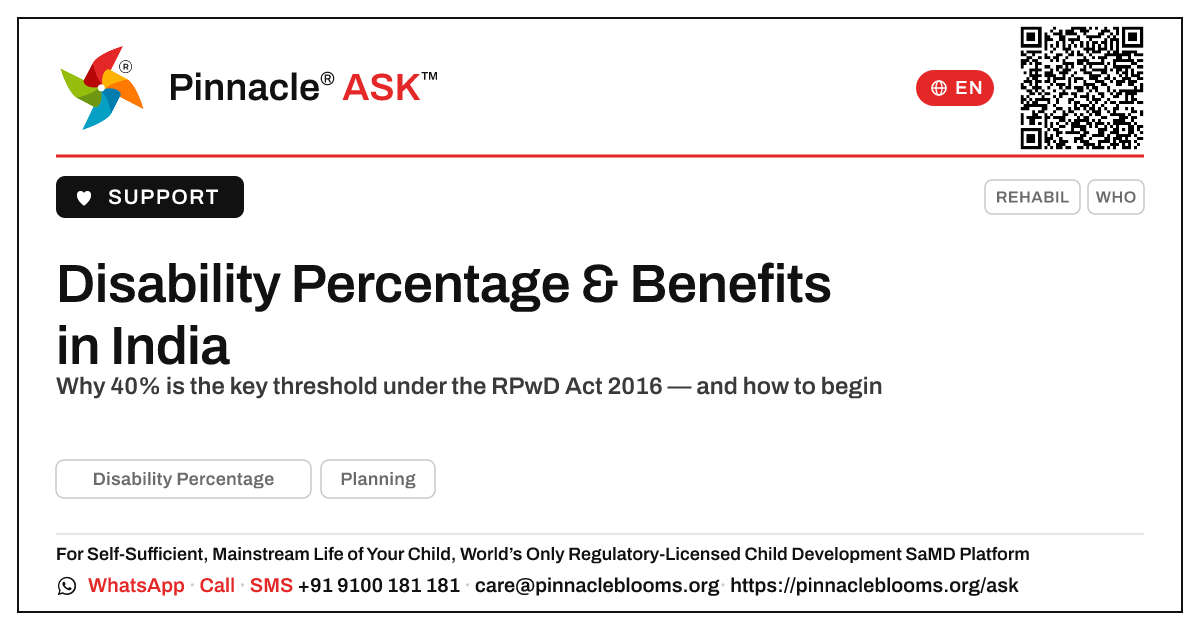
In India, a child with 40% or more disability, as certified by a notified government medical board under the RPwD Act 2016, is recognised as having a benchmark disability and qualifies for a UDID card and most associated benefits, though some schemes use their own thresholds. The percentage is decided by a designated medical authority, not by any therapy centre or app. AbilityScore® is part of Pinnacle’s developmental assessment. Diagnosis, where needed, requires an appropriately qualified healthcare professional.
In this answer 5 sections
A percentage on a certificate is not a verdict on your child — it is a key that unlocks the support and rights they are entitled to.
In short
In India, a child is generally recognised as a person with benchmark disability when they have 40% or more disability as assessed and certified by a notified medical authority under the Rights of Persons with Disabilities (RPwD) Act, 2016. This 40% threshold opens the door to a UDID (Unique Disability ID) card and a range of benefits — though some specific schemes, scholarships or reservations may use their own criteria. The percentage is decided by a designated government medical board, not by any app, school or therapy centre.
What the percentage means
- 40% and above = “benchmark disability” — this is the headline figure under the RPwD Act, 2016, and it qualifies a child for a UDID card and most associated entitlements.
- The UDID card is your single, nationally valid proof of disability — it saves your child from being re-assessed at every office and simplifies access to schemes.
- What benefits can follow — these may include educational concessions and scholarships, reservation in certain settings, travel and tax concessions for the family, aids and appliances, and access to early-intervention and therapy support.
- Some thresholds differ — a few schemes (for example certain higher-education reservations or specific allowances) may require a higher percentage or particular conditions, so always check the rule for the specific benefit you are applying for.
- Who certifies — only a notified medical authority / district medical board assesses and issues the disability certificate. The percentage is based on standardised government guidelines for each condition.
The percentage describes a degree of support need on paper — it does not measure your child's worth, intelligence or potential.
How to begin
Apply for the disability certificate and UDID card through the national UDID portal (or your district hospital / designated medical board). You will typically need medical records, identity proof and photographs. A clear developmental or clinical profile of your child helps the board assess accurately — and helps you understand what support to seek alongside any certificate.
The Pinnacle way
AbilityScore® is part of Pinnacle’s developmental assessment. Diagnosis, where needed, requires an appropriately qualified healthcare professional — never from an app or online form, and separately from the government's certification process. A clear, structured developmental profile from our team can sit alongside your certificate application and guide a focused support plan. Start by understanding how we map your child's abilities, explore early-intervention and therapy support, or reach our family team to plan your next steps.
Trusted sources
Rehabilitation Council of India (rehabcouncil.nic.in) on disability certification and the RPwD framework; WHO guidance on disability and functioning. For scheme-specific thresholds, always confirm with the relevant government department.
Next step — Want help building a clear developmental picture of your child to support your benefits journey? Talk to the Pinnacle family team.
This is general information, not a diagnosis — individual assessment and diagnosis require an appropriately qualified healthcare professional.
CONNECT THE ANSWER TO YOUR CHILD’S DAY
Something to notice. Something to discuss.
What to notice
Check the specific threshold for each scheme — most require 40% benchmark disability, but some scholarships, reservations or allowances may need a higher percentage or particular conditions. Ensure the certificate is issued by a notified medical authority and that you obtain a UDID card for nationally valid proof.
In everyday life
Keep a single folder — physical and digital — with your child's diagnosis reports, the disability certificate and UDID card, so you never have to scramble when applying for a school, scheme or concession.
Bring your observations and questions to your child’s professional. Choose activities that suit your child’s comfort, abilities and agreed plan.
Bring your questions to a first visitQuestions families ask
What disability percentage is needed for benefits in India?
Generally 40% or more disability, certified by a notified government medical board under the RPwD Act 2016, qualifies a child as having a 'benchmark disability' and unlocks a UDID card and most associated benefits. Some specific schemes may set their own thresholds.
Who decides my child's disability percentage?
Only a notified medical authority or district medical board, using standardised government guidelines for each condition. Therapy centres, schools and apps cannot assign or certify a disability percentage.
What is a UDID card and why does it matter?
The UDID (Unique Disability ID) card is your child's single, nationally valid proof of disability. It saves repeated re-assessment at different offices and simplifies access to schemes, concessions and entitlements.
Does the percentage measure my child's potential?
No. The percentage describes a degree of support need on paper for the purpose of accessing rights and benefits. It does not measure your child's intelligence, worth or potential to grow with the right support.
FOLLOW THE SOURCE
References behind this answer.
- Organisation website · further readingRehabilitation Council of India — disability certification & RPwD framework
- Source referenceWHO — disability and functioning
References are supplied with this answer. An organisation homepage offers further reading; it does not establish an independent review of this page.
Content attribution: SETU Consortium · Pinnacle Blooms Network.
PEOPLE, TOPICS & DEVELOPMENT
See the connections.
Browse the wider question collections connected with this answer’s audience, developmental area and stage.
FROM UNDERSTANDING TO PURPOSEFUL SUPPORT
One question. Your child’s whole life.
Your child’s self-sufficient, mainstream-included life is the purpose from the beginning. At Pinnacle, that purpose shapes what we understand, the goals we choose, the people we bring together, everyday practice and review.
Connect this question with the right support.
Start with your child’s strengths, your observations and what you want everyday life to become.
Make the next conversation useful.
Bring the situations you notice at home or school. We’ll explain a suitable service, centre and first visit, including availability and fees, before you decide.
How PinnacleAI® connects the journeyExplore the seven stages
- 1Understand abilities
A starting picture of your child’s capabilities.
- 2Choose meaningful goals
Readiness and a plan shaped around the child.
- 3Bring the right support together
Suitable therapies and people for those goals.
- 4Carry practice into everyday life
Guidance for family, home and school.
- 5Track and correct
Use observations to adjust the plan.
- 6Reassess and review
Decide what to continue, change or do next.
- 7Grow independence and participation
The child’s life gives each step its purpose.
Explore the whole PinnacleAI® system → · Participation at school and in the community →
PINNACLE’S EVIDENCE, OPEN TO YOU
Look at the evidence behind our work.
Read our research, inspect the original regulatory documents and check what each institutional measure means.
General information supports a conversation with an appropriately qualified professional. Advice, goals and support depend on the individual child.