
YOUR QUESTION. A CLEARER NEXT STEP.
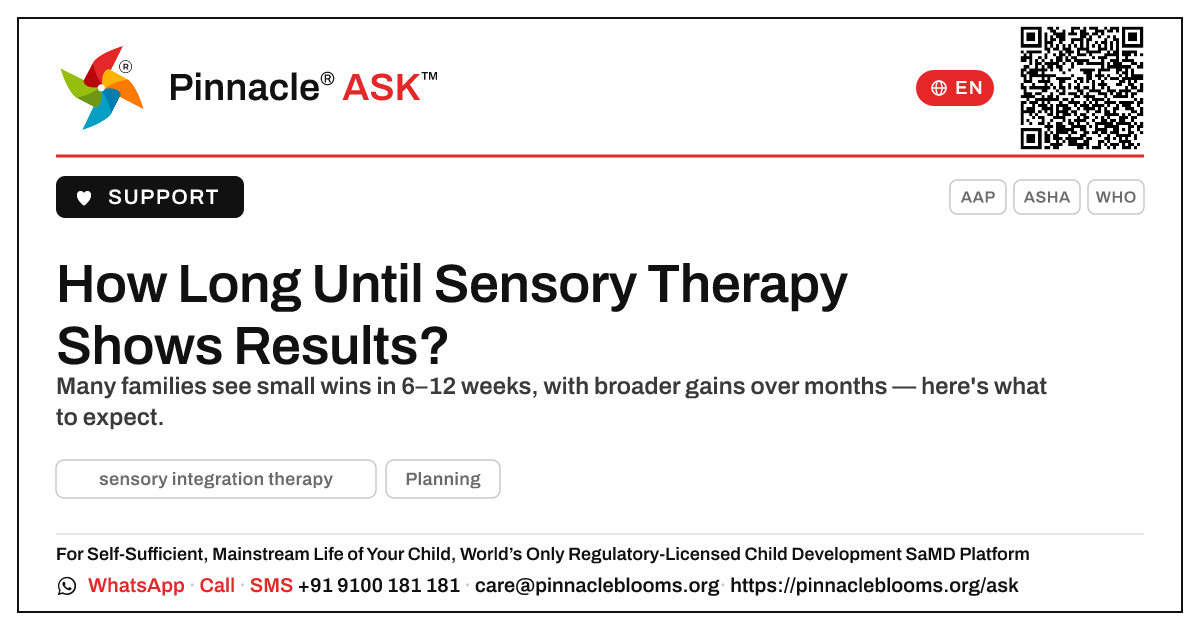
How long does sensory integration therapy take to show results?
Sensory integration therapy works at each child's own pace — many families notice small, encouraging changes within 6 to 12 weeks of regular sessions, while broader gains in daily participation build over several months. The timeline depends on the child's profile, session frequency and home practice. AbilityScore® is part of Pinnacle’s developmental assessment. Diagnosis, where needed, requires an appropriately qualified healthcare professional.
In this answer 5 sections
Every child's nervous system finds its rhythm at its own pace — and small, real-life wins often arrive sooner than you'd expect.
In short
There is no single timeline — sensory integration therapy works differently for every child. Many families notice small, encouraging changes within the first 6 to 12 weeks of regular sessions, such as calmer transitions or better tolerance of textures and sounds, while broader, lasting gains in daily participation usually build over several months of consistent therapy. The pace depends on your child's profile, how often they attend, and how much sensory-friendly practice happens at home. Progress in this work is steady and cumulative, not overnight.
What shapes the timeline
Several things influence how quickly you'll see change:
- Starting point and goals — a child working on tolerating a single texture may show change faster than one building several skills at once.
- Frequency and consistency — regular, weekly sessions with the same therapist let progress compound; gaps slow momentum.
- Home carry-over — the families who see results soonest are those who weave small sensory strategies into everyday routines, so practice happens daily, not just in the therapy room.
- The child's nervous system — some children respond quickly to certain sensory inputs; for others, the brain needs more repetition before new responses settle in.
Good therapy tracks progress against your child's own baseline, not a fixed schedule. Your therapist will set short-term targets and review them regularly, so you can see movement clearly even before the bigger goals are reached.
What "results" really look like
Early wins are often small and practical: a calmer school morning, sitting through a meal, tolerating a haircut, or coping better in a noisy room. These everyday changes are the foundation of the larger goals — focus, learning and confident participation — that grow over the following months. Celebrate the small steps; they are real evidence the work is taking hold.
The Pinnacle way
AbilityScore® is part of Pinnacle’s developmental assessment. Diagnosis, where needed, requires an appropriately qualified healthcare professional — never from an app or online form. From there, a clinician-administered structured assessment sets your child's true baseline, so progress is measured against them, not a generic timetable. Explore our occupational and sensory therapy support, and learn how we build a plan around your child.
Trusted sources
American Academy of Pediatrics (HealthyChildren.org) guidance on sensory processing and occupational therapy; American Occupational Therapy guidance via ASHA-aligned developmental practice; WHO healthy-development principles emphasising consistent, responsive support.
Next step — Want a clear baseline and a realistic timeline for your child? Book a sensory assessment with a Pinnacle clinician.
This is general information, not a diagnosis — individual assessment and diagnosis require an appropriately qualified healthcare professional.
CONNECT THE ANSWER TO YOUR CHILD’S DAY
Something to notice. Something to discuss.
What to notice
Watch for small, real-life wins — calmer transitions, better tolerance of textures, sounds or grooming, and steadier focus. These early signs show the work is taking hold; if you see no change at all after several months of consistent therapy, ask your therapist to review the plan.
In everyday life
Weave one small sensory strategy into a daily routine — a few minutes of heavy-work play (pushing, pulling, carrying) before a tricky transition can help your child feel calmer and more ready, and daily practice speeds progress.
Bring your observations and questions to your child’s professional. Choose activities that suit your child’s comfort, abilities and agreed plan.
Bring your questions to a first visitQuestions families ask
When will I first notice changes from sensory integration therapy?
Many families notice small, encouraging changes within the first 6 to 12 weeks of regular sessions — such as calmer transitions, better tolerance of textures or sounds, or coping better in busy environments. These early wins are the foundation for bigger gains that build over the following months.
Why does my child seem to progress more slowly than others?
Every child's nervous system responds at its own pace. The timeline depends on your child's starting point, how many skills they're working on, how consistently they attend, and how much sensory-friendly practice happens at home. Progress is measured against your child's own baseline, not a fixed schedule.
Can I speed up the results?
Consistency helps most. Regular weekly sessions and weaving small sensory strategies into everyday routines at home mean practice happens daily, not just in the therapy room — and the families who do this often see results soonest.
What if I see no change at all?
If there's genuinely no movement after several months of consistent therapy, ask your therapist to review the plan and goals. Sometimes the approach, frequency or targets need adjusting, and a fresh look at your child's baseline can reset the path forward.
FOLLOW THE SOURCE
References behind this answer.
- Organisation website · further readingAAP HealthyChildren.org — sensory processing & occupational therapy guidance
- Organisation website · further readingASHA — developmental and sensory-related therapy practice
- Organisation website · further readingWHO — principles of consistent, responsive child development support
References are supplied with this answer. An organisation homepage offers further reading; it does not establish an independent review of this page.
Content attribution: SETU Consortium · Pinnacle Blooms Network.
PEOPLE, TOPICS & DEVELOPMENT
See the connections.
Browse the wider question collections connected with this answer’s audience, developmental area and stage.
FROM UNDERSTANDING TO PURPOSEFUL SUPPORT
One question. Your child’s whole life.
Your child’s self-sufficient, mainstream-included life is the purpose from the beginning. At Pinnacle, that purpose shapes what we understand, the goals we choose, the people we bring together, everyday practice and review.
Connect this question with the right support.
Explore how the relevant service contributes to everyday abilities, then speak with us about your child.
Make the next conversation useful.
Bring the situations you notice at home or school. We’ll explain a suitable service, centre and first visit, including availability and fees, before you decide.
How PinnacleAI® connects the journeyExplore the seven stages
- 1Understand abilities
A starting picture of your child’s capabilities.
- 2Choose meaningful goals
Readiness and a plan shaped around the child.
- 3Bring the right support together
Suitable therapies and people for those goals.
- 4Carry practice into everyday life
Guidance for family, home and school.
- 5Track and correct
Use observations to adjust the plan.
- 6Reassess and review
Decide what to continue, change or do next.
- 7Grow independence and participation
The child’s life gives each step its purpose.
Explore the whole PinnacleAI® system → · Participation at school and in the community →
PINNACLE’S EVIDENCE, OPEN TO YOU
Look at the evidence behind our work.
Read our research, inspect the original regulatory documents and check what each institutional measure means.
General information supports a conversation with an appropriately qualified professional. Advice, goals and support depend on the individual child.