
YOUR QUESTION. A CLEARER NEXT STEP.
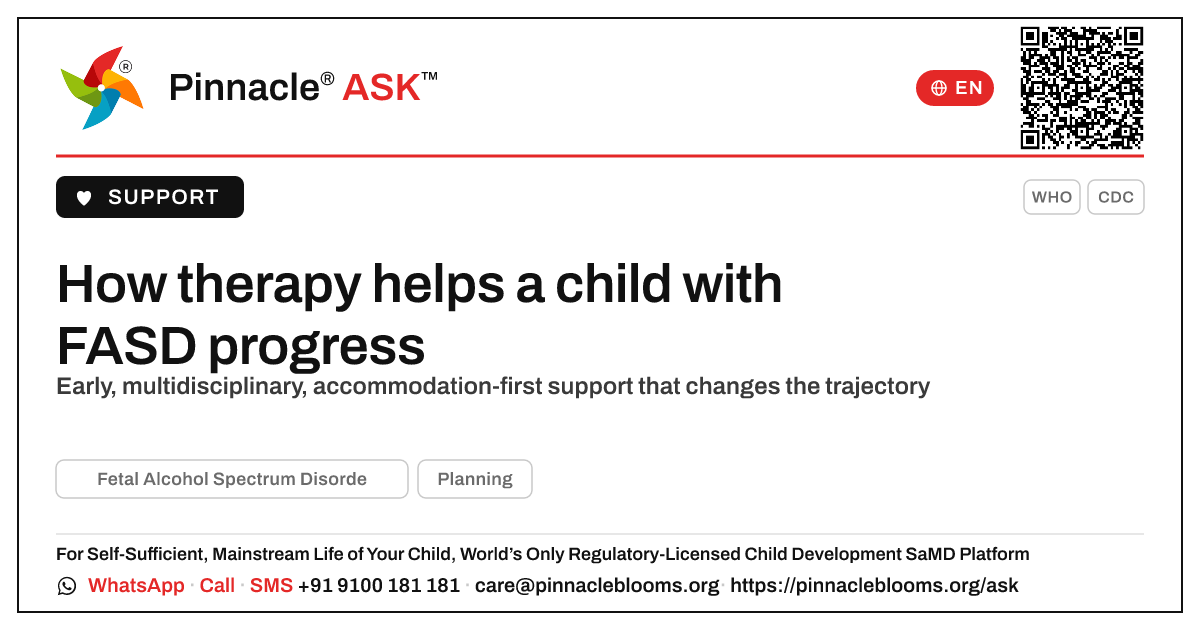
How therapy helps a child with FASD make progress
Therapy cannot reverse FASD, but early, structured, multidisciplinary intervention measurably improves outcomes by building skills, scaffolding executive function and re-engineering the child's environment. Speech therapy, occupational therapy, executive-function support and caregiver coaching target the uneven neurocognitive profile and reduce secondary difficulties. A clinical AbilityScore® and diagnosis are formed only at a Pinnacle centre.
In this answer 5 sections
FASD is a lifelong, brain-based condition — but the child's developmental trajectory is highly modifiable when support is matched to the actual neurocognitive profile.
In short
Therapy does not reverse the underlying neurodevelopmental impact of prenatal alcohol exposure, but it meaningfully changes outcomes by building skills, scaffolding executive function and re-engineering the environment around the child's strengths. The most robust gains come from early, structured, multidisciplinary intervention that targets the specific domains affected — language, sensory regulation, attention, motor coordination and adaptive behaviour. Crucially, much of the progress comes from teaching caregivers and educators to accommodate the brain difference, reducing the secondary difficulties (anxiety, school exclusion, behavioural escalation) that otherwise compound over time.
How therapy drives progress
FASD typically presents as an uneven profile — relative strengths alongside marked deficits in working memory, processing speed, executive function, language pragmatics and sensory modulation. Effective therapy works on several fronts:
- Speech & language therapy targets receptive-expressive gaps, social communication and the language–memory interface, using concrete, repetitive, visually supported strategies that suit a slower processing tempo. See speech therapy.
- Occupational therapy addresses sensory dysregulation, fine and gross motor coordination and daily self-care routines, building the regulation foundation that attention and learning depend on.
- Behaviour and executive-function support reframes "won't" as "can't yet" — externalising memory and planning through visual schedules, predictable routines and reduced demands rather than punitive consequences.
- Caregiver coaching is the highest-yield lever: a neurobehavioural, accommodation-first parenting approach lowers the risk of secondary difficulties and stabilises the home environment.
Progress is therefore measured not only in skill acquisition but in better daily functioning and fewer crises — which is why a baseline functional profile and repeat measurement matter.
When to escalate
Refer promptly for a paediatric and developmental review where there is a confirmed or suspected prenatal alcohol history with growth, facial or central nervous system features, or where adaptive functioning is markedly below age expectation. Co-occurring ADHD, sensory processing differences, sleep disturbance and learning difficulty are common and each warrants its own targeted plan.
The Pinnacle way
AbilityScore® is part of Pinnacle’s developmental assessment. Diagnosis, where needed, requires an appropriately qualified healthcare professional — never from an app or an online form. For a child with FASD this matters because the uneven profile must be mapped precisely before a plan is built. Start with the FASD pathway, understand the baseline measure at what is the AbilityScore and how is it calculated, and pair language goals with speech therapy and regulation goals with occupational therapy.
Trusted sources
WHO ICD-11 and the ICF functioning framework; CDC guidance on fetal alcohol spectrum disorders; American Academy of Pediatrics developmental guidance. These inform an accommodation-first, multidisciplinary, early-intervention model.
Next step — Map your child's exact profile and build a matched plan: book an assessment at a Pinnacle centre.
This is general information, not a diagnosis — individual assessment and diagnosis require an appropriately qualified healthcare professional.
CONNECT THE ANSWER TO YOUR CHILD’S DAY
Something to notice. Something to discuss.
What to notice
Watch for an uneven profile: relative strengths alongside marked difficulty with working memory, processing speed, attention, language pragmatics, sensory regulation and adaptive daily skills — plus rising anxiety or behavioural escalation that signals environmental demands outpacing capacity.
In everyday life
Externalise memory and planning: use a consistent visual schedule, break instructions into one concrete step at a time, and reframe 'won't' as 'can't yet' — accommodating the brain difference reduces meltdowns and protects learning.
Bring your observations and questions to your child’s professional. Choose activities that suit your child’s comfort, abilities and agreed plan.
Bring your questions to a first visitQuestions families ask
Can therapy cure or reverse FASD?
No. FASD is a lifelong, brain-based condition caused by prenatal alcohol exposure and cannot be reversed. However, early, structured, multidisciplinary therapy meaningfully improves skills, daily functioning and quality of life, and reduces the secondary difficulties that otherwise accumulate over time.
Which therapies matter most for a child with FASD?
An accommodation-first, multidisciplinary approach works best: speech and language therapy for communication and the language–memory interface, occupational therapy for sensory regulation and motor and self-care skills, executive-function and behaviour support, and caregiver coaching — which is often the highest-yield intervention.
When should a child with suspected FASD be referred?
Refer promptly for paediatric and developmental review where there is a confirmed or suspected prenatal alcohol history with growth, facial or central nervous system features, or where adaptive functioning is markedly below age expectation. Co-occurring ADHD, sleep and learning difficulties each warrant their own plan.
FOLLOW THE SOURCE
References behind this answer.
- Organisation website · further readingWHO ICD-11
- Organisation website · further readingCDC — Fetal Alcohol Spectrum Disorders
- Organisation website · further readingWHO — ICF functioning framework
References are supplied with this answer. An organisation homepage offers further reading; it does not establish an independent review of this page.
Content attribution: SETU Consortium · Pinnacle Blooms Network.
PEOPLE, TOPICS & DEVELOPMENT
See the connections.
Browse the wider question collections connected with this answer’s audience, developmental area and stage.
FROM UNDERSTANDING TO PURPOSEFUL SUPPORT
One question. Your child’s whole life.
Your child’s self-sufficient, mainstream-included life is the purpose from the beginning. At Pinnacle, that purpose shapes what we understand, the goals we choose, the people we bring together, everyday practice and review.
Connect this question with the right support.
Start with your child’s strengths, your observations and what you want everyday life to become.
Make the next conversation useful.
Bring the situations you notice at home or school. We’ll explain a suitable service, centre and first visit, including availability and fees, before you decide.
How PinnacleAI® connects the journeyExplore the seven stages
- 1Understand abilities
A starting picture of your child’s capabilities.
- 2Choose meaningful goals
Readiness and a plan shaped around the child.
- 3Bring the right support together
Suitable therapies and people for those goals.
- 4Carry practice into everyday life
Guidance for family, home and school.
- 5Track and correct
Use observations to adjust the plan.
- 6Reassess and review
Decide what to continue, change or do next.
- 7Grow independence and participation
The child’s life gives each step its purpose.
Explore the whole PinnacleAI® system → · Participation at school and in the community →
PINNACLE’S EVIDENCE, OPEN TO YOU
Look at the evidence behind our work.
Read our research, inspect the original regulatory documents and check what each institutional measure means.
General information supports a conversation with an appropriately qualified professional. Advice, goals and support depend on the individual child.