
YOUR QUESTION. A CLEARER NEXT STEP.
How Prematurity-Related Developmental Risk affects daily life
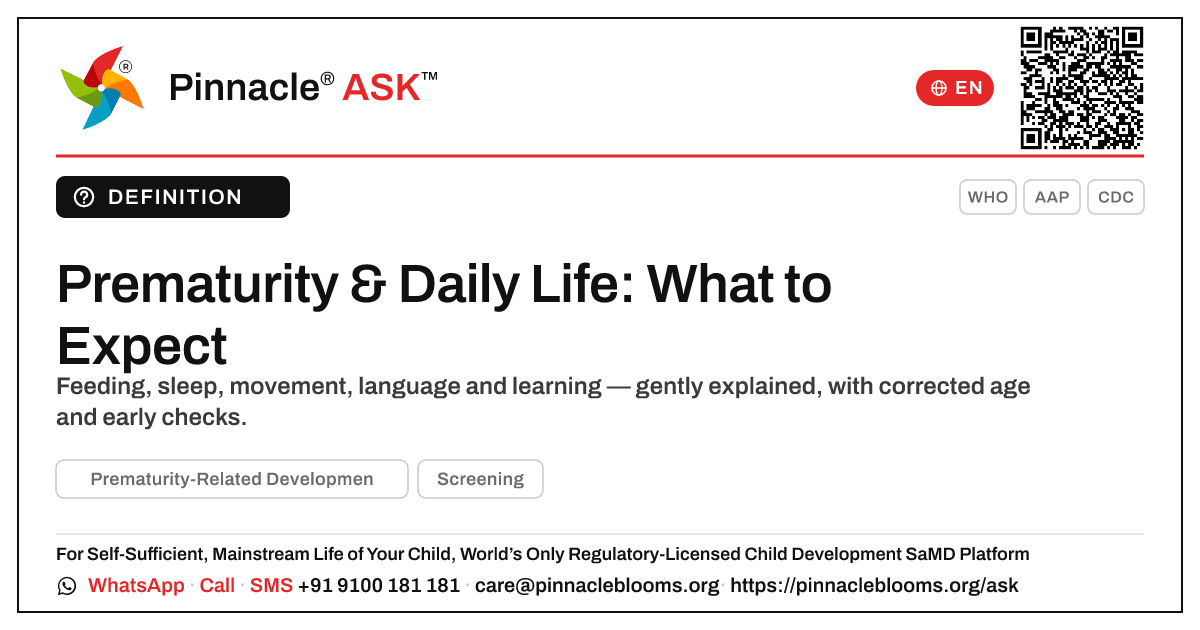
Prematurity-Related Developmental Risk means a baby born before 37 weeks may need more time and support to reach everyday milestones in feeding, sleep, movement, communication, regulation and learning. It is a risk, not a destiny — many children catch up, especially with early tracking using corrected age and timely support. Developmental measurement supports care planning; diagnosis requires an appropriately qualified healthcare professional.
In this answer 5 sections
Your baby arrived early and fought hard to be here — now you simply want to know how those early weeks might shape the everyday moments ahead.
In short
Prematurity-Related Developmental Risk means that a baby born before 37 weeks may, because of an earlier-than-expected start, need a little more time and support to reach some everyday milestones. In daily life this can show up gently — feeding and sleep that take longer to settle, movement and posture that develop on their own timeline, language and play that arrive a touch later, and a child who tires or gets overwhelmed more easily. It is a risk, not a destiny: many children born early catch up beautifully, especially with early watching and timely support. The key is to track development using the corrected age (counting from the due date, not the birth date) until about two years.
How it can show up day to day
Every child born early is different, but families often notice patterns like these:
- Feeding and sleep: more effort to coordinate sucking, swallowing and breathing as a baby; broken or shorter sleep in the early months.
- Movement and play: sitting, crawling, standing or walking emerging a little later; stiffness or floppiness in how the body holds itself.
- Communication: babble, first words and gestures arriving on a gentler timeline.
- Attention and regulation: getting overwhelmed by bright, busy or noisy places, or tiring quickly during activity.
- Learning later on: some children born very early may need extra help with focus or pre-school skills.
None of these alone means a diagnosis — they are simply cues that a developmental check is worthwhile so support, if needed, starts early. Always use corrected age when comparing milestones in the first two years.
When to seek a check
Bring your child for a developmental review if milestones are well behind corrected age, if you notice loss of skills already gained, marked stiffness or floppiness, or if your gut tells you something needs a closer look. Parent instinct is one of the most reliable early signals there is.
The Pinnacle way
A clinical AbilityScore® and any diagnosis are formed only at a Pinnacle Blooms Network centre, by qualified clinicians — never from an app or an online form. That care is what makes early support both gentle and precise. Learn more about Prematurity-Related Developmental Risk, see how a clinician-administered AbilityScore® works, and explore how early developmental support builds on your child's strengths.
Trusted sources
WHO guidance on preterm birth and child development; American Academy of Pediatrics guidance on follow-up of infants born preterm; CDC developmental-milestone resources for tracking progress by corrected age.
Next step — Curious where your child stands today? Book a developmental check with a Pinnacle clinician.
This is general information, not a diagnosis — individual assessment and diagnosis require an appropriately qualified healthcare professional.
CONNECT THE ANSWER TO YOUR CHILD’S DAY
Something to notice. Something to discuss.
What to notice
Milestones well behind corrected age, loss of skills already gained, marked stiffness or floppiness, easy overwhelm in busy places, or a persistent parent feeling that something needs a closer look.
In everyday life
Until your child turns two, track milestones using corrected age — count from the due date, not the birth date — so you're comparing fairly and not worrying about weeks your baby simply hadn't reached yet.
Bring your observations and questions to your child’s professional. Choose activities that suit your child’s comfort, abilities and agreed plan.
Bring your questions to a first visitQuestions families ask
Will my premature baby catch up with other children?
Many children born early do catch up, especially when development is tracked using corrected age and support starts promptly if it's needed. Every child's timeline is different — a developmental check helps you understand your child's specific starting point and strengths.
What is corrected age and why does it matter?
Corrected age counts from your baby's original due date rather than the birth date. Using it in the first two years gives a fairer picture of milestones, so you don't worry about the weeks your baby simply hadn't reached yet.
When should I seek a developmental check?
Consider a check if milestones are well behind corrected age, if your child loses skills already gained, if you notice marked stiffness or floppiness, or simply if your instinct tells you something needs a closer look.
FOLLOW THE SOURCE
References behind this answer.
- Source referenceWHO — Preterm birth
- Organisation website · further readingAAP — HealthyChildren guidance on preterm follow-up
- Source referenceCDC — Developmental milestones
References are supplied with this answer. An organisation homepage offers further reading; it does not establish an independent review of this page.
Content attribution: SETU Consortium · Pinnacle Blooms Network.
PEOPLE, TOPICS & DEVELOPMENT
See the connections.
Browse the wider question collections connected with this answer’s audience, developmental area and stage.
FROM UNDERSTANDING TO PURPOSEFUL SUPPORT
One question. Your child’s whole life.
Your child’s self-sufficient, mainstream-included life is the purpose from the beginning. At Pinnacle, that purpose shapes what we understand, the goals we choose, the people we bring together, everyday practice and review.
Connect this question with the right support.
Explore how the relevant service contributes to everyday abilities, then speak with us about your child.
Make the next conversation useful.
Bring the situations you notice at home or school. We’ll explain a suitable service, centre and first visit, including availability and fees, before you decide.
How PinnacleAI® connects the journeyExplore the seven stages
- 1Understand abilities
A starting picture of your child’s capabilities.
- 2Choose meaningful goals
Readiness and a plan shaped around the child.
- 3Bring the right support together
Suitable therapies and people for those goals.
- 4Carry practice into everyday life
Guidance for family, home and school.
- 5Track and correct
Use observations to adjust the plan.
- 6Reassess and review
Decide what to continue, change or do next.
- 7Grow independence and participation
The child’s life gives each step its purpose.
Explore the whole PinnacleAI® system → · Participation at school and in the community →
PINNACLE’S EVIDENCE, OPEN TO YOU
Look at the evidence behind our work.
Read our research, inspect the original regulatory documents and check what each institutional measure means.
General information supports a conversation with an appropriately qualified professional. Advice, goals and support depend on the individual child.