
YOUR QUESTION. A CLEARER NEXT STEP.
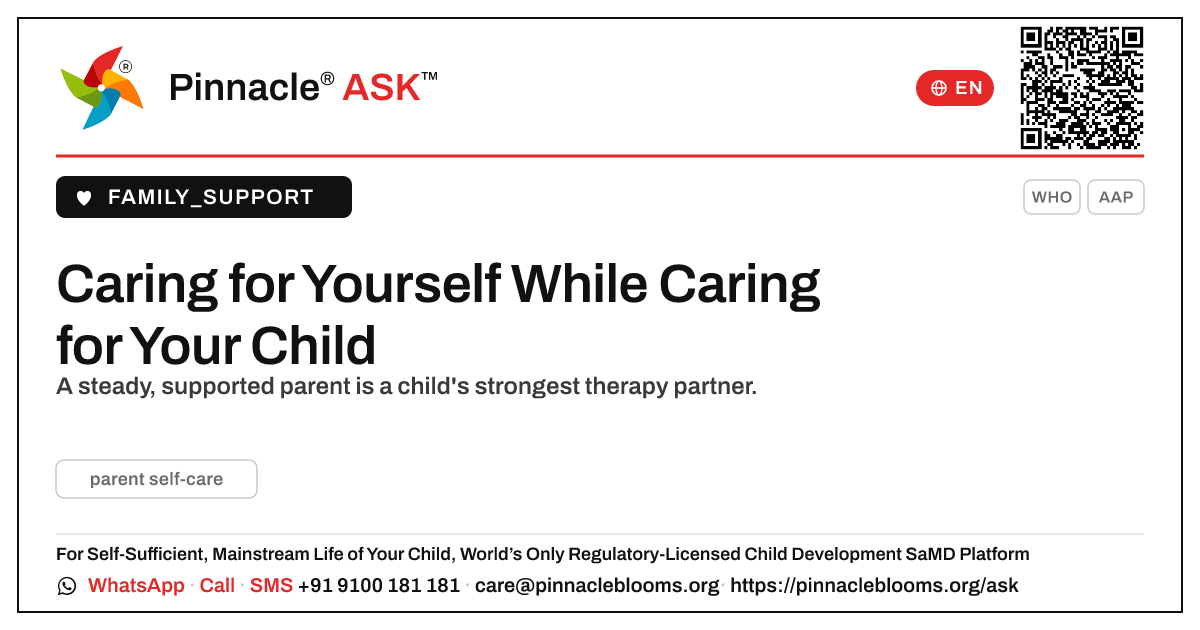
How do I take care of myself while caring for my child?
Caring for yourself is part of caring for your child, not separate from it. Protect sleep, food and daily movement, accept specific help, stay connected to others, and watch for low mood or burnout — speaking to your GP if it persists. A steady, supported parent is a child's strongest therapy partner.
In this answer 4 sections
You cannot pour from an empty cup — and your child's progress is built on a parent who is still standing.
In short
Looking after yourself is not a luxury or a distraction from caring for your child — it is part of the care. When you sleep, eat, connect with others and take small breaks, you regulate better, respond more patiently and stay in this journey for the long run. Start with tiny, repeatable habits, accept help, and remember that asking for support is a strength, not a failure.
Practical ways to protect yourself
Protect the basics
- Guard sleep where you can — short rests count; share night-time duties if there are two of you.
- Eat and drink on a rhythm, even simple meals, rather than running on empty.
- Step outside daily, even for a few minutes — movement and light steady the mood.
Share the load
- Say yes to specific help: "Could you watch her for an hour?" is easier for others to act on.
- Build a small circle — family, a friend, a parent who gets it — and stay in touch.
- Use respite and support groups; you are not meant to carry this alone.
Mind your emotions
- Name how you feel without judging it. Worry, grief and joy can all sit together.
- Notice warning signs — constant exhaustion, tearfulness, hopelessness or losing interest — and speak to your GP. Low mood is treatable, and getting help models good self-care for your child.
The Pinnacle way
At Pinnacle Blooms Network we treat the family as the unit of care — a steady, supported parent is the most powerful therapy partner a child can have. Any clinical AbilityScore® and any diagnosis are formed only at a Pinnacle Blooms Network centre, under qualified clinician care — never from an app or an online form. Our therapists routinely coach families on parent self-care alongside your child's therapy plan, because both move forward together.
Trusted sources
WHO Nurturing Care Framework on caregiver wellbeing and responsive caregiving; American Academy of Pediatrics guidance for families on caregiver stress and support.
Next step — Feeling stretched thin? Talk to a Pinnacle clinician about a plan that supports your whole family, not just your child.
This is general information, not a diagnosis — individual assessment and diagnosis require an appropriately qualified healthcare professional.
CONNECT THE ANSWER TO YOUR CHILD’S DAY
Something to notice. Something to discuss.
What to notice
Persistent exhaustion, tearfulness, hopelessness, losing interest in things you enjoyed, or feeling you cannot cope — these are signs to speak to your GP, not to push through alone.
In everyday life
Pick one tiny habit you can repeat daily — a glass of water each morning, five minutes outside, or one honest text to a friend. Small and consistent beats big and occasional.
Bring your observations and questions to your child’s professional. Choose activities that suit your child’s comfort, abilities and agreed plan.
Bring your questions to a first visitQuestions families ask
Is taking time for myself selfish when my child needs so much?
No. Rest and support help you regulate, stay patient and keep going for the long run. Your wellbeing directly shapes the calm, responsive care your child receives — looking after yourself is part of looking after them.
How do I find time for self-care when every day is full?
Start tiny and repeatable — a few minutes outside, a proper glass of water, one short rest. Ask for specific, time-limited help, such as someone watching your child for an hour. Small consistent habits add up far more than waiting for a free day that rarely comes.
When should I speak to a doctor about how I'm feeling?
If exhaustion, tearfulness, hopelessness or losing interest in things lasts more than a couple of weeks, or you feel unable to cope, speak to your GP. Low mood is common and treatable, and getting help is one of the best things you can do for your child.
FOLLOW THE SOURCE
References behind this answer.
- Organisation website · further readingWHO Nurturing Care Framework — caregiver wellbeing
- Organisation website · further readingAAP HealthyChildren — caregiver stress and support
References are supplied with this answer. An organisation homepage offers further reading; it does not establish an independent review of this page.
Content attribution: SETU Consortium · Pinnacle Blooms Network.
PEOPLE, TOPICS & DEVELOPMENT
See the connections.
Browse the wider question collections connected with this answer’s audience, developmental area and stage.
FROM UNDERSTANDING TO PURPOSEFUL SUPPORT
One question. Your child’s whole life.
Your child’s self-sufficient, mainstream-included life is the purpose from the beginning. At Pinnacle, that purpose shapes what we understand, the goals we choose, the people we bring together, everyday practice and review.
Connect this question with the right support.
Start with your child’s strengths, your observations and what you want everyday life to become.
Make the next conversation useful.
Bring the situations you notice at home or school. We’ll explain a suitable service, centre and first visit, including availability and fees, before you decide.
How PinnacleAI® connects the journeyExplore the seven stages
- 1Understand abilities
A starting picture of your child’s capabilities.
- 2Choose meaningful goals
Readiness and a plan shaped around the child.
- 3Bring the right support together
Suitable therapies and people for those goals.
- 4Carry practice into everyday life
Guidance for family, home and school.
- 5Track and correct
Use observations to adjust the plan.
- 6Reassess and review
Decide what to continue, change or do next.
- 7Grow independence and participation
The child’s life gives each step its purpose.
Explore the whole PinnacleAI® system → · Participation at school and in the community →
PINNACLE’S EVIDENCE, OPEN TO YOU
Look at the evidence behind our work.
Read our research, inspect the original regulatory documents and check what each institutional measure means.
General information supports a conversation with an appropriately qualified professional. Advice, goals and support depend on the individual child.