
YOUR QUESTION. A CLEARER NEXT STEP.
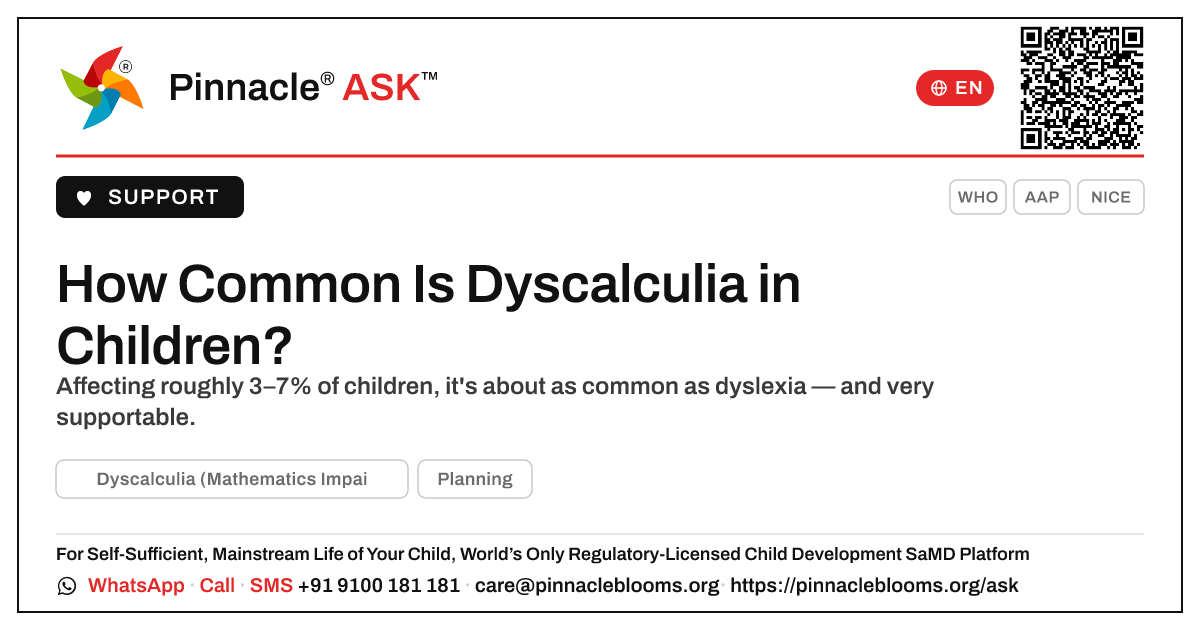
How common is dyscalculia in children?
Dyscalculia, a specific learning difference affecting number and arithmetic skills, is estimated to affect around 3 to 7 percent of school-aged children, making it roughly as common as dyslexia. It affects girls and boys similarly and is unrelated to overall intelligence. AbilityScore® is part of Pinnacle’s developmental assessment. Diagnosis, where needed, requires an appropriately qualified healthcare professional.
In this answer 5 sections
When numbers feel like a foreign language for your child, you are far from alone — dyscalculia is a recognised, well-understood learning difference, and the right support genuinely helps.
In short
Dyscalculia — a specific learning difference that affects how a child understands numbers, quantities and arithmetic — is thought to affect around 3 to 7 children in every 100, making it roughly as common as dyslexia. That means in a typical classroom of 30 children, one or two may have it. It affects girls and boys in similar numbers, and it has nothing to do with how clever or hardworking a child is. With targeted support, children with dyscalculia can build solid, lasting maths confidence.
What the numbers tell us
- It is common. Most research places dyscalculia in the 3–7% range of school-aged children, depending on how strictly it is defined. Many more children have everyday maths difficulties that aren't a formal learning difference.
- It often travels with other differences. Dyscalculia frequently overlaps with dyslexia, ADHD or language difficulties — so a child who struggles with maths may need a broader look at how they learn.
- It is under-recognised. Reading difficulties tend to be spotted earlier, while maths difficulties are sometimes mistaken for "not trying" or "maths just isn't their thing." This means many children go unsupported for longer than they need to.
- It is identified later than some labels. Because early number skills naturally vary a great deal, a specific learning difficulty in maths is usually only meaningful from around age 7–8 onwards, once formal arithmetic teaching is well underway. Before that, the wise approach is to nurture early number play and simply keep an eye on progress.
When to seek a check
Consider a developmental check if, beyond around age 7–8, your child consistently struggles to connect a number to a quantity, loses track when counting, finds basic addition or subtraction far harder than peers despite good teaching, mixes up maths symbols, or shows real anxiety or avoidance around numbers and money. Early, encouraging support protects both skills and self-belief.
The Pinnacle way
AbilityScore® is part of Pinnacle’s developmental assessment. Diagnosis, where needed, requires an appropriately qualified healthcare professional — never from an app or online quiz. Our clinicians build a clear picture of how your child learns and thinks through a structured, clinician-administered assessment, then shape a plan around their strengths. Explore how we support learning and adaptive skills and the everyday building blocks of number confidence.
Trusted sources
WHO ICD-11 describes developmental learning disorder with impairment in mathematics; the American Academy of Pediatrics (via HealthyChildren.org) and NICE provide guidance on recognising and supporting specific learning difficulties in children.
Next step — Wondering if your child needs maths-learning support? Book a developmental assessment with a Pinnacle clinician.
This is general information, not a diagnosis — individual assessment and diagnosis require an appropriately qualified healthcare professional.
CONNECT THE ANSWER TO YOUR CHILD’S DAY
Something to notice. Something to discuss.
What to notice
Beyond age 7–8, watch for ongoing trouble linking numbers to quantities, losing track when counting, basic arithmetic being far harder than peers' despite good teaching, mixing up maths symbols, and anxiety or avoidance around numbers and money.
In everyday life
Weave numbers into everyday play — counting steps, sharing snacks equally, or spotting house numbers — so maths feels practical and fun rather than a test.
Bring your observations and questions to your child’s professional. Choose activities that suit your child’s comfort, abilities and agreed plan.
Bring your questions to a first visitQuestions families ask
How common is dyscalculia in children?
Most research estimates dyscalculia affects around 3 to 7 children in every 100 — roughly as common as dyslexia. In a typical class of 30, one or two children may have it.
Is dyscalculia more common in boys or girls?
Dyscalculia appears to affect girls and boys in broadly similar numbers, unlike some other developmental differences that show a clearer gender pattern.
Does dyscalculia mean my child isn't clever?
Not at all. Dyscalculia is a specific learning difference in how the brain processes numbers and quantities — it has no bearing on a child's overall intelligence, creativity or effort.
At what age can dyscalculia be identified?
Because early number skills naturally vary, a specific maths learning difficulty is usually only meaningful from around age 7–8, once formal arithmetic teaching is well established. Before that, nurturing number play and monitoring progress is the right approach.
FOLLOW THE SOURCE
References behind this answer.
- Organisation website · further readingWHO ICD-11: Developmental learning disorder with impairment in mathematics
- Organisation website · further readingAAP HealthyChildren.org: learning differences in children
- Organisation website · further readingNICE guidance on specific learning difficulties
References are supplied with this answer. An organisation homepage offers further reading; it does not establish an independent review of this page.
Content attribution: SETU Consortium · Pinnacle Blooms Network.
PEOPLE, TOPICS & DEVELOPMENT
See the connections.
Browse the wider question collections connected with this answer’s audience, developmental area and stage.
FROM UNDERSTANDING TO PURPOSEFUL SUPPORT
One question. Your child’s whole life.
Your child’s self-sufficient, mainstream-included life is the purpose from the beginning. At Pinnacle, that purpose shapes what we understand, the goals we choose, the people we bring together, everyday practice and review.
Connect this question with the right support.
Start with your child’s strengths, your observations and what you want everyday life to become.
Make the next conversation useful.
Bring the situations you notice at home or school. We’ll explain a suitable service, centre and first visit, including availability and fees, before you decide.
How PinnacleAI® connects the journeyExplore the seven stages
- 1Understand abilities
A starting picture of your child’s capabilities.
- 2Choose meaningful goals
Readiness and a plan shaped around the child.
- 3Bring the right support together
Suitable therapies and people for those goals.
- 4Carry practice into everyday life
Guidance for family, home and school.
- 5Track and correct
Use observations to adjust the plan.
- 6Reassess and review
Decide what to continue, change or do next.
- 7Grow independence and participation
The child’s life gives each step its purpose.
Explore the whole PinnacleAI® system → · Participation at school and in the community →
PINNACLE’S EVIDENCE, OPEN TO YOU
Look at the evidence behind our work.
Read our research, inspect the original regulatory documents and check what each institutional measure means.
General information supports a conversation with an appropriately qualified professional. Advice, goals and support depend on the individual child.