
YOUR QUESTION. A CLEARER NEXT STEP.
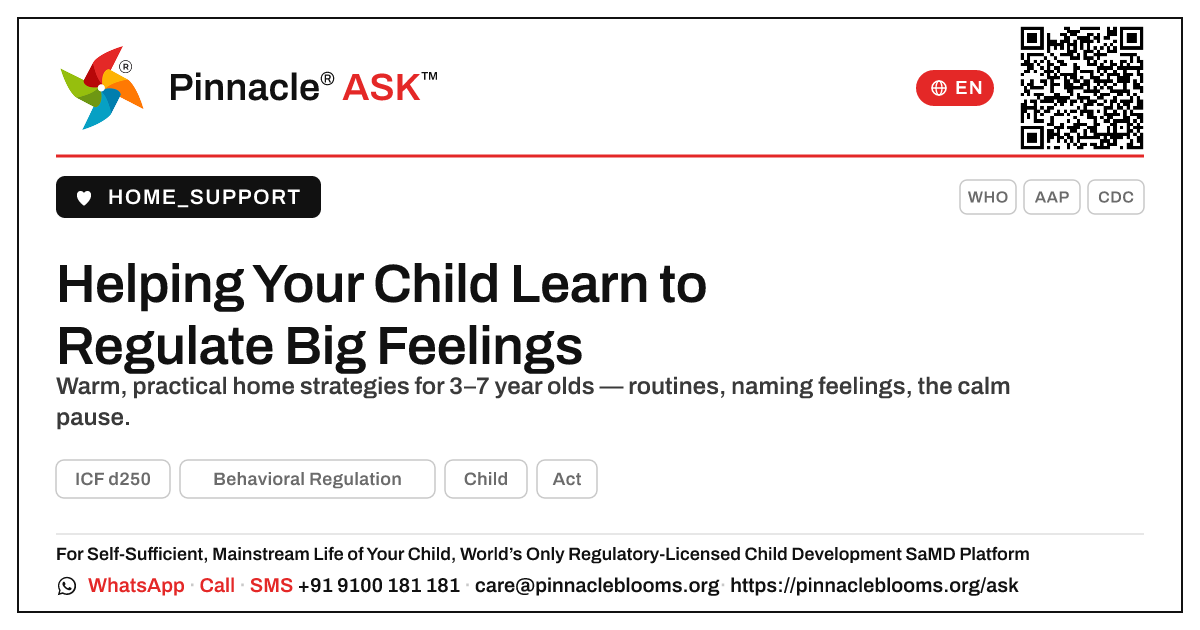
How to Support Your Child's Behavioural Regulation
Support a 3–7 year old's behavioural regulation at home with predictable routines, naming feelings, calm co-regulation, teaching a pause before reacting, and warm, consistent limits. Regulation is a skill that grows with practice — your steady presence is the strongest tool.
In this answer 5 sections
Every meltdown, every brave pause before a big reaction — these are your child practising one of life's hardest skills, and you are their best coach.
In short
You can support your 3–7 year old's behavioural regulation at home by keeping routines predictable, naming feelings out loud, staying calm yourself, and gently coaching the pause between a big feeling and what they do next. Regulation is a skill that grows with warm, repeated practice — not a behaviour to be punished into place. Most children at this age are still learning, and your steady presence does the heavy lifting.
Everyday ways to build it
- Predictable rhythm. Same wake, meal, play and bedtime anchors lower the stress that drives outbursts. Warn before transitions — "five more minutes, then we tidy up."
- Name to tame. "You're really cross the tower fell." Putting words to feelings helps a child's thinking brain steer the feeling brain.
- Co-regulate first. A calm, low voice and a steady body settle a dysregulated child faster than reasoning does. Connect, then redirect.
- Teach the pause. Simple tools — three big breaths, a calm corner with a soft toy, counting together — give the body a way down.
- Catch the good. Notice and praise the moments they wait, share, or recover. What gets attention grows.
- Keep limits kind and firm. Clear, consistent boundaries feel safe; you can be warm and unwavering at once.
The science
Self-regulation (ICF d250) develops gradually as the prefrontal brain matures across early childhood. It is built through thousands of small co-regulation moments — which is why your responses, repeated daily, are the strongest intervention a young child has.
The Pinnacle way
Developmental measurement supports care planning; diagnosis requires an appropriately qualified healthcare professional., under the care of a qualified clinician — never from a website or a worry. If outbursts are intense, frequent or holding back daily life, our team can help through behaviour therapy and a structured AbilityScore® assessment. Across 70+ centres and 25 million+ therapy sessions, we partner with families, never label children.
Trusted sources
Guidance aligns with the WHO ICF framework (d250), the American Academy of Pediatrics and HealthyChildren.org on positive parenting and emotional development, and CDC early-childhood resources.
Next step — try one tool from above this week, and message our team on WhatsApp (+91 91001 81181) for a friendly developmental check if you'd like guidance tailored to your child.
This is general information, not a diagnosis — individual assessment and diagnosis require an appropriately qualified healthcare professional.
CONNECT THE ANSWER TO YOUR CHILD’S DAY
Something to notice. Something to discuss.
What to notice
Seek a developmental check if outbursts are very intense or frequent, last far longer than peers', cause harm, or hold back daily life, friendships or learning across home and school.
In everyday life
Name the feeling before fixing the behaviour: "You're cross the tower fell" — putting words to big feelings helps the thinking brain steer the feeling brain.
Bring your observations and questions to your child’s professional. Choose activities that suit your child’s comfort, abilities and agreed plan.
Bring your questions to a first visitQuestions families ask
At what age should my child manage their feelings well?
Behavioural regulation develops gradually across early childhood and into the school years. A 3–7 year old is still very much learning — big feelings and the occasional meltdown are normal. Your calm coaching, repeated daily, is what builds the skill over time.
Is it wrong to use time-outs?
Brief, calm time-away can give an overwhelmed child space to settle, but it works best paired with connection and teaching — "calm corner" rather than punishment. Warm, consistent limits and noticing the good behaviour tend to help regulation grow most.
When should I seek professional help?
Consider a developmental check if outbursts are very intense, frequent or long, cause harm, or are holding back friendships, learning or family life across more than one setting. A Pinnacle clinician can guide you with a structured assessment.
FOLLOW THE SOURCE
References behind this answer.
- Organisation website · further readingWHO ICF · d250 Behavioural regulation
- Organisation website · further readingAAP HealthyChildren.org · emotional development & positive parenting
- Organisation website · further readingCDC · early childhood development resources
References are supplied with this answer. An organisation homepage offers further reading; it does not establish an independent review of this page.
Content attribution: SETU Consortium · Pinnacle Blooms Network.
Reviewer field in the source record: VII · 11 June 2026.
PEOPLE, TOPICS & DEVELOPMENT
See the connections.
Browse the wider question collections connected with this answer’s audience, developmental area and stage.
FROM UNDERSTANDING TO PURPOSEFUL SUPPORT
One question. Your child’s whole life.
Your child’s self-sufficient, mainstream-included life is the purpose from the beginning. At Pinnacle, that purpose shapes what we understand, the goals we choose, the people we bring together, everyday practice and review.
Connect this question with the right support.
Explore how the relevant service contributes to everyday abilities, then speak with us about your child.
Make the next conversation useful.
Bring the situations you notice at home or school. We’ll explain a suitable service, centre and first visit, including availability and fees, before you decide.
How PinnacleAI® connects the journeyExplore the seven stages
- 1Understand abilities
A starting picture of your child’s capabilities.
- 2Choose meaningful goals
Readiness and a plan shaped around the child.
- 3Bring the right support together
Suitable therapies and people for those goals.
- 4Carry practice into everyday life
Guidance for family, home and school.
- 5Track and correct
Use observations to adjust the plan.
- 6Reassess and review
Decide what to continue, change or do next.
- 7Grow independence and participation
The child’s life gives each step its purpose.
Explore the whole PinnacleAI® system → · Participation at school and in the community →
PINNACLE’S EVIDENCE, OPEN TO YOU
Look at the evidence behind our work.
Read our research, inspect the original regulatory documents and check what each institutional measure means.
General information supports a conversation with an appropriately qualified professional. Advice, goals and support depend on the individual child.