
YOUR QUESTION. A CLEARER NEXT STEP.
Helping Your Child Build Conversation Skills at Home
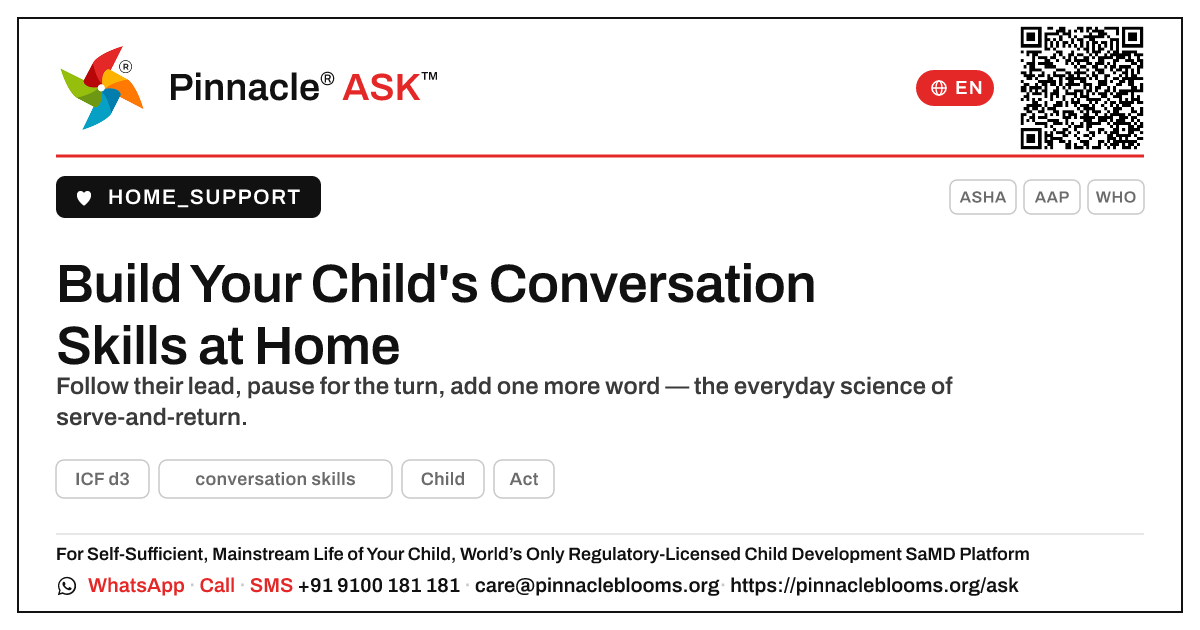
Grow conversation skills through everyday back-and-forth: follow your child's lead, pause and wait for their turn, then add one more word. Many short playful exchanges across the day build the serve-and-return that drives social communication.
In this answer 5 sections
Conversation is the bridge between your child's thoughts and the world — and your living room is the best place to build it.
In short
The most powerful way to grow conversation skills at home is everyday back-and-forth: follow your child's lead, talk about what they are interested in, pause and wait for their turn, then add a little more. Aim for many short, playful exchanges across the day rather than one long lesson. For a 3–7 year old, the magic ingredient is the turn — your child says or shows something, you respond, they respond again.
Simple things you can do every day
- Follow their lead. Talk about whatever has their attention right now — the toy, the dog, the dosa. Interest fuels conversation.
- Pause and wait. After you speak or ask, count silently to five. That gap invites your child to take their turn.
- Add one more. When they say "car", you say "red car going fast!" — you model the next step without correcting.
- Use real moments. Mealtimes, bath, the walk to the shop — narrate and ask genuine questions: "What should we cook?" not just "What colour is this?"
- Play pretend. Tea parties, doctor-doctor and toy phone calls naturally rehearse greetings, questions and turn-taking.
- Read together and stop. Pause mid-story: "What do you think happens next?"
The science
Conversation is an ICF social-communication skill (d3) that grows through serve-and-return — the rapid back-and-forth between child and caregiver. Each turn you take strengthens the neural circuits for language and social understanding. Responsive, contingent talk — answering what the child actually meant — predicts stronger language far more than the sheer number of words a child hears.
The Pinnacle way
A clinical AbilityScore® and any diagnosis are formed only at a Pinnacle Blooms Network centre under qualified clinician care — never from an online article. If conversation feels effortful or one-sided despite daily practice, our team can help you understand why and what to do next. Explore conversation skills and how speech therapy builds them step by step.
Trusted sources
Guided by WHO ICF social-communication concepts, the American Speech-Language-Hearing Association (ASHA) on early language and turn-taking, and AAP/HealthyChildren guidance on talking and reading with young children.
Next step — pick one daily routine this week, add the five-second pause, and watch the turns grow. For tailored support, message the Pinnacle team on WhatsApp: +91 91001 81181.
This is general information, not a diagnosis — individual assessment and diagnosis require an appropriately qualified healthcare professional.
CONNECT THE ANSWER TO YOUR CHILD’S DAY
Something to notice. Something to discuss.
What to notice
If your child rarely takes a back-and-forth turn, doesn't combine words by around age 3, mostly repeats what others say, or finds it hard to start or hold a simple chat despite daily practice, mention it at a developmental check.
In everyday life
After you ask a question, silently count to five before saying anything else — that pause is your child's invitation to take their turn.
Bring your observations and questions to your child’s professional. Choose activities that suit your child’s comfort, abilities and agreed plan.
Bring your questions to a first visitQuestions families ask
How much practice does my child need each day?
Little and often beats one long session. Aim for many short, playful exchanges woven into meals, play and walks — even five back-and-forth turns at a time builds the skill.
My child only repeats what I say. Is that a problem?
Repeating (echoing) is a normal step many children pass through. Keep modelling natural responses and pausing for their turn. If it remains the main way they communicate beyond age 3, mention it at a developmental check.
Should I correct my child's mistakes?
Rather than correct, gently model the better version. If they say "him going", you reply "yes, he is going!" — they hear the right form without feeling stopped.
FOLLOW THE SOURCE
References behind this answer.
- Source referenceASHA: how speech and language develop
- Source referenceAAP HealthyChildren: talking with young children
- Organisation website · further readingWHO ICF: communication (d3)
References are supplied with this answer. An organisation homepage offers further reading; it does not establish an independent review of this page.
Content attribution: SETU Consortium · Pinnacle Blooms Network.
PEOPLE, TOPICS & DEVELOPMENT
See the connections.
Browse the wider question collections connected with this answer’s audience, developmental area and stage.
FROM UNDERSTANDING TO PURPOSEFUL SUPPORT
One question. Your child’s whole life.
Your child’s self-sufficient, mainstream-included life is the purpose from the beginning. At Pinnacle, that purpose shapes what we understand, the goals we choose, the people we bring together, everyday practice and review.
Connect this question with the right support.
Start with your child’s strengths, your observations and what you want everyday life to become.
Make the next conversation useful.
Bring the situations you notice at home or school. We’ll explain a suitable service, centre and first visit, including availability and fees, before you decide.
How PinnacleAI® connects the journeyExplore the seven stages
- 1Understand abilities
A starting picture of your child’s capabilities.
- 2Choose meaningful goals
Readiness and a plan shaped around the child.
- 3Bring the right support together
Suitable therapies and people for those goals.
- 4Carry practice into everyday life
Guidance for family, home and school.
- 5Track and correct
Use observations to adjust the plan.
- 6Reassess and review
Decide what to continue, change or do next.
- 7Grow independence and participation
The child’s life gives each step its purpose.
Explore the whole PinnacleAI® system → · Participation at school and in the community →
PINNACLE’S EVIDENCE, OPEN TO YOU
Look at the evidence behind our work.
Read our research, inspect the original regulatory documents and check what each institutional measure means.
General information supports a conversation with an appropriately qualified professional. Advice, goals and support depend on the individual child.