
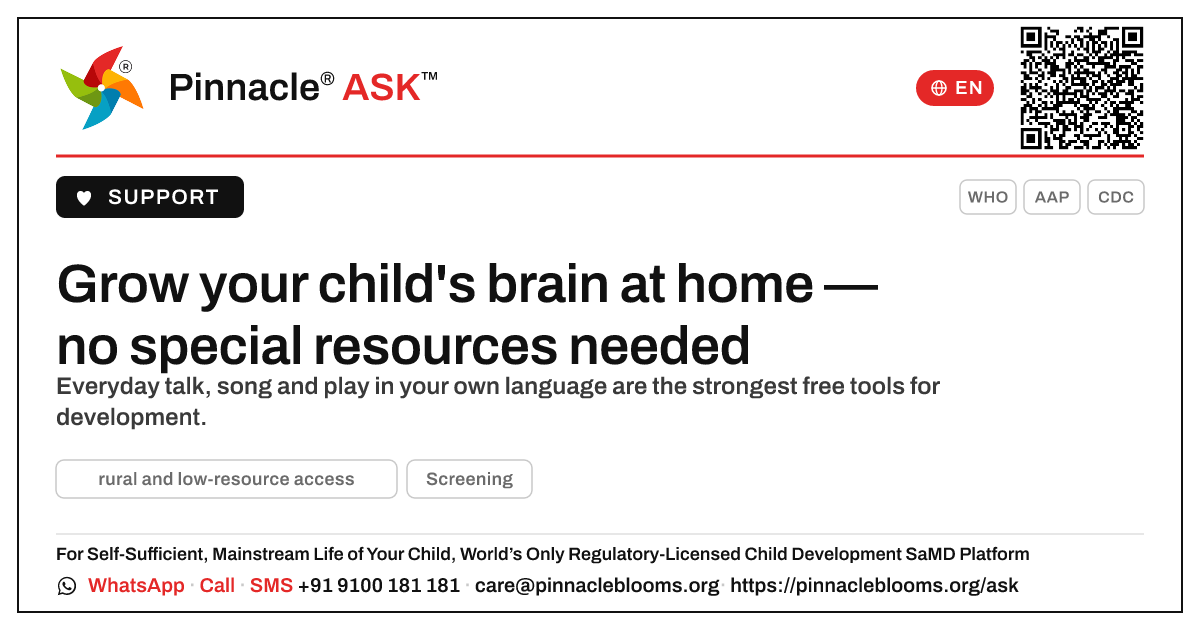
YOUR QUESTION. A CLEARER NEXT STEP.
Helping your child's development at home with few resources
You can support your child's development powerfully with no special resources by using everyday routines, your home language and warm back-and-forth interaction — talking, singing, playing and responding. These free, repeated exchanges are the strongest driver of early development. A developmental check is still wise if you have any milestone concern.
In this answer 5 sections
You do not need a single toy, gadget or app to grow your child's brain — you already have the most powerful tools in your voice, your hands and your daily routine.
In short
Early development is built through everyday warm, responsive interaction — talking, singing, naming, playing and responding — far more than through any product you can buy. With very few resources you can do a great deal: turn cooking, bathing, walking and chores into rich learning moments, use your home language freely, and follow your child's lead. These simple, repeated exchanges are exactly what the science of early childhood calls the strongest driver of development.
What you can do at home, free
- Talk through your day. Narrate what you do — "now we pour the water, now we stir the dal." Every word you say feeds language.
- Serve and return. When your child makes a sound, points or looks at something, respond to it. This back-and-forth is the brain's building block.
- Sing and recite. Folk songs, rhymes and counting in your mother tongue build memory, rhythm and listening.
- Play with what you have. Stacking cups, sorting lentils (supervised), pouring water, naming body parts during a bath — household objects become learning toys.
- Read or tell stories. No book? Tell stories from memory, point at pictures on packets, or describe what you see on a walk.
- Move together. Crawling races, clapping games, climbing safely — movement builds the brain too.
- Keep routines steady. Predictable mealtimes and sleep help a child feel safe enough to learn.
Doing a little, often, in your own language, matters more than any expensive material.
When to check in
Home stimulation is powerful, but it is not a substitute for a developmental check if you have a worry. If your child is not meeting milestones — not responding to sound, not babbling, not making eye contact, losing skills, or far behind same-age children — a developmental screen is wise, wherever you live. Distance or cost should never stop you asking; many checks can begin with a simple conversation.
The Pinnacle way
Developmental measurement supports care planning; diagnosis requires an appropriately qualified healthcare professional., under qualified clinician care — never from an app or a home checklist. Across 70+ centres in 4 states and through remote support, we work to bring early help within reach of every family, including rural and low-resource homes. If you would like a starting point, learn what the AbilityScore is and how it is established or explore speech and language support.
Trusted sources
WHO and UNICEF Nurturing Care Framework on responsive caregiving and early stimulation; CDC and AAP guidance on everyday learning through play and talk in the early years.
Next step — Have a worry, or simply want to know your child's starting point? Speak to a Pinnacle clinician — distance need not be a barrier.
This is general information, not a diagnosis — individual assessment and diagnosis require an appropriately qualified healthcare professional.
CONNECT THE ANSWER TO YOUR CHILD’S DAY
Something to notice. Something to discuss.
What to notice
Watch for missed milestones across settings — no response to sound or name, no babble or words at the expected age, little eye contact, or loss of skills already gained. Persistent worry is itself a good reason to seek a check.
In everyday life
Pick one daily routine — bath, mealtime or a walk — and simply narrate it out loud in your home language. Naming what you see and do, every day, is free and is some of the richest brain food there is.
Bring your observations and questions to your child’s professional. Choose activities that suit your child’s comfort, abilities and agreed plan.
Bring your questions to a first visitQuestions families ask
Do I need to buy toys or apps to help my child develop?
No. Warm, responsive everyday interaction — talking, singing, naming, playing with household objects and following your child's lead — drives development far more than any product. Your voice and your routines are the most powerful tools you have.
Can I use my own language instead of English?
Yes, absolutely. Speaking richly in your mother tongue is one of the best things you can do. Children learn language from the warmth and amount of talk they hear, not from which language it is in.
I live far from any centre — can I still get help?
Yes. Distance need not be a barrier. Many developmental conversations and screens can begin remotely, and Pinnacle works to bring early support within reach of rural and low-resource families. Developmental measurement supports care planning; diagnosis requires an appropriately qualified healthcare professional.
FOLLOW THE SOURCE
References behind this answer.
- Organisation website · further readingWHO–UNICEF Nurturing Care Framework: responsive caregiving and early stimulation
- Organisation website · further readingAAP HealthyChildren: learning through everyday play and talk
- Organisation website · further readingCDC: early brain development and everyday interaction
References are supplied with this answer. An organisation homepage offers further reading; it does not establish an independent review of this page.
Content attribution: SETU Consortium · Pinnacle Blooms Network.
PEOPLE, TOPICS & DEVELOPMENT
See the connections.
Browse the wider question collections connected with this answer’s audience, developmental area and stage.
FROM UNDERSTANDING TO PURPOSEFUL SUPPORT
One question. Your child’s whole life.
Your child’s self-sufficient, mainstream-included life is the purpose from the beginning. At Pinnacle, that purpose shapes what we understand, the goals we choose, the people we bring together, everyday practice and review.
Connect this question with the right support.
Explore how the relevant service contributes to everyday abilities, then speak with us about your child.
Make the next conversation useful.
Bring the situations you notice at home or school. We’ll explain a suitable service, centre and first visit, including availability and fees, before you decide.
How PinnacleAI® connects the journeyExplore the seven stages
- 1Understand abilities
A starting picture of your child’s capabilities.
- 2Choose meaningful goals
Readiness and a plan shaped around the child.
- 3Bring the right support together
Suitable therapies and people for those goals.
- 4Carry practice into everyday life
Guidance for family, home and school.
- 5Track and correct
Use observations to adjust the plan.
- 6Reassess and review
Decide what to continue, change or do next.
- 7Grow independence and participation
The child’s life gives each step its purpose.
Explore the whole PinnacleAI® system → · Participation at school and in the community →
PINNACLE’S EVIDENCE, OPEN TO YOU
Look at the evidence behind our work.
Read our research, inspect the original regulatory documents and check what each institutional measure means.
General information supports a conversation with an appropriately qualified professional. Advice, goals and support depend on the individual child.