
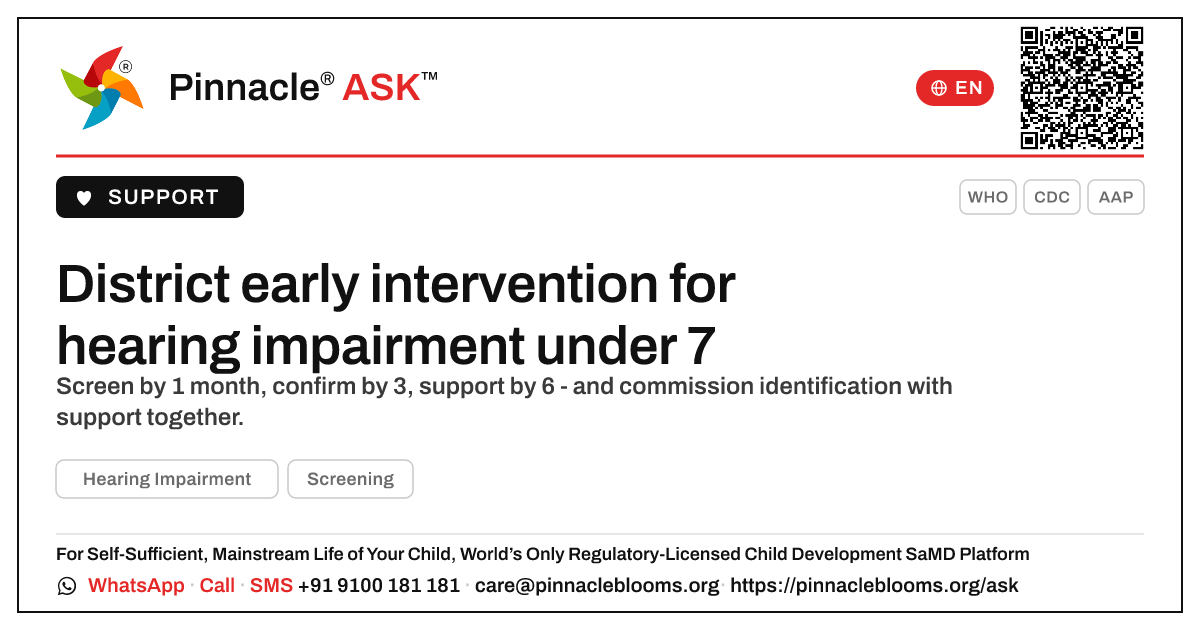
YOUR QUESTION. A CLEARER NEXT STEP.
Identifying and supporting children under 7 with hearing impairment in a district programme
A district programme identifies children under 7 with hearing impairment through universal newborn hearing screening, re-screening at immunisation and Anganwadi contacts, and a fast no-cost referral pathway to audiology and therapy — aiming for the 1-3-6 standard. Screening flags; a clinician-administered assessment at a Pinnacle centre establishes diagnosis and support.
In this answer 5 sections
A child who cannot hear clearly is not a child who cannot learn — found early, hearing impairment becomes a solvable infrastructure problem, not a lifelong barrier.
In short
A district early intervention programme can reach children under 7 with hearing impairment through three linked actions: universal newborn hearing screening at every delivery point, routine re-screening at immunisation and Anganwadi contacts through early childhood, and a clear, fast referral pathway to diagnostic audiology and therapy. The goal is the 1–3–6 standard — screen by 1 month, confirm by 3 months, begin support by 6 months — because the months before age 3 are when spoken language, listening and social connection are most readily built. Identification without a funded support pathway helps no one; the two must be commissioned together.
Building the identification pathway
Screen at every contact point. Equip delivery centres with otoacoustic emission (OAE) or automated ABR screening, and embed a simple hearing check into the immunisation schedule and Anganwadi growth-monitoring visits. Frontline workers (ASHA, AWW) can be trained to use validated parent-report milestone tools and a quick behavioural-response check.
Watch for the everyday markers that should trigger referral at any age: a baby who does not startle to loud sound or quieten to a familiar voice; no babbling by 9–10 months; not turning to their name or to sound by 12 months; no single words by 16 months; speech that stays unclear or stalls; a child who relies heavily on watching faces, or who has frequent ear infections. Persistent parental concern is itself a referral trigger.
Make the referral fast and free. Each block needs a named diagnostic audiology link and a no-cost route to hearing aids or cochlear-implant evaluation, plus listening-and-spoken-language and speech therapy. A tracked register ensures no flagged child is lost between screening and support.
How Pinnacle partners with district programmes
Pinnacle Blooms Network operates as developmental infrastructure — 70+ centres across 4 states, 700+ therapists, 25 million+ therapy sessions, and 4.95 lakh+ families served — and can serve as a district's diagnostic-and-therapy backbone: structured developmental profiling, audiology-linked speech and listening therapy, therapist training for frontline cadres, and a shared follow-up register so screened children actually reach support. Learn more about hearing impairment and early support.
The Pinnacle way
AbilityScore® is part of Pinnacle’s developmental assessment. Diagnosis, where needed, requires an appropriately qualified healthcare professional — never from a screening tick-box or an app. Screening flags a child for attention; a clinician-administered structured assessment establishes where they truly stand and what support fits. That separation — population screening at the front, clinical governance at the centre — is what makes a district programme both wide-reaching and trustworthy.
Trusted sources
WHO ICD-11 for classifying hearing impairment; CDC Learn the Signs. Act Early. milestone guidance; Indian Academy of Pediatrics and American Academy of Pediatrics (HealthyChildren.org) on newborn hearing screening and the 1–3–6 early-detection framework.
Next step — District and government teams can partner with Pinnacle to commission screening, diagnostics and therapy as one connected pathway.
This is general information, not a diagnosis — individual assessment and diagnosis require an appropriately qualified healthcare professional.
CONNECT THE ANSWER TO YOUR CHILD’S DAY
Something to notice. Something to discuss.
What to notice
No startle to loud sound or calming to a familiar voice; no babbling by 9-10 months; not turning to name or sound by 12 months; no single words by 16 months; unclear or stalled speech; heavy reliance on watching faces; frequent ear infections.
In everyday life
Train every frontline worker to treat persistent parental concern as a stand-alone referral trigger — parents often notice a hearing difference long before any formal screen catches it.
Bring your observations and questions to your child’s professional. Choose activities that suit your child’s comfort, abilities and agreed plan.
Bring your questions to a first visitQuestions families ask
At what age should a child's hearing first be screened?
Ideally at birth or within the first month, using OAE or automated ABR screening at the delivery point. The internationally recognised 1-3-6 standard aims to screen by 1 month, confirm any concern by 3 months, and begin support by 6 months.
Who can carry out hearing screening in a district programme?
Trained frontline workers such as ASHA and Anganwadi workers can perform validated parent-report milestone checks and simple behavioural-response screens at immunisation and growth-monitoring visits. Confirmatory diagnostic audiology is done by qualified audiologists at a linked centre.
Does early identification of hearing impairment really change outcomes?
Yes. The months before age 3 are when listening, spoken language and social connection are most readily built. Children identified and supported early - by around 6 months - have markedly better language and learning outcomes, which is why screening and support must be commissioned together.
What support follows a confirmed hearing impairment?
Depending on the child, this may include hearing aids or cochlear-implant evaluation, plus listening-and-spoken-language therapy and speech therapy. A tracked register ensures every flagged child reaches diagnostics and ongoing support.
FOLLOW THE SOURCE
References behind this answer.
- Source referenceWHO ICD-11 classification of hearing impairment
- Source referenceCDC - Learn the Signs. Act Early. milestones
- Organisation website · further readingAmerican Academy of Pediatrics - HealthyChildren.org
References are supplied with this answer. An organisation homepage offers further reading; it does not establish an independent review of this page.
Content attribution: SETU Consortium · Pinnacle Blooms Network.
PEOPLE, TOPICS & DEVELOPMENT
See the connections.
Browse the wider question collections connected with this answer’s audience, developmental area and stage.
FROM UNDERSTANDING TO PURPOSEFUL SUPPORT
One question. Your child’s whole life.
Your child’s self-sufficient, mainstream-included life is the purpose from the beginning. At Pinnacle, that purpose shapes what we understand, the goals we choose, the people we bring together, everyday practice and review.
Connect this question with the right support.
Start with your child’s strengths, your observations and what you want everyday life to become.
Make the next conversation useful.
Bring the situations you notice at home or school. We’ll explain a suitable service, centre and first visit, including availability and fees, before you decide.
How PinnacleAI® connects the journeyExplore the seven stages
- 1Understand abilities
A starting picture of your child’s capabilities.
- 2Choose meaningful goals
Readiness and a plan shaped around the child.
- 3Bring the right support together
Suitable therapies and people for those goals.
- 4Carry practice into everyday life
Guidance for family, home and school.
- 5Track and correct
Use observations to adjust the plan.
- 6Reassess and review
Decide what to continue, change or do next.
- 7Grow independence and participation
The child’s life gives each step its purpose.
Explore the whole PinnacleAI® system → · Participation at school and in the community →
PINNACLE’S EVIDENCE, OPEN TO YOU
Look at the evidence behind our work.
Read our research, inspect the original regulatory documents and check what each institutional measure means.
General information supports a conversation with an appropriately qualified professional. Advice, goals and support depend on the individual child.