
YOUR QUESTION. A CLEARER NEXT STEP.
Does Tourette Syndrome get better or worse as a child grows?
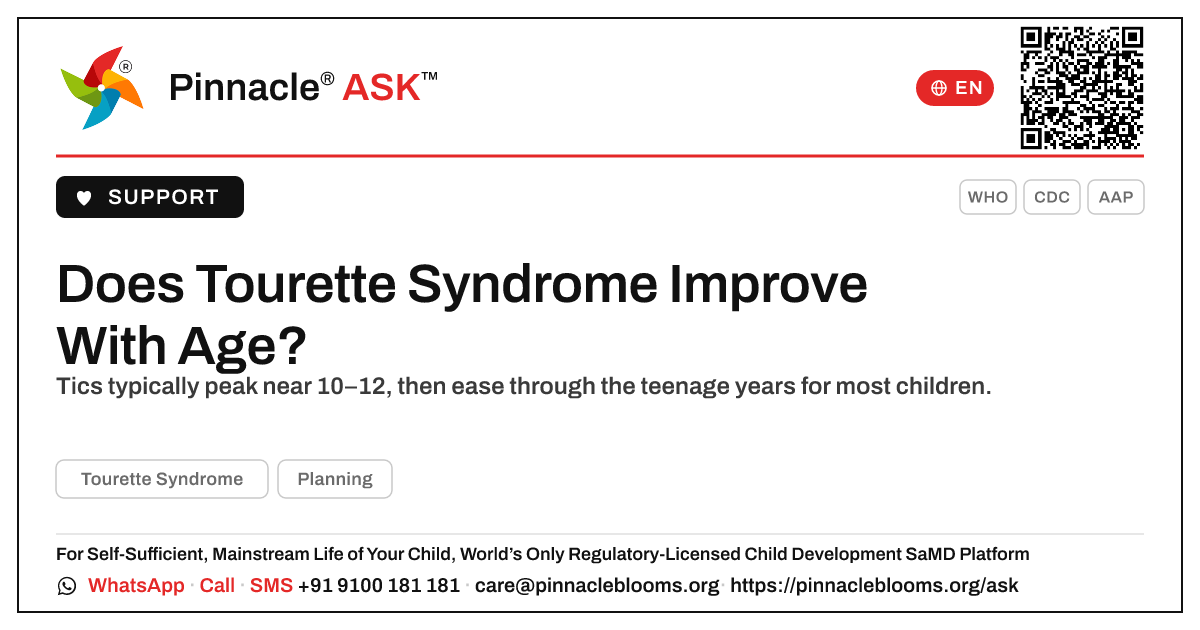
For most children, Tourette Syndrome improves with age: tics typically begin around 5–7, peak near 10–12, then ease through the teenage years, often markedly. Tics naturally wax and wane, so temporary flares are not a sign of lasting decline. AbilityScore® is part of Pinnacle’s developmental assessment. Diagnosis, where needed, requires an appropriately qualified healthcare professional.
In this answer 5 sections
For most children with Tourette Syndrome, tics ride a wave that gradually settles — and the years often bring more calm, not more storm.
In short
For the majority of children, Tourette Syndrome tends to improve as they move through adolescence into the teenage years and early adulthood. Tics usually start around ages 5–7, often reach their most noticeable point between roughly 10 and 12, and then ease for most young people — sometimes fading almost entirely. Tics naturally wax and wane (some weeks busier, some quieter), so a temporary increase rarely means things are getting permanently worse.
Understanding the journey
- The typical pattern. Tics commonly begin in early childhood, build to a peak in the pre-teen years, and then lessen in intensity for most children as the brain's regulation networks mature.
- Waxing and waning is normal. Tics shift with tiredness, excitement, stress, illness or big changes. A flare during exams or a busy term is usually temporary, not a sign of long-term decline.
- Every child is different. A smaller number of young people carry more persistent tics into adulthood, often in milder form. The overall trajectory is encouraging, but it is individual.
- What helps day to day. Reducing pressure around tics, calm routines, good sleep, and supportive responses at home and school all ease the load. Behavioural approaches (such as comprehensive behavioural intervention for tics) can help a child manage tics that interfere with daily life, and co-occurring areas like attention or anxiety are supported alongside.
- Tics are involuntary. Telling a child to "just stop" increases stress and can make tics busier — understanding and acceptance genuinely help.
When to seek a check
Speak to a clinician if tics are painful, exhausting, or interfering with learning, friendships or self-esteem, or if you notice alongside them concerns with attention, anxiety, mood or obsessive patterns. Any new, sudden or unusual movements — or anything that looks like a seizure rather than a tic — needs prompt medical review.
The Pinnacle way
AbilityScore® is part of Pinnacle’s developmental assessment. Diagnosis, where needed, requires an appropriately qualified healthcare professional — never from an app or online form. Through a clinician-administered structured assessment we map your child's tics alongside attention, learning and emotional wellbeing, then shape supportive, family-centred behavioural and developmental therapy. Explore more about supporting your child's overall development with us.
Trusted sources
WHO ICD-11 (tic disorders, including Tourette syndrome); CDC guidance on Tourette syndrome and its typical course; American Academy of Pediatrics (HealthyChildren.org) family guidance on tics.
Next step — Worried about your child's tics? Book a developmental assessment with a Pinnacle clinician.
This is general information, not a diagnosis — individual assessment and diagnosis require an appropriately qualified healthcare professional.
CONNECT THE ANSWER TO YOUR CHILD’S DAY
Something to notice. Something to discuss.
What to notice
Watch for tics that cause pain or exhaustion, or that interfere with learning, friendships or self-esteem; alongside concerns with attention, anxiety, mood or obsessive patterns; and any sudden, unusual movements or anything resembling a seizure, which needs prompt medical review.
In everyday life
Respond to tics with calm acceptance rather than asking your child to stop — protect good sleep and ease pressure during busy or stressful weeks, since tics naturally get busier when a child is tired or anxious.
Bring your observations and questions to your child’s professional. Choose activities that suit your child’s comfort, abilities and agreed plan.
Bring your questions to a first visitQuestions families ask
At what age do tics usually peak in Tourette Syndrome?
Tics most often become most noticeable between roughly ages 10 and 12, then tend to ease for most children as they move through adolescence.
Will my child's tics go away completely?
For many young people tics lessen markedly and some fade almost entirely by early adulthood. A smaller number carry milder, persistent tics into adult life. Every child's path is individual.
Why do my child's tics seem worse some weeks than others?
Tics naturally wax and wane with tiredness, excitement, stress, illness or big changes. A temporary flare — for example during exams — is usually short-lived, not a sign of lasting worsening.
Can my child control their tics?
Tics are involuntary, so telling a child to stop tends to increase stress and tics. Understanding, acceptance and, where helpful, structured behavioural approaches support a child far better.
FOLLOW THE SOURCE
References behind this answer.
- Organisation website · further readingWHO ICD-11 — tic disorders including Tourette syndrome
- Organisation website · further readingCDC — Tourette syndrome and its typical course
- Organisation website · further readingAAP HealthyChildren.org — family guidance on tics
References are supplied with this answer. An organisation homepage offers further reading; it does not establish an independent review of this page.
Content attribution: SETU Consortium · Pinnacle Blooms Network.
PEOPLE, TOPICS & DEVELOPMENT
See the connections.
Browse the wider question collections connected with this answer’s audience, developmental area and stage.
FROM UNDERSTANDING TO PURPOSEFUL SUPPORT
One question. Your child’s whole life.
Your child’s self-sufficient, mainstream-included life is the purpose from the beginning. At Pinnacle, that purpose shapes what we understand, the goals we choose, the people we bring together, everyday practice and review.
Connect this question with the right support.
Start with your child’s strengths, your observations and what you want everyday life to become.
Make the next conversation useful.
Bring the situations you notice at home or school. We’ll explain a suitable service, centre and first visit, including availability and fees, before you decide.
How PinnacleAI® connects the journeyExplore the seven stages
- 1Understand abilities
A starting picture of your child’s capabilities.
- 2Choose meaningful goals
Readiness and a plan shaped around the child.
- 3Bring the right support together
Suitable therapies and people for those goals.
- 4Carry practice into everyday life
Guidance for family, home and school.
- 5Track and correct
Use observations to adjust the plan.
- 6Reassess and review
Decide what to continue, change or do next.
- 7Grow independence and participation
The child’s life gives each step its purpose.
Explore the whole PinnacleAI® system → · Participation at school and in the community →
PINNACLE’S EVIDENCE, OPEN TO YOU
Look at the evidence behind our work.
Read our research, inspect the original regulatory documents and check what each institutional measure means.
General information supports a conversation with an appropriately qualified professional. Advice, goals and support depend on the individual child.