
YOUR QUESTION. A CLEARER NEXT STEP.
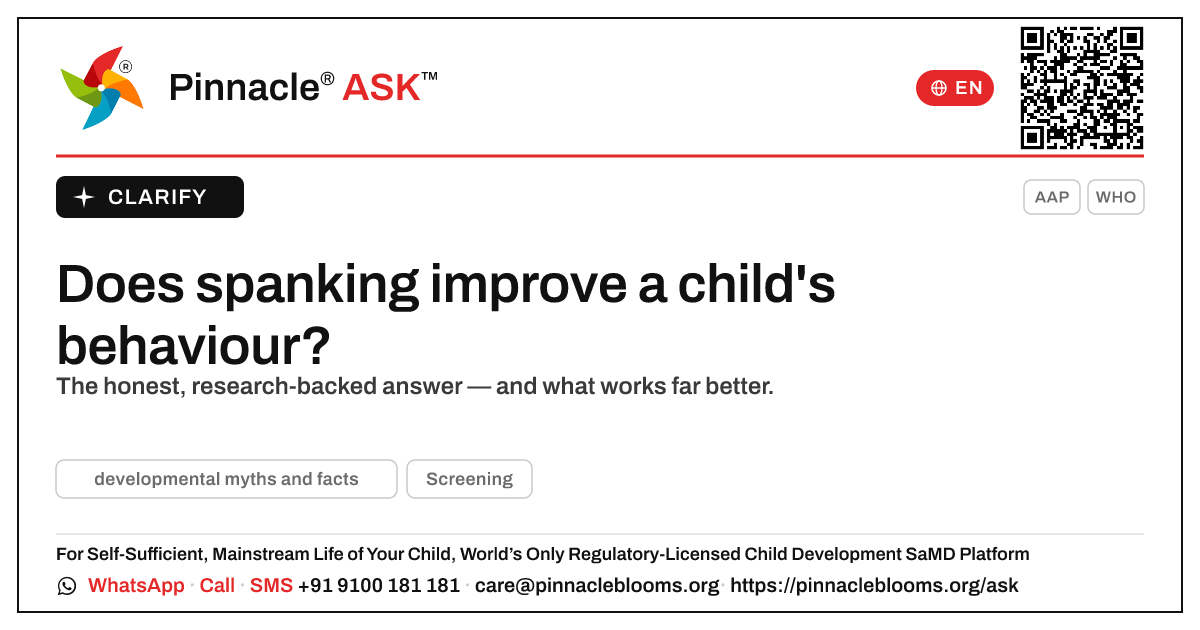
Does spanking improve a child's behaviour problems?
No — spanking does not improve behaviour. Research links physical punishment to more aggression, anxiety and defiance over time, not less. Calm, consistent, connection-based discipline works better. Only a clinician can assess if behaviour needs closer support.
In this answer 5 sections
Every parent of a strong-willed toddler has felt that flash of frustration — so it's fair to ask whether a smack actually works. The honest answer brings real relief.
In short
No — spanking does not improve children's behaviour. Decades of research show it is linked to more aggression, anxiety and defiance over time, not less, and it weakens the parent–child bond that good behaviour is actually built on. The reassuring news: calm, consistent, connection-based approaches work better and feel better for everyone.
Myth vs fact
The myth: "A quick smack teaches a child to behave and respects authority."
The fact: Spanking may stop a behaviour for a few seconds, but it does not teach the child what to do instead. Large reviews of research consistently find that physical punishment predicts more behaviour problems, more aggression, and poorer emotional regulation as the child grows — the opposite of the intended effect. It also teaches that hitting is a way to solve problems.
What works better:
- Connect first, correct second — a calm, regulated child can actually learn; a frightened one cannot.
- Clear, consistent limits — children feel safe when rules are predictable.
- Catch the good — praise the behaviour you want to see more of.
- Natural consequences and brief, calm time-outs — instead of pain or fear.
- Name the feeling — "You're angry the game stopped" helps a child learn words for big emotions.
When behaviour needs a closer look
Sometimes "difficult" behaviour is a child telling us something — frustration from unmet communication needs, sensory overwhelm, or difficulty with attention or self-regulation. If tantrums, aggression or defiance are frequent, intense, or not easing with consistent gentle parenting, a developmental check is a kind and sensible next step — not a sign you've failed.
The Pinnacle way
AbilityScore® is part of Pinnacle’s developmental assessment. Diagnosis, where needed, requires an appropriately qualified healthcare professional. Our behaviour and parent-coaching support helps families replace power struggles with strategies that genuinely build cooperation, and the structured AbilityScore® helps a clinician understand why a behaviour is happening so support fits the child.
Trusted sources
Guidance from the American Academy of Pediatrics and HealthyChildren.org advises against physical punishment and recommends positive, consistent discipline; WHO nurturing-care resources echo responsive, non-violent caregiving as the foundation for healthy development.
Next step — if your child's behaviour feels overwhelming, talk to our team on WhatsApp at +91 91001 81181 and book a gentle developmental check.
This is general information, not a diagnosis — individual assessment and diagnosis require an appropriately qualified healthcare professional.
CONNECT THE ANSWER TO YOUR CHILD’S DAY
Something to notice. Something to discuss.
What to notice
Watch if tantrums, aggression or defiance are very frequent, intense, or not easing with consistent gentle parenting over weeks — this can signal an underlying communication, sensory or regulation need worth a developmental check.
In everyday life
Next time you feel the urge to smack, pause and take one slow breath first. Name your child's feeling out loud — "You're so cross the toy stopped working" — then offer a calm choice. Connection calms behaviour faster than fear.
Bring your observations and questions to your child’s professional. Choose activities that suit your child’s comfort, abilities and agreed plan.
Bring your questions to a first visitQuestions families ask
Is the occasional light smack really harmful?
Even occasional physical punishment is linked to more behaviour problems over time, not fewer, and it doesn't teach a child what to do instead. Calm, consistent approaches are both safer and more effective.
If I don't spank, how do I set limits?
Clear, predictable rules, praising good behaviour, natural consequences and brief calm time-outs all set firm limits without fear. Children actually cooperate more when they feel safe and connected.
My child only listens when I shout or smack — why?
Fear can pause a behaviour briefly, but it doesn't build lasting cooperation and the effect fades fast. If behaviour feels unmanageable despite gentle, consistent parenting, a developmental check can uncover any underlying need.
FOLLOW THE SOURCE
References behind this answer.
- Organisation website · further readingAAP HealthyChildren.org — positive discipline guidance
- Organisation website · further readingAmerican Academy of Pediatrics — effective discipline
- Organisation website · further readingWHO Nurturing Care — responsive, non-violent caregiving
References are supplied with this answer. An organisation homepage offers further reading; it does not establish an independent review of this page.
Content attribution: SETU Consortium · Pinnacle Blooms Network.
PEOPLE, TOPICS & DEVELOPMENT
See the connections.
Browse the wider question collections connected with this answer’s audience, developmental area and stage.
FROM UNDERSTANDING TO PURPOSEFUL SUPPORT
One question. Your child’s whole life.
Your child’s self-sufficient, mainstream-included life is the purpose from the beginning. At Pinnacle, that purpose shapes what we understand, the goals we choose, the people we bring together, everyday practice and review.
Connect this question with the right support.
Explore how the relevant service contributes to everyday abilities, then speak with us about your child.
Make the next conversation useful.
Bring the situations you notice at home or school. We’ll explain a suitable service, centre and first visit, including availability and fees, before you decide.
How PinnacleAI® connects the journeyExplore the seven stages
- 1Understand abilities
A starting picture of your child’s capabilities.
- 2Choose meaningful goals
Readiness and a plan shaped around the child.
- 3Bring the right support together
Suitable therapies and people for those goals.
- 4Carry practice into everyday life
Guidance for family, home and school.
- 5Track and correct
Use observations to adjust the plan.
- 6Reassess and review
Decide what to continue, change or do next.
- 7Grow independence and participation
The child’s life gives each step its purpose.
Explore the whole PinnacleAI® system → · Participation at school and in the community →
PINNACLE’S EVIDENCE, OPEN TO YOU
Look at the evidence behind our work.
Read our research, inspect the original regulatory documents and check what each institutional measure means.
General information supports a conversation with an appropriately qualified professional. Advice, goals and support depend on the individual child.