
YOUR QUESTION. A CLEARER NEXT STEP.
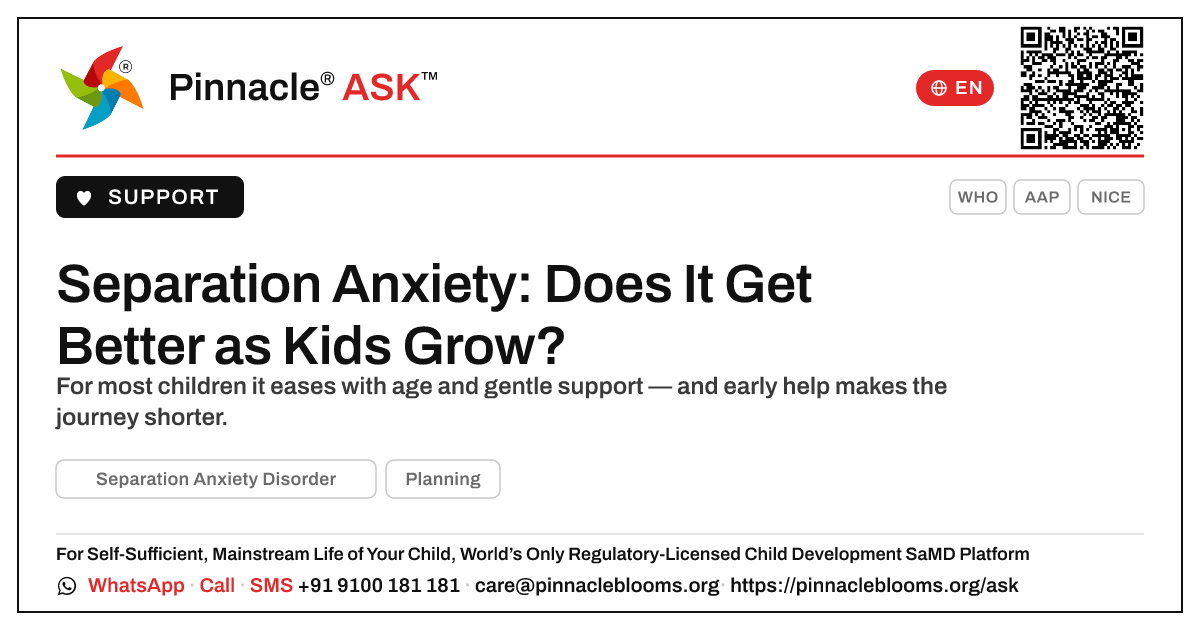
Does Separation Anxiety Disorder Get Better or Worse as a Child Grows?
For most children, Separation Anxiety Disorder eases as they grow, particularly with consistent routines and gentle support; milder forms often fade naturally. Severe or long-lasting anxiety that disrupts school or sleep is less likely to resolve alone and benefits from structured, child-friendly therapy. AbilityScore® is part of Pinnacle’s developmental assessment. Diagnosis, where needed, requires an appropriately qualified healthcare professional.
In this answer 5 sections
A child clinging at the school gate today does not mean a lifetime of fear — with the right support, this is one of the most responsive worries of childhood.
In short
For most children, Separation Anxiety Disorder gets better as they grow — especially with warm, consistent support and, where needed, child-friendly therapy. A degree of separation worry is a normal part of early development that naturally eases as a child builds confidence and trust that loved ones return. When the anxiety is intense, lasts a long time, or stops a child going to school or sleeping alone, it can persist or even grow without help — which is exactly why early, gentle support makes such a difference.
How it usually changes over time
- The natural arc — Separation worry peaks in the toddler and early preschool years and softens as children develop language, independence and an understanding that goodbyes are temporary. Many children simply grow out of milder forms.
- When it tends to improve — With predictable routines, calm goodbyes, and gradual practice at being apart, most children's distress steadily reduces over months.
- When it can stick or worsen — If the anxiety is severe, comes with physical complaints (tummy aches, headaches), causes repeated school refusal, panic at bedtime, or persists well beyond the early years, it is less likely to fade on its own and benefits from structured help. Untreated, it can sometimes carry into later childhood anxiety.
- The good news — Childhood anxiety is among the most treatable areas of development. Approaches that gently build a child's tolerance for separation, paired with parent coaching, are highly effective.
When to seek a check
Seek a check if the anxiety lasts more than about four weeks, is much stronger than in other children the same age, keeps your child from school or sleep, causes frequent physical complaints with no medical cause, or is distressing for your child or your family. Early support shortens the journey and prevents worries from taking deeper root.
The Pinnacle way
AbilityScore® is part of Pinnacle’s developmental assessment. Diagnosis, where needed, requires an appropriately qualified healthcare professional — never from an app or online form. From there your child receives a precise, clinician-administered developmental profile and a plan that builds confidence at your child's own pace. Explore our child behaviour and emotional-support therapy and learn more about how we help children grow with confidence.
Trusted sources
WHO ICD-11 guidance on separation anxiety disorder; American Academy of Pediatrics (HealthyChildren.org) on childhood anxiety and separation; NICE guidance on anxiety in children and young people.
Next step — Worried the worry isn't easing on its own? Book a gentle assessment with a Pinnacle clinician.
This is general information, not a diagnosis — individual assessment and diagnosis require an appropriately qualified healthcare professional.
CONNECT THE ANSWER TO YOUR CHILD’S DAY
Something to notice. Something to discuss.
What to notice
Watch for anxiety lasting more than about four weeks, distress much stronger than peers, repeated school refusal, trouble sleeping alone, and frequent tummy aches or headaches around separations with no medical cause.
In everyday life
Practise short, predictable goodbyes — leave calmly with a clear 'I'll be back after lunch', and keep your return reliable so your child learns that separations always end safely.
Bring your observations and questions to your child’s professional. Choose activities that suit your child’s comfort, abilities and agreed plan.
Bring your questions to a first visitQuestions families ask
Is separation anxiety normal in young children?
Yes. Some separation worry is a normal and healthy part of early development, peaking in the toddler and preschool years. It becomes a concern only when it is intense, long-lasting, or stops a child managing everyday life such as school and sleep.
Will my child simply grow out of it?
Many children with milder separation anxiety do ease out of it as they build confidence and language. More severe or persistent anxiety is less likely to fade on its own and responds very well to gentle, structured support and parent coaching.
Can separation anxiety get worse if untreated?
It can. When severe anxiety is left unsupported, it may persist or grow and sometimes carry into later childhood anxiety. Early, calm support is the most reliable way to help worries settle.
When should I seek professional help?
Seek a check if the anxiety lasts more than about four weeks, is far stronger than in other children the same age, causes school refusal or sleep problems, or brings frequent physical complaints with no medical cause.
FOLLOW THE SOURCE
References behind this answer.
- Organisation website · further readingWHO ICD-11 — separation anxiety disorder
- Organisation website · further readingAAP HealthyChildren.org — childhood anxiety and separation
- Organisation website · further readingNICE — anxiety in children and young people
References are supplied with this answer. An organisation homepage offers further reading; it does not establish an independent review of this page.
Content attribution: SETU Consortium · Pinnacle Blooms Network.
PEOPLE, TOPICS & DEVELOPMENT
See the connections.
Browse the wider question collections connected with this answer’s audience, developmental area and stage.
FROM UNDERSTANDING TO PURPOSEFUL SUPPORT
One question. Your child’s whole life.
Your child’s self-sufficient, mainstream-included life is the purpose from the beginning. At Pinnacle, that purpose shapes what we understand, the goals we choose, the people we bring together, everyday practice and review.
Connect this question with the right support.
Start with your child’s strengths, your observations and what you want everyday life to become.
Make the next conversation useful.
Bring the situations you notice at home or school. We’ll explain a suitable service, centre and first visit, including availability and fees, before you decide.
How PinnacleAI® connects the journeyExplore the seven stages
- 1Understand abilities
A starting picture of your child’s capabilities.
- 2Choose meaningful goals
Readiness and a plan shaped around the child.
- 3Bring the right support together
Suitable therapies and people for those goals.
- 4Carry practice into everyday life
Guidance for family, home and school.
- 5Track and correct
Use observations to adjust the plan.
- 6Reassess and review
Decide what to continue, change or do next.
- 7Grow independence and participation
The child’s life gives each step its purpose.
Explore the whole PinnacleAI® system → · Participation at school and in the community →
PINNACLE’S EVIDENCE, OPEN TO YOU
Look at the evidence behind our work.
Read our research, inspect the original regulatory documents and check what each institutional measure means.
General information supports a conversation with an appropriately qualified professional. Advice, goals and support depend on the individual child.