
YOUR QUESTION. A CLEARER NEXT STEP.
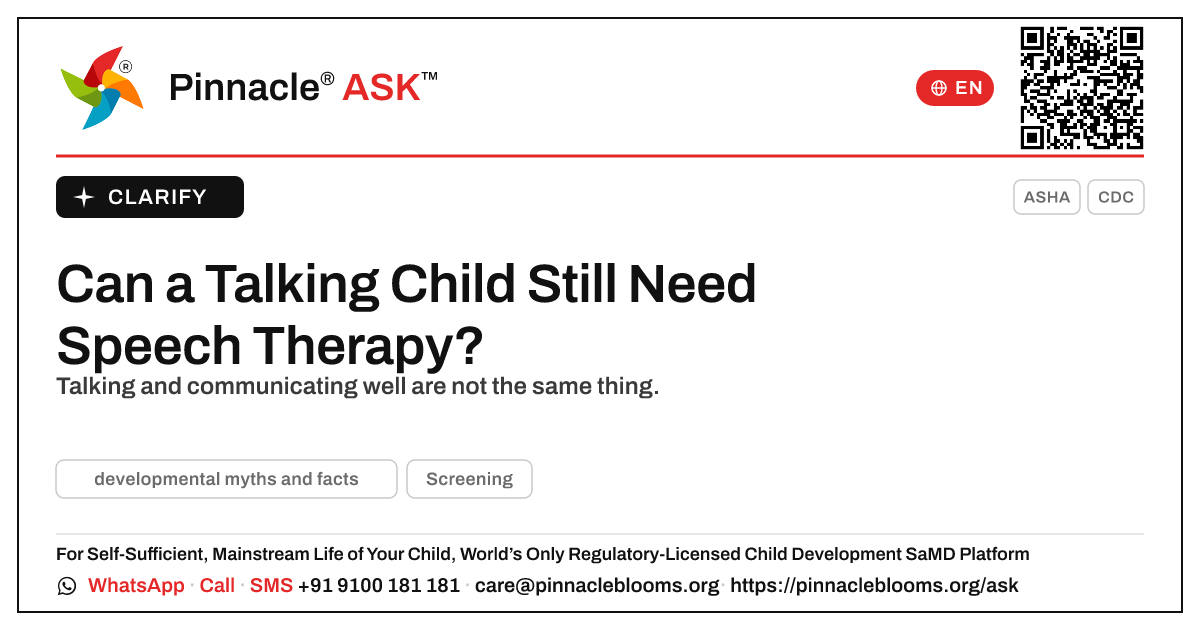
Does a Talking Child Never Need Speech Therapy?
Yes, a talking child can still need speech therapy. Speech-language support covers far more than saying words — clarity, stammering, understanding, social conversation, voice and feeding. If a verbal child is hard to understand, can't follow instructions or struggles with back-and-forth conversation, a check is worthwhile.
In this answer 5 sections
Talking and communicating well are not the same thing — and that gap is exactly where speech therapy can help.
In short
No — this is a myth. A child can speak in full sentences and still need speech therapy. Speech-language support covers far more than "saying words": it includes clear pronunciation, stammering, understanding language, social conversation, voice, and even safe eating and swallowing. If a child talks but is hard to understand, struggles to follow instructions, or finds back-and-forth conversation difficult, a check is worthwhile.
Talking is only one piece
Speech-language therapy supports many skills beyond first words:
- Clarity (articulation) — a chatty child whose words strangers can't understand may need help with specific sounds.
- Fluency — stammering or blocking on words, often appearing once talking is well established.
- Understanding (receptive language) — a child may speak plenty yet struggle to follow two-step instructions or grasp questions.
- Social communication (pragmatics) — taking turns, staying on topic, reading tone and body language.
- Voice — hoarseness, or a voice that is too loud, soft or strained.
- Feeding and swallowing — chewing, managing textures, and safe swallowing.
A child can be fluent and verbal in one of these areas while needing support in another. That is common, and it is helpable.
When to consider a check
Consider a speech therapy check if your talking child is often hard to understand beyond age 4, repeats or gets stuck on words, can't follow simple instructions, avoids conversation with peers, or finds eating certain textures difficult. Earlier, gentle support is almost always easier than waiting.
The Pinnacle way
A clinical AbilityScore® and any diagnosis are formed only at a Pinnacle Blooms Network centre under qualified clinician care — never from an online list. Our therapists look at the whole communication picture, not just whether words are present. Explore developmental myths and facts to separate worry from fact.
Trusted sources
Guidance from the American Speech-Language-Hearing Association and the CDC's developmental milestone resources both describe speech-language skills as far broader than spoken words alone, spanning understanding, clarity, social use and feeding.
Next step — if your child talks but something about their communication still puzzles you, book a friendly assessment with Pinnacle Blooms Network or message us on WhatsApp at +91 91001 81181.
This is general information, not a diagnosis — individual assessment and diagnosis require an appropriately qualified healthcare professional.
CONNECT THE ANSWER TO YOUR CHILD’S DAY
Something to notice. Something to discuss.
What to notice
Watch if your talking child is hard to understand beyond age 4, repeats or blocks on words, struggles to follow simple instructions, avoids talking with peers, or finds chewing or certain food textures difficult.
In everyday life
Once a day, give your child a simple two-step instruction ("Put the cup on the table, then bring me your shoes") and see how they follow it — understanding matters as much as talking.
Bring your observations and questions to your child’s professional. Choose activities that suit your child’s comfort, abilities and agreed plan.
Bring your questions to a first visitQuestions families ask
My child talks a lot but is hard to understand. Is that normal?
Some unclear speech is normal in toddlers, but by around age 4 most of what a child says should be understandable to people outside the family. If strangers often can't follow your chatty child, a speech check can help with specific sounds.
Does speech therapy only help children who can't talk?
No. Speech therapy supports clarity, stammering, understanding language, social conversation, voice, and even safe chewing and swallowing — many of which involve children who already talk well.
My child speaks in sentences but can't follow instructions. Should I worry?
Speaking and understanding are different skills. A child can talk fluently yet find it hard to process what others say. This is worth a gentle assessment rather than a wait-and-see approach.
FOLLOW THE SOURCE
References behind this answer.
- Organisation website · further readingASHA — speech and language skills explained
- Source referenceCDC — developmental milestones
References are supplied with this answer. An organisation homepage offers further reading; it does not establish an independent review of this page.
Content attribution: SETU Consortium · Pinnacle Blooms Network.
PEOPLE, TOPICS & DEVELOPMENT
See the connections.
Browse the wider question collections connected with this answer’s audience, developmental area and stage.
FROM UNDERSTANDING TO PURPOSEFUL SUPPORT
One question. Your child’s whole life.
Your child’s self-sufficient, mainstream-included life is the purpose from the beginning. At Pinnacle, that purpose shapes what we understand, the goals we choose, the people we bring together, everyday practice and review.
Connect this question with the right support.
Explore how the relevant service contributes to everyday abilities, then speak with us about your child.
Make the next conversation useful.
Bring the situations you notice at home or school. We’ll explain a suitable service, centre and first visit, including availability and fees, before you decide.
How PinnacleAI® connects the journeyExplore the seven stages
- 1Understand abilities
A starting picture of your child’s capabilities.
- 2Choose meaningful goals
Readiness and a plan shaped around the child.
- 3Bring the right support together
Suitable therapies and people for those goals.
- 4Carry practice into everyday life
Guidance for family, home and school.
- 5Track and correct
Use observations to adjust the plan.
- 6Reassess and review
Decide what to continue, change or do next.
- 7Grow independence and participation
The child’s life gives each step its purpose.
Explore the whole PinnacleAI® system → · Participation at school and in the community →
PINNACLE’S EVIDENCE, OPEN TO YOU
Look at the evidence behind our work.
Read our research, inspect the original regulatory documents and check what each institutional measure means.
General information supports a conversation with an appropriately qualified professional. Advice, goals and support depend on the individual child.