
YOUR QUESTION. A CLEARER NEXT STEP.
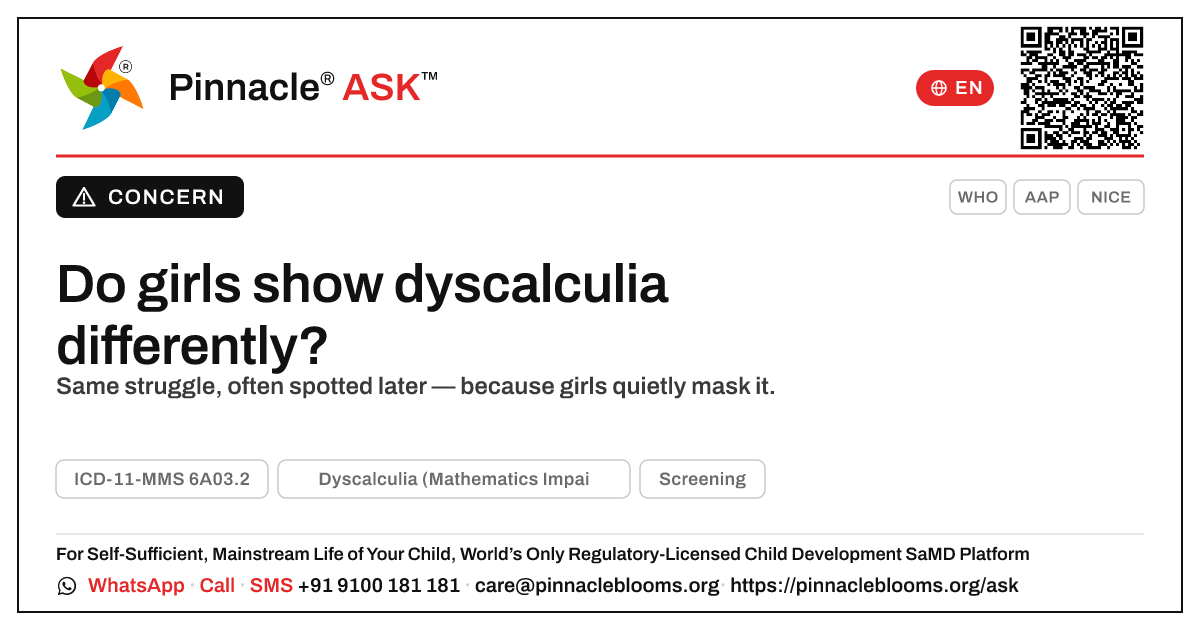
Do girls show dyscalculia differently?
Dyscalculia affects girls and boys at similar rates, but girls are often identified later because they mask difficulty, work quietly, and show worry rather than disruptive behaviour. The maths struggle is the same; its visibility differs. A persistent gap despite good teaching from around age 7–8 is worth a clinician-led assessment.
In this answer 5 sections
If you've noticed your daughter quietly struggling with numbers — yet sailing through reading and conversation — your instinct to look closer is a good one.
In short
Dyscalculia (a specific difficulty with understanding and working with numbers) affects girls and boys at broadly similar rates, but it is often spotted later in girls. Many girls compensate skilfully — staying quiet, working harder, hiding confusion behind neat work and good behaviour — so the difficulty slips under the radar. The maths struggle itself is the same; what differs is how visible it is. Persistent trouble with number sense, counting, recalling number facts, or telling the time, despite real effort, is worth a proper look.
What this can look like in girls
Because girls are more often referred for anxiety or low confidence than for the maths itself, watch for the pattern beneath the behaviour:
- Quiet avoidance — slipping out of maths, saying "I'm just bad at it", tummy aches before tests
- Effortful masking — neat workings that hide shaky understanding, leaning hard on counting fingers long after peers have stopped
- Number sense gaps — struggling to sense which number is bigger, to estimate, or to recall simple facts like 6+7 automatically
- Everyday number tasks — difficulty with time, money, sequences or remembering phone numbers
- A mismatch — strong reading and talking, but maths that lags well behind
Girls more frequently turn the difficulty inward as worry rather than acting out, which is exactly why it is under-identified — not because it is milder.
When to look closer
Dyscalculia is recognised once a child has had real, supported teaching and still shows a persistent gap — usually from around age 7–8 onward. Before that, slow number growth is often just normal variation. If the gap persists across a couple of years despite good teaching and your daughter's genuine effort, an assessment brings clarity.
The Pinnacle way
No online article — and no behaviour list — can diagnose dyscalculia. A clinical AbilityScore® and any diagnosis are formed only at a Pinnacle Blooms Network centre, under a qualified clinician's care, where we look at how your child learns numbers rather than how loudly she struggles. From there we build a plan that rebuilds number confidence step by step. Explore our learning and developmental support and our therapy services to see how we work alongside families.
Trusted sources
WHO ICD-11 (6A03.2, developmental learning disorder with impairment in mathematics); CDC and HealthyChildren (AAP) guidance on learning differences; NICE guidance on supporting learning needs. All paraphrased.
Next step — If your daughter's maths worries you, the kindest move is to check. Book a learning assessment with a Pinnacle clinician.
This is general information, not a diagnosis — individual assessment and diagnosis require an appropriately qualified healthcare professional.
CONNECT THE ANSWER TO YOUR CHILD’S DAY
Something to notice. Something to discuss.
What to notice
Look closer if your daughter avoids maths or shows test anxiety while excelling at reading, relies on finger-counting long after peers, struggles with time and money, or shows a persistent maths gap across two years despite good teaching and real effort.
In everyday life
Weave numbers into warm, low-pressure moments — sharing snacks equally, counting steps, handling small change at the shop. Praise the thinking, not just the right answer, so number-time feels safe rather than a test.
Bring your observations and questions to your child’s professional. Choose activities that suit your child’s comfort, abilities and agreed plan.
Bring your questions to a first visitQuestions families ask
Is dyscalculia more common in boys than girls?
Research suggests it affects girls and boys at broadly similar rates. It can appear more common in boys partly because boys are referred more readily, while girls who mask their difficulty are often missed.
Why is dyscalculia spotted later in girls?
Many girls compensate by working harder, keeping quiet and hiding confusion behind neat work. Their difficulty often shows as anxiety or low confidence rather than disruption, so it slips under the radar.
At what age can dyscalculia be identified?
It is usually recognised from around age 7–8, once a child has had real, supported maths teaching and still shows a persistent gap. Before that, slower number growth is often normal variation.
My daughter reads well but struggles with maths — is that dyscalculia?
A mismatch between strong language skills and lagging maths can be one sign, but only a qualified clinician can tell. A structured assessment looks at how she learns numbers and rules out other causes.
FOLLOW THE SOURCE
References behind this answer.
- Organisation website · further readingHealthyChildren (AAP): learning differences in children
- Organisation website · further readingNICE: supporting children with learning needs
References are supplied with this answer. An organisation homepage offers further reading; it does not establish an independent review of this page.
Content attribution: SETU Consortium · Pinnacle Blooms Network.
PEOPLE, TOPICS & DEVELOPMENT
See the connections.
Browse the wider question collections connected with this answer’s audience, developmental area and stage.
FROM UNDERSTANDING TO PURPOSEFUL SUPPORT
One question. Your child’s whole life.
Your child’s self-sufficient, mainstream-included life is the purpose from the beginning. At Pinnacle, that purpose shapes what we understand, the goals we choose, the people we bring together, everyday practice and review.
Connect this question with the right support.
Start with your child’s strengths, your observations and what you want everyday life to become.
Make the next conversation useful.
Bring the situations you notice at home or school. We’ll explain a suitable service, centre and first visit, including availability and fees, before you decide.
How PinnacleAI® connects the journeyExplore the seven stages
- 1Understand abilities
A starting picture of your child’s capabilities.
- 2Choose meaningful goals
Readiness and a plan shaped around the child.
- 3Bring the right support together
Suitable therapies and people for those goals.
- 4Carry practice into everyday life
Guidance for family, home and school.
- 5Track and correct
Use observations to adjust the plan.
- 6Reassess and review
Decide what to continue, change or do next.
- 7Grow independence and participation
The child’s life gives each step its purpose.
Explore the whole PinnacleAI® system → · Participation at school and in the community →
PINNACLE’S EVIDENCE, OPEN TO YOU
Look at the evidence behind our work.
Read our research, inspect the original regulatory documents and check what each institutional measure means.
General information supports a conversation with an appropriately qualified professional. Advice, goals and support depend on the individual child.