
YOUR QUESTION. A CLEARER NEXT STEP.
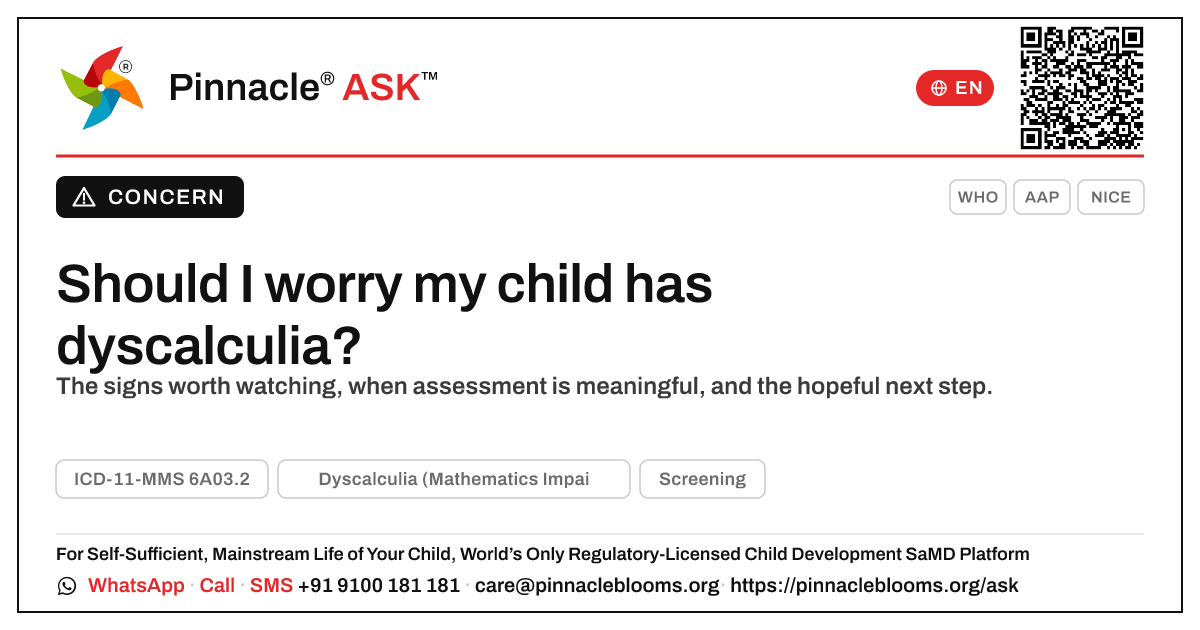
Should I be worried my child might have dyscalculia?
Worry is reasonable, but worry is not a diagnosis. Dyscalculia is a persistent, specific difficulty with numbers and maths — meaningfully assessed from around age 6–8, once formal maths teaching is underway. A lasting pattern, not one bad day, is the flag. Only a clinician can confirm it.
In this answer 5 sections
If maths feels like a wall your child keeps hitting, the worry is real — and reasonable. Here's what it may mean, and what to do with it.
In short
Dyscalculia is a persistent, specific difficulty understanding numbers and learning maths facts that is well below what's expected for your child's age — and not explained by lack of teaching, poor eyesight or another condition. A few wobbly maths days are normal; a pattern that persists is the real flag. Crucially, dyscalculia is meaningfully assessed only from around age 6–8, once formal maths teaching is well underway. Worry is a reason to check — it is not, by itself, a diagnosis.
Signs worth attention
In a child of school age (roughly 7+), watch for a persistent cluster, not one-off slips:
- Trouble linking a number to a quantity (knowing 5 means five things)
- Still counting on fingers for sums peers do from memory
- Difficulty remembering simple maths facts and number sequences
- Confusing maths symbols, place value or telling the time
- Real anxiety, avoidance or tears around maths, despite trying hard
Bright children with strong reading can still have dyscalculia — it is often missed for exactly this reason.
The science, briefly
The WHO classifies dyscalculia as a Developmental Learning Disorder with impairment in mathematics (ICD-11 6A03.2). It affects roughly 3–6% of children and tends to run in families. Identified early, targeted support changes the trajectory — children learn strategies that work for them and rebuild confidence. Left unaddressed, the gap and the anxiety usually widen.
The Pinnacle way
A clinical AbilityScore® and any diagnosis are formed only at a Pinnacle Blooms Network centre, under qualified clinician care — never from an online form. Our clinicians rule out other causes first, measure your child against their own baseline, and give you a plan through structured learning and developmental therapy — not a label. The goal is always your child thriving in the mainstream.
Trusted sources
WHO ICD-11 (6A03.2); American Academy of Pediatrics guidance on learning disorders; NICE guidance on learning support; Pinnacle Blooms Network clinical studies.
Next step — The kindest thing you can do with worry is check. Book a developmental assessment with a Pinnacle clinician.
This is general information, not a diagnosis — individual assessment and diagnosis require an appropriately qualified healthcare professional.
CONNECT THE ANSWER TO YOUR CHILD’S DAY
Something to notice. Something to discuss.
What to notice
Seek assessment if, past age 7, your child shows a persistent gap in number sense and maths facts despite good teaching, or real anxiety and avoidance around maths even when reading and other learning are strong.
In everyday life
Make numbers playful and everyday: count steps, share snacks equally, cook with measuring cups, play simple board games with dice. Keep it light and pressure-free — confidence with numbers grows fastest when maths feels like play, not a test.
Bring your observations and questions to your child’s professional. Choose activities that suit your child’s comfort, abilities and agreed plan.
Bring your questions to a first visitQuestions families ask
At what age can dyscalculia be diagnosed?
It is meaningfully assessed from around age 6–8, once formal maths teaching is well underway, because younger children are still naturally building early number skills. Before then, the focus is on playful number exposure and general developmental monitoring rather than labelling.
Is dyscalculia a sign of low intelligence?
No. Dyscalculia is a specific difficulty with numbers and maths and is not explained by overall ability — many bright children with strong reading and reasoning have it. That is exactly why it is so often missed.
Can dyscalculia be helped?
Yes. Identified early, targeted learning support teaches strategies that work for your child and rebuilds confidence. A Pinnacle clinician measures your child against their own baseline and builds a plan around their strengths.
FOLLOW THE SOURCE
References behind this answer.
- Organisation website · further readingWHO ICD-11: Developmental learning disorder with impairment in mathematics
- Organisation website · further readingAAP HealthyChildren: learning disorders and school readiness
- Organisation website · further readingNICE guidance on learning support
References are supplied with this answer. An organisation homepage offers further reading; it does not establish an independent review of this page.
Content attribution: SETU Consortium · Pinnacle Blooms Network.
PEOPLE, TOPICS & DEVELOPMENT
See the connections.
Browse the wider question collections connected with this answer’s audience, developmental area and stage.
FROM UNDERSTANDING TO PURPOSEFUL SUPPORT
One question. Your child’s whole life.
Your child’s self-sufficient, mainstream-included life is the purpose from the beginning. At Pinnacle, that purpose shapes what we understand, the goals we choose, the people we bring together, everyday practice and review.
Connect this question with the right support.
Start with your child’s strengths, your observations and what you want everyday life to become.
Make the next conversation useful.
Bring the situations you notice at home or school. We’ll explain a suitable service, centre and first visit, including availability and fees, before you decide.
How PinnacleAI® connects the journeyExplore the seven stages
- 1Understand abilities
A starting picture of your child’s capabilities.
- 2Choose meaningful goals
Readiness and a plan shaped around the child.
- 3Bring the right support together
Suitable therapies and people for those goals.
- 4Carry practice into everyday life
Guidance for family, home and school.
- 5Track and correct
Use observations to adjust the plan.
- 6Reassess and review
Decide what to continue, change or do next.
- 7Grow independence and participation
The child’s life gives each step its purpose.
Explore the whole PinnacleAI® system → · Participation at school and in the community →
PINNACLE’S EVIDENCE, OPEN TO YOU
Look at the evidence behind our work.
Read our research, inspect the original regulatory documents and check what each institutional measure means.
General information supports a conversation with an appropriately qualified professional. Advice, goals and support depend on the individual child.