
YOUR QUESTION. A CLEARER NEXT STEP.
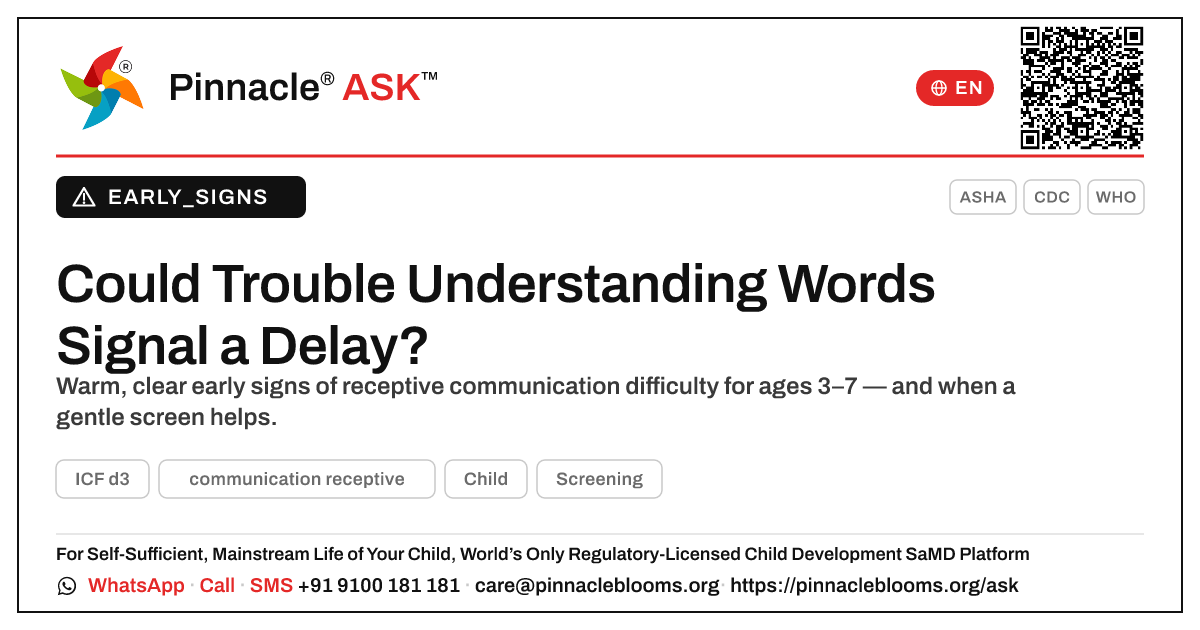
Could Difficulty Understanding Language Be a Developmental Delay?
Difficulty with receptive communication — understanding spoken words, questions and instructions — can be one early sign of a developmental delay between ages 3 and 7, but on its own it is not a diagnosis. Watch for trouble following two- or three-step instructions, off-topic answers, limited understanding of everyday words, or frequent need for repetition, especially if it persists over months or affects daily life. A hearing check should come first. Early, play-based support works best when started promptly, so raise any concern with a professional rather than waiting for a label.
In this answer 5 sections
When your child seems to hear you but not quite understand you, it's natural to wonder what's going on — and to want a clear, kind answer.
In short
Yes — difficulty with receptive communication (understanding spoken language) can be one early sign of a developmental delay, but on its own it is not a diagnosis. Between 3 and 7 years, children should follow longer instructions, answer questions and understand everyday words and concepts. If understanding seems persistently behind same-age peers, it's worth a gentle, professional look — and the good news is that support works best when it starts early.
Early signs to watch (ages 3–7)
Receptive language means how well your child takes in and understands words, questions and instructions — separate from how they speak.
Following and understanding
- Struggles to follow simple two- or three-step instructions ("get your shoes and bring them here")
- Often answers off-topic, or relies heavily on watching others to know what to do
- Difficulty understanding question words — who, what, where, why
Words and concepts
- Limited understanding of everyday words, opposites, or position words (in, on, under)
- Frequently needs things repeated or seems "tuned out" during conversation
Patterns that matter most What shifts this from ordinary variation towards something to assess is a gap that persists or widens over several months, affects daily life at home or school, or comes alongside delays in speaking, play or attention. A hearing check should always come first, as it's common and easily treated.
When to seek a check
If understanding seems clearly behind peers, or your child's teacher or doctor shares a concern, arrange a developmental screen — you don't need to wait for a label. Early, play-based support builds comprehension naturally.
The Pinnacle way
At Pinnacle Blooms Network, we begin with your child's strengths and build understanding through warm, play-based speech therapy, coaching parents as everyday partners. Learn more about receptive communication. A clinical AbilityScore® and any diagnosis are formed only at a Pinnacle Blooms Network centre under qualified clinician care — nothing here is a diagnosis. Across 70+ centres in 4 states and 4.95 lakh+ families served, our aim is steady, strengths-first progress.
Trusted sources
Aligned with WHO ICF framing of communication, ASHA guidance on receptive language development, and CDC and HealthyChildren.org milestone resources.
Next step — if your child's understanding feels behind, book a developmental screen with our clinical team on WhatsApp at +91 91001 81181, and let's understand your little one together.
CONNECT THE ANSWER TO YOUR CHILD’S DAY
Something to notice. Something to discuss.
What to notice
Trouble following two- or three-step instructions, frequent off-topic answers, limited understanding of everyday words or position words, and often needing things repeated — especially if this persists over months, affects home or school, or comes with delays in speaking, play or attention. A hearing check should come first.
In everyday life
Give one clear instruction at a time, pair words with gestures or pictures, and pause to let your child process before repeating — then slowly add a second step as understanding grows.
Bring your observations and questions to your child’s professional. Choose activities that suit your child’s comfort, abilities and agreed plan.
Bring your questions to a first visitQuestions families ask
What is receptive communication in children?
Receptive communication is how well a child understands spoken language — taking in words, questions and instructions. It is separate from expressive language, which is how they speak. A child may understand more than they can say, or sometimes speak words without fully understanding them.
At what age should I worry about my child not understanding instructions?
Between 3 and 7 years, children should manage simple two- or three-step instructions and understand everyday words. If understanding seems clearly behind peers and the gap persists over several months or affects daily life, it is worth a developmental screen — not a reason to panic, but a reason to check.
Could a hearing problem be the cause?
Yes. Difficulty understanding language can sometimes stem from hearing issues, which are common and very treatable. A hearing check is always a sensible first step before any other assessment.
Is difficulty understanding language always a developmental delay?
No. Children develop at different paces, and many catch up well. Receptive difficulty is one sign to observe, not a diagnosis. A qualified clinician forms any conclusion through a structured assessment, never from a single sign.
FOLLOW THE SOURCE
References behind this answer.
- Source referenceASHA: speech and language development
- Source referenceCDC developmental milestones
- Organisation website · further readingWHO ICF communication framework
References are supplied with this answer. An organisation homepage offers further reading; it does not establish an independent review of this page.
Content attribution: SETU Consortium · Pinnacle Blooms Network.
PEOPLE, TOPICS & DEVELOPMENT
See the connections.
Browse the wider question collections connected with this answer’s audience, developmental area and stage.
FROM UNDERSTANDING TO PURPOSEFUL SUPPORT
One question. Your child’s whole life.
Your child’s self-sufficient, mainstream-included life is the purpose from the beginning. At Pinnacle, that purpose shapes what we understand, the goals we choose, the people we bring together, everyday practice and review.
Connect this question with the right support.
Explore how the relevant service contributes to everyday abilities, then speak with us about your child.
Make the next conversation useful.
Bring the situations you notice at home or school. We’ll explain a suitable service, centre and first visit, including availability and fees, before you decide.
How PinnacleAI® connects the journeyExplore the seven stages
- 1Understand abilities
A starting picture of your child’s capabilities.
- 2Choose meaningful goals
Readiness and a plan shaped around the child.
- 3Bring the right support together
Suitable therapies and people for those goals.
- 4Carry practice into everyday life
Guidance for family, home and school.
- 5Track and correct
Use observations to adjust the plan.
- 6Reassess and review
Decide what to continue, change or do next.
- 7Grow independence and participation
The child’s life gives each step its purpose.
Explore the whole PinnacleAI® system → · Participation at school and in the community →
PINNACLE’S EVIDENCE, OPEN TO YOU
Look at the evidence behind our work.
Read our research, inspect the original regulatory documents and check what each institutional measure means.
General information supports a conversation with an appropriately qualified professional. Advice, goals and support depend on the individual child.