
YOUR QUESTION. A CLEARER NEXT STEP.
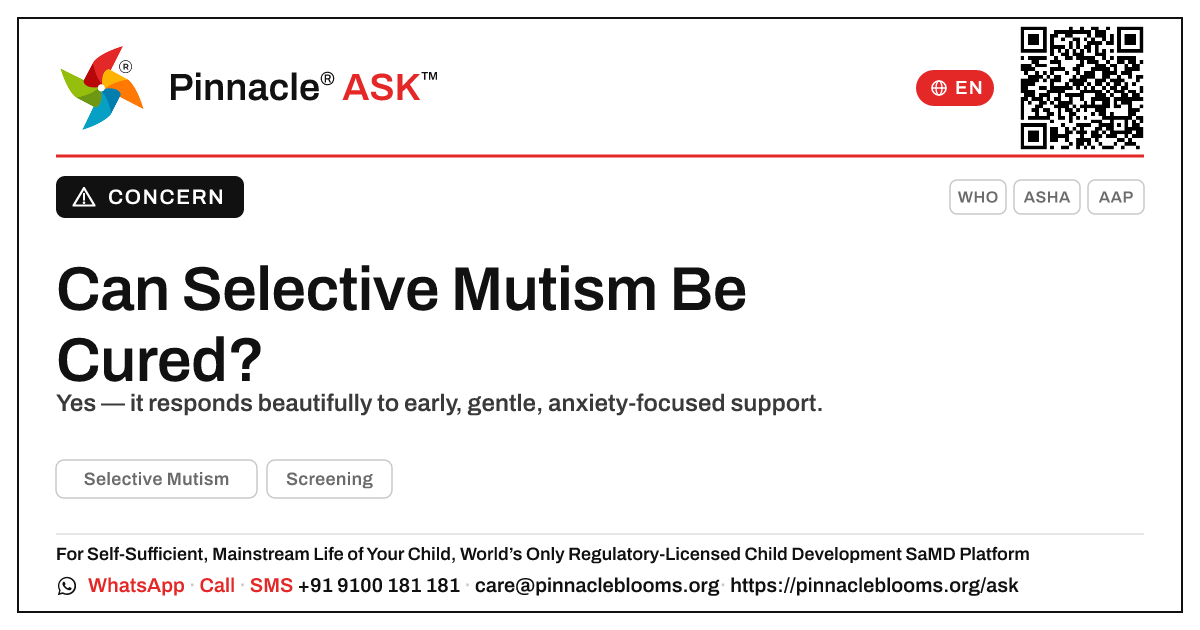
Can Selective Mutism Be Cured?
Yes — Selective Mutism responds very well to early, gentle, anxiety-focused support, and many children go on to speak confidently across settings. It isn't shyness or stubbornness but a treatable anxiety pattern. Begin early, work with the school, and only a clinician can confirm the picture.
In this answer 5 sections
When your child speaks freely at home but falls silent at school, the silence can feel frightening — and the good news is real: this responds beautifully to the right help.
In short
Yes — Selective Mutism responds very well to early, well-targeted support, and many children go on to speak comfortably across settings. It is best understood not as stubbornness or shyness, but as an anxiety-based difficulty: your child wants to speak but freezes in certain situations, such as school. "Cure" isn't quite the clinical word — what we aim for, and very often reach, is your child speaking confidently and freely wherever they are. The earlier support begins, the smoother and faster that journey tends to be.
Why it responds so well
Selective Mutism is rooted in anxiety, and anxiety is one of the most treatable parts of child development. The most effective approach is a gentle, gradual one — building speaking confidence in small, safe steps, starting where your child already feels comfortable and slowly widening the circle of people and places. There is no medicine that "fixes" it; the work is behavioural and relational, and it usually involves parents and the school as partners alongside the therapist. Children supported early — ideally soon after the pattern is noticed — often respond more readily, before silence becomes a settled habit.
When to seek help
A brief quiet phase in a brand-new setting is common. Seek an assessment if your child speaks normally at home but has stayed consistently silent in a particular setting — usually school — for a month or more (beyond the first settling-in weeks). The sooner the gentle work begins, the kinder it is for your child.
The Pinnacle way
Developmental measurement supports care planning; diagnosis requires an appropriately qualified healthcare professional., under the care of a qualified clinician — never from an online form. At Pinnacle, the clinician understands the anxiety behind the silence, measures your child against their own AbilityScore baseline, and builds a step-by-step plan with you and your child's school. Where speech and confidence need rebuilding, our speech therapy team works at your child's pace — small wins first, never pressure.
Trusted sources
WHO ICD-11 classification of selective mutism within anxiety-related disorders; American Speech-Language-Hearing Association (ASHA) guidance on selective mutism; American Academy of Pediatrics parent resources (HealthyChildren.org).
Next step — Silence is not the end of the story. Book a gentle assessment with a Pinnacle clinician and start the path to your child speaking freely.
This is general information, not a diagnosis — individual assessment and diagnosis require an appropriately qualified healthcare professional.
CONNECT THE ANSWER TO YOUR CHILD’S DAY
Something to notice. Something to discuss.
What to notice
Seek help if your child speaks normally at home but stays consistently silent in one setting (usually school) for a month or more beyond the settling-in weeks, or if the silence is spreading to more places and people.
In everyday life
Never pressure your child to speak or ask others to 'make' them talk — it deepens the freeze. Instead, lower the spotlight: play side-by-side, accept gestures or whispers first, and warmly celebrate any sound or word without making a fuss of it.
Bring your observations and questions to your child’s professional. Choose activities that suit your child’s comfort, abilities and agreed plan.
Bring your questions to a first visitQuestions families ask
Will my child grow out of Selective Mutism on their own?
Some children do improve naturally, but waiting carries a risk: the longer the silence persists, the more it can settle into a habit and affect learning and friendships. Because it responds so well to early, gentle support, the kindest choice is to seek an assessment rather than wait and hope.
Is Selective Mutism the same as shyness?
No. Shy children warm up over time; a child with Selective Mutism stays consistently unable to speak in specific settings even when comfortable elsewhere. It's an anxiety-based difficulty — your child wants to speak but freezes — and that is exactly why it is so treatable.
Does Selective Mutism need medication?
Usually not. The most effective help is behavioural and relational — building speaking confidence in small, safe steps with parents and the school as partners. A clinician will advise on the right plan for your child after a proper assessment.
How long does it take for a child to start speaking more?
Every child is different, and progress moves in small steps rather than a straight line. Children supported early often respond more readily. Your clinician reviews progress against your child's own baseline, so even quiet gains become visible.
FOLLOW THE SOURCE
References behind this answer.
- Organisation website · further readingWHO ICD-11 — selective mutism within anxiety-related disorders
- Organisation website · further readingASHA — guidance on selective mutism
- Organisation website · further readingAAP HealthyChildren.org — parent resources on anxiety and speaking
References are supplied with this answer. An organisation homepage offers further reading; it does not establish an independent review of this page.
Content attribution: SETU Consortium · Pinnacle Blooms Network.
PEOPLE, TOPICS & DEVELOPMENT
See the connections.
Browse the wider question collections connected with this answer’s audience, developmental area and stage.
FROM UNDERSTANDING TO PURPOSEFUL SUPPORT
One question. Your child’s whole life.
Your child’s self-sufficient, mainstream-included life is the purpose from the beginning. At Pinnacle, that purpose shapes what we understand, the goals we choose, the people we bring together, everyday practice and review.
Connect this question with the right support.
Start with your child’s strengths, your observations and what you want everyday life to become.
Make the next conversation useful.
Bring the situations you notice at home or school. We’ll explain a suitable service, centre and first visit, including availability and fees, before you decide.
How PinnacleAI® connects the journeyExplore the seven stages
- 1Understand abilities
A starting picture of your child’s capabilities.
- 2Choose meaningful goals
Readiness and a plan shaped around the child.
- 3Bring the right support together
Suitable therapies and people for those goals.
- 4Carry practice into everyday life
Guidance for family, home and school.
- 5Track and correct
Use observations to adjust the plan.
- 6Reassess and review
Decide what to continue, change or do next.
- 7Grow independence and participation
The child’s life gives each step its purpose.
Explore the whole PinnacleAI® system → · Participation at school and in the community →
PINNACLE’S EVIDENCE, OPEN TO YOU
Look at the evidence behind our work.
Read our research, inspect the original regulatory documents and check what each institutional measure means.
General information supports a conversation with an appropriately qualified professional. Advice, goals and support depend on the individual child.