
YOUR QUESTION. A CLEARER NEXT STEP.
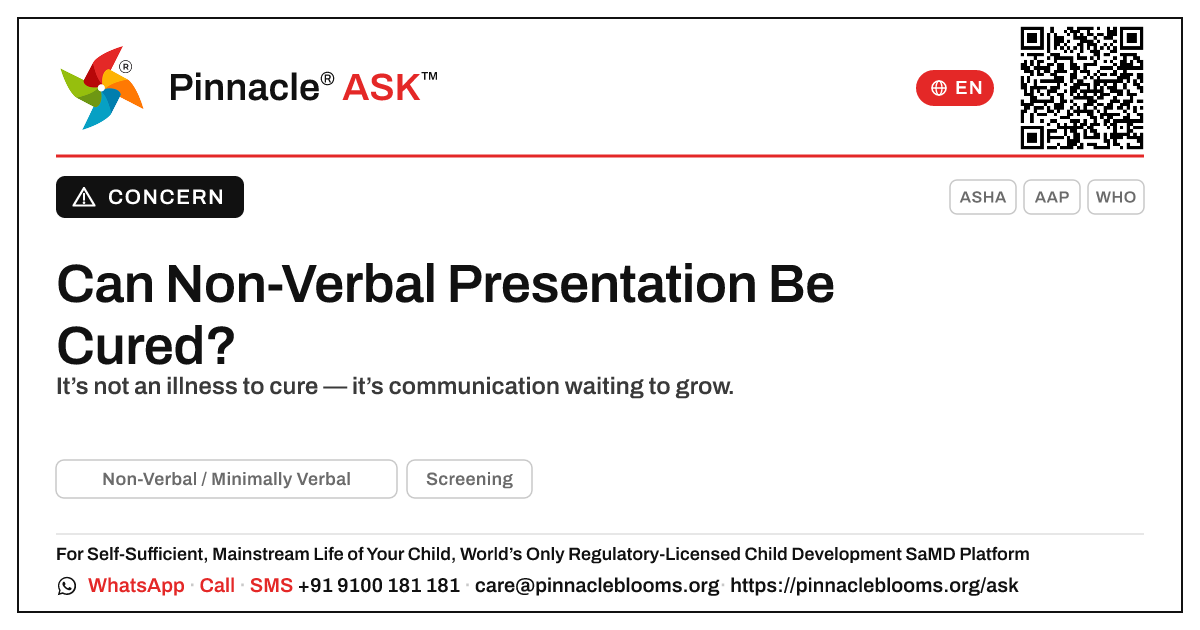
Can a Non-Verbal or Minimally Verbal Child Be “Cured”?
"Cure" is the wrong frame — non-verbal presentation is a description, not an incurable illness. With early, right support, communication can grow remarkably, through speech, signs, pictures or devices. Only a Pinnacle clinician can assess the cause and chart the path.
In this answer 5 sections
If your child isn't speaking yet — or speaks very little — the word you're really searching for is "hope." Let's reframe what "cure" means here, because the news is genuinely encouraging.
In short
Non-verbal or minimally verbal presentation is not an illness with a cure — it is a description of how a child communicates right now, not a fixed destiny. The honest, hopeful truth is that communication can grow remarkably with the right support, and many children who started with few or no spoken words go on to communicate richly — through speech, signs, pictures or devices. The goal isn't to "cure" your child; it's to unlock the communication that is already inside them.
What "progress" really means here
Being non-verbal is a presentation that can accompany several different underlying reasons — a language delay, autism, apraxia, hearing differences, or others. Because the causes differ, so do the paths forward — but the principle holds across them:
- Communication is not the same as speech. A child who points, signs, uses a picture board or a speech-generating device is communicating — and these are not "giving up" on speech; they often build the bridge towards it.
- The window is wide, not closed. Spoken language can emerge in later childhood and beyond. "Minimally verbal at five" does not mean "silent forever."
- Every child's path is their own. Some develop fluent speech; others communicate beautifully through alternative means. Both are real, valid, joyful communication.
So the better question than "Can it be cured?" is "How far can my child's communication grow, and how do we start?" — and the answer to that is: often, much further than parents dare hope.
When to act
Don't wait to "see if words come." If your child is well past the usual milestones with very few or no words, the kindest step is an assessment now — early support consistently makes the biggest difference. Also have hearing checked first, as it's a common and treatable contributor.
The Pinnacle way
No online page can diagnose your child or predict their ceiling — a clinical AbilityScore® and any diagnosis are formed only at a Pinnacle Blooms Network centre, under the care of a qualified clinician. There, a speech-language pathologist finds out why speech is slow to come, introduces tools that give your child a voice today, and builds towards spoken language wherever it's possible. The aim is always the same: your child communicating, connecting, and thriving.
Trusted sources
American Speech-Language-Hearing Association (ASHA) on augmentative and alternative communication; WHO guidance on developmental speech and language; American Academy of Pediatrics developmental guidance via HealthyChildren.org.
Next step — Replace worry with a plan. Book a communication assessment with a Pinnacle speech-language pathologist and discover how far your child's voice can go.
This is general information, not a diagnosis — individual assessment and diagnosis require an appropriately qualified healthcare professional.
CONNECT THE ANSWER TO YOUR CHILD’S DAY
Something to notice. Something to discuss.
What to notice
Seek assessment sooner if your child loses words they once used, shows no babbling or pointing by 12–18 months, has very few or no words well past age 2, or grows frustrated and withdrawn when trying to be understood. Always have hearing checked first.
In everyday life
Honour every attempt to communicate — a sound, a gesture, a reach — by responding as if it were a full sentence: “You want the ball? Here's the ball!” This shows your child that communicating works, which is the spark that fuels more of it.
Bring your observations and questions to your child’s professional. Choose activities that suit your child’s comfort, abilities and agreed plan.
Bring your questions to a first visitQuestions families ask
Will my non-verbal child ever speak?
Many children who begin non-verbal or minimally verbal do develop spoken language, sometimes later than expected. Others communicate richly through signs, pictures or devices. No page can predict your child's path — a clinical assessment finds the cause and charts what's most possible for them.
Does using picture boards or a device stop my child from learning to speak?
No — this is a common worry, but evidence shows the opposite. Augmentative and alternative communication tools often support and encourage spoken language rather than replace it, by reducing frustration and building the foundations of communication.
Is it too late if my child is already five and minimally verbal?
It is not too late. Communication can grow well into later childhood and beyond. Earlier support helps, but meaningful progress is possible at any age — the right next step is an assessment, not waiting.
FOLLOW THE SOURCE
References behind this answer.
- Source referenceASHA — Augmentative and Alternative Communication
- Organisation website · further readingAAP HealthyChildren.org — Speech & Language Development
- Organisation website · further readingWHO — Child Development
References are supplied with this answer. An organisation homepage offers further reading; it does not establish an independent review of this page.
Content attribution: SETU Consortium · Pinnacle Blooms Network.
PEOPLE, TOPICS & DEVELOPMENT
See the connections.
Browse the wider question collections connected with this answer’s audience, developmental area and stage.
FROM UNDERSTANDING TO PURPOSEFUL SUPPORT
One question. Your child’s whole life.
Your child’s self-sufficient, mainstream-included life is the purpose from the beginning. At Pinnacle, that purpose shapes what we understand, the goals we choose, the people we bring together, everyday practice and review.
Connect this question with the right support.
Start with your child’s strengths, your observations and what you want everyday life to become.
Make the next conversation useful.
Bring the situations you notice at home or school. We’ll explain a suitable service, centre and first visit, including availability and fees, before you decide.
How PinnacleAI® connects the journeyExplore the seven stages
- 1Understand abilities
A starting picture of your child’s capabilities.
- 2Choose meaningful goals
Readiness and a plan shaped around the child.
- 3Bring the right support together
Suitable therapies and people for those goals.
- 4Carry practice into everyday life
Guidance for family, home and school.
- 5Track and correct
Use observations to adjust the plan.
- 6Reassess and review
Decide what to continue, change or do next.
- 7Grow independence and participation
The child’s life gives each step its purpose.
Explore the whole PinnacleAI® system → · Participation at school and in the community →
PINNACLE’S EVIDENCE, OPEN TO YOU
Look at the evidence behind our work.
Read our research, inspect the original regulatory documents and check what each institutional measure means.
General information supports a conversation with an appropriately qualified professional. Advice, goals and support depend on the individual child.