
YOUR QUESTION. A CLEARER NEXT STEP.
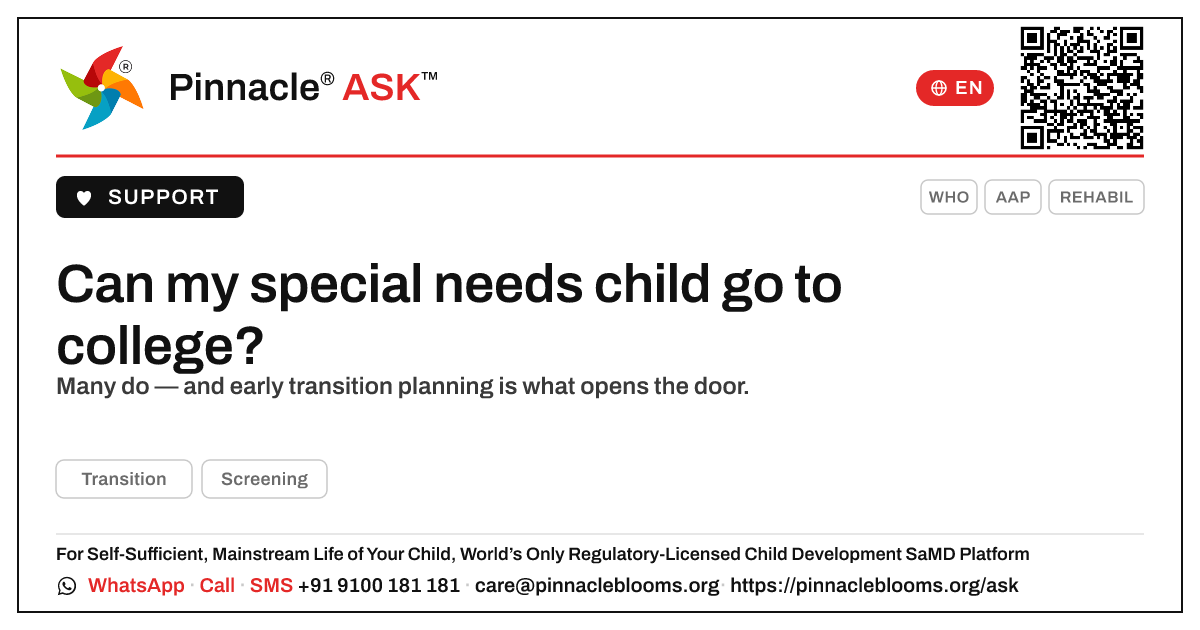
Can my child with special needs go to college?
Yes — many young people with special needs go to college and on to independent adult lives. The path depends on individual strengths, not a label, and is shaped most by early transition planning that builds self-advocacy, communication, daily-living and academic skills. A clinician-administered assessment maps real strengths so the plan is built on what your child can do.
In this answer 4 sections
The question every parent of a teenager with special needs carries quietly: what does the future actually hold? Here is the honest, hopeful answer.
In short
Yes — many young people with special needs go to college, train for skilled work, and build full, independent lives. The right path depends on your child's individual strengths and support needs, not on a label. What matters most is starting the planning early — ideally in the early teen years — so that academic, communication, self-care and social skills grow alongside the dream. College is one good destination among several; the goal is the most independent, fulfilling life your child can lead.
What helps a child get there
Think of the journey as a transition, not a single leap. The teens who thrive at college are usually those whose families began building everyday independence early:
- Self-advocacy — knowing their own strengths, needs and how to ask for help
- Functional communication — expressing needs clearly, in whatever form works for your child
- Daily-living skills — managing time, money, travel and self-care
- Academic readiness matched to interest, with reasonable accommodations
- Social and emotional regulation for new, less-structured environments
In India, colleges are required to provide reasonable accommodations and many now have disability support cells. Pathways vary — mainstream colleges with support, vocational and skill-development courses, and supported-employment routes all lead to meaningful, independent adulthood. There is no single "right" door.
The Pinnacle way
AbilityScore® is part of Pinnacle’s developmental assessment. Diagnosis, where needed, requires an appropriately qualified healthcare professional — never from an app or an online form. A clinician-administered assessment maps your child's real strengths across communication, learning, social and self-care domains, so transition planning is built on what your child can do. From there we shape a therapy and skills plan that grows with them, track progress through the AbilityScore®, and walk the long road toward independence alongside your family. Start exploring at Pinnacle.
Trusted sources
WHO's framework on functioning and participation (ICF) emphasises building real-world capability and removing barriers in the environment; India's Rehabilitation Council guidance supports inclusive education and transition to adulthood. American Academy of Pediatrics resources on transition to adult life echo early, structured planning.
Next step — Want a clear picture of your child's strengths and a transition plan that builds toward college? Book an assessment with a Pinnacle clinician.
This is general information, not a diagnosis — individual assessment and diagnosis require an appropriately qualified healthcare professional.
CONNECT THE ANSWER TO YOUR CHILD’S DAY
Something to notice. Something to discuss.
What to notice
From the early teen years, watch how your child manages everyday independence — communicating their needs, handling money and time, travelling, and coping with changes in routine. These functional skills, more than any single grade, shape readiness for college and adult life.
In everyday life
Give your teen one real responsibility they own fully each week — managing pocket money, planning a small outing, or a household task. Everyday independence built young is the strongest foundation for college and beyond.
Bring your observations and questions to your child’s professional. Choose activities that suit your child’s comfort, abilities and agreed plan.
Bring your questions to a first visitQuestions families ask
At what age should we start planning for college or adult life?
Begin in the early teen years — around 12 to 14. Early transition planning gives time to build self-advocacy, communication, daily-living and academic skills gradually, rather than rushing them before college. The earlier you start, the wider the options stay open.
Will my child need a different kind of college?
Not necessarily. Pathways vary by individual strength and support need — mainstream colleges with accommodations, vocational and skill-development courses, and supported routes all lead to meaningful adulthood. In India, colleges are required to offer reasonable accommodations and many have disability support cells.
How does an assessment help with college planning?
A clinician-administered assessment maps your child's real strengths across communication, learning, social and self-care domains, so transition planning is built on what they can do rather than on a label. It gives a clear baseline and a plan that grows toward independence.
FOLLOW THE SOURCE
References behind this answer.
- Source referenceWHO — ICF framework on functioning and participation
- Organisation website · further readingAAP — transition to adult life resources
- Organisation website · further readingRehabilitation Council of India — inclusive education
References are supplied with this answer. An organisation homepage offers further reading; it does not establish an independent review of this page.
Content attribution: SETU Consortium · Pinnacle Blooms Network.
PEOPLE, TOPICS & DEVELOPMENT
See the connections.
Browse the wider question collections connected with this answer’s audience, developmental area and stage.
FROM UNDERSTANDING TO PURPOSEFUL SUPPORT
One question. Your child’s whole life.
Your child’s self-sufficient, mainstream-included life is the purpose from the beginning. At Pinnacle, that purpose shapes what we understand, the goals we choose, the people we bring together, everyday practice and review.
Connect this question with the right support.
Start with your child’s strengths, your observations and what you want everyday life to become.
Make the next conversation useful.
Bring the situations you notice at home or school. We’ll explain a suitable service, centre and first visit, including availability and fees, before you decide.
How PinnacleAI® connects the journeyExplore the seven stages
- 1Understand abilities
A starting picture of your child’s capabilities.
- 2Choose meaningful goals
Readiness and a plan shaped around the child.
- 3Bring the right support together
Suitable therapies and people for those goals.
- 4Carry practice into everyday life
Guidance for family, home and school.
- 5Track and correct
Use observations to adjust the plan.
- 6Reassess and review
Decide what to continue, change or do next.
- 7Grow independence and participation
The child’s life gives each step its purpose.
Explore the whole PinnacleAI® system → · Participation at school and in the community →
PINNACLE’S EVIDENCE, OPEN TO YOU
Look at the evidence behind our work.
Read our research, inspect the original regulatory documents and check what each institutional measure means.
General information supports a conversation with an appropriately qualified professional. Advice, goals and support depend on the individual child.