
YOUR QUESTION. A CLEARER NEXT STEP.
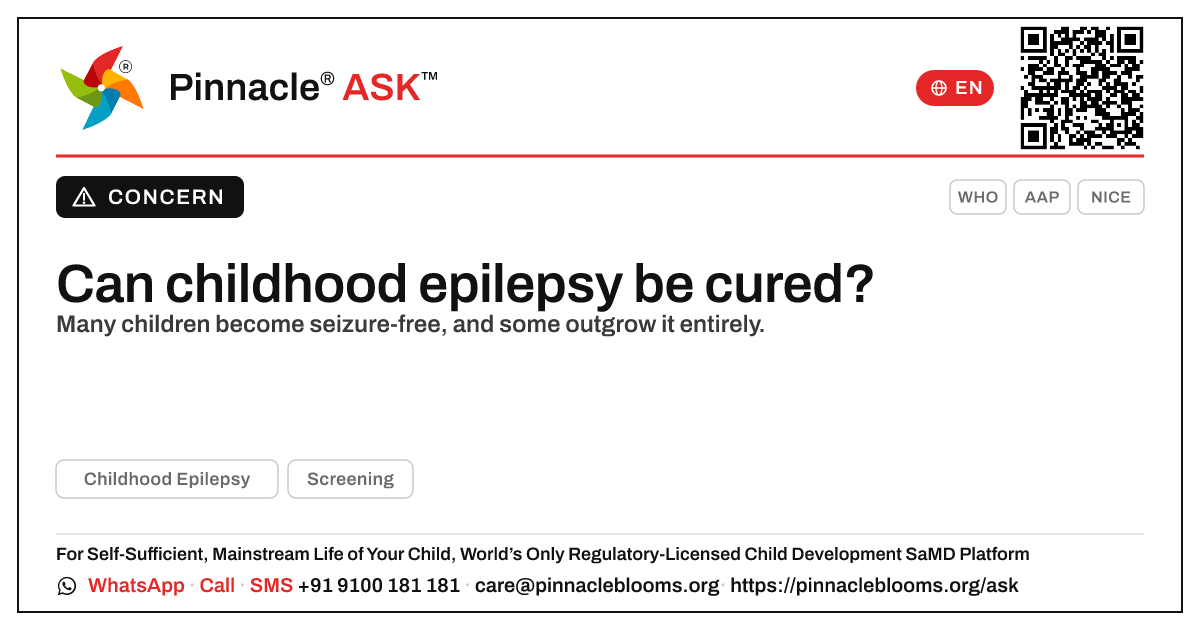
Can childhood epilepsy be cured?
Many children with epilepsy become seizure-free, and some self-limited childhood epilepsies are outgrown entirely as the brain matures — around two in three achieve good control. "Cure" varies by epilepsy type, so a paediatric neurologist must lead diagnosis and treatment, with developmental support alongside.
In this answer 5 sections
When your child has a seizure, one question rises above all others: will this go away? For very many children, the honest answer is hopeful.
In short
Many children with epilepsy do become seizure-free — and a meaningful number outgrow it entirely. With the right diagnosis and treatment, around two in three children achieve good seizure control, and some childhood epilepsy types (the so-called "self-limited" or age-related epilepsies) resolve naturally as the brain matures, often by adolescence. "Cure" is the wrong word for every case, but "well-controlled" and "outgrown" are very real outcomes. The key is prompt, accurate medical care from a paediatric neurologist.
What shapes the outcome
Epilepsy is not one condition — it is many, and the outlook depends heavily on the type.
- Self-limited childhood epilepsies (such as the benign focal epilepsies of childhood) frequently remit on their own as the child grows.
- Well-controlled epilepsy — many children become seizure-free on medication, and after a sustained seizure-free period a neurologist may carefully consider tapering treatment.
- Drug-resistant epilepsy — a smaller group needs more specialised options, which may include dietary therapy, surgery or other interventions assessed at an epilepsy centre.
Epilepsy is a medical condition first. It needs a doctor's diagnosis and a doctor's treatment plan — therapy supports learning, development and confidence alongside medical care, never instead of it.
When to act
A first seizure, or any change in a known seizure pattern, warrants prompt review by a doctor — do not wait. Seek emergency care if a seizure lasts more than 5 minutes, if seizures come one after another without recovery, or if your child has trouble breathing or does not wake afterwards. Developmental support matters too: epilepsy can sit alongside learning, speech or attention differences, and these deserve their own gentle attention.
The Pinnacle way
Developmental measurement supports care planning; diagnosis requires an appropriately qualified healthcare professional. under qualified clinician care — and for epilepsy itself, treatment is always directed by your child's paediatric neurologist. Where seizures touch development, our role is to support your child's speech, learning and developmental progress against their own AbilityScore baseline, in step with their medical team. You can read more about childhood epilepsy and how development support fits around it.
Trusted sources
WHO and ICD-11 framing of epilepsy as a treatable neurological condition; American Academy of Pediatrics guidance on childhood seizures via HealthyChildren; NICE guidance on epilepsy management. Always paired with your treating neurologist's advice.
Next step — Keep your neurologist as the lead for seizures, and book a developmental check at Pinnacle to support your child's learning and confidence alongside their medical care.
This is general information, not a diagnosis — individual assessment and diagnosis require an appropriately qualified healthcare professional.
CONNECT THE ANSWER TO YOUR CHILD’S DAY
Something to notice. Something to discuss.
What to notice
Seek emergency care if a seizure lasts over 5 minutes, repeats without recovery, or your child struggles to breathe or won't wake. Review any first seizure or change in seizure pattern promptly with a doctor.
In everyday life
Keep a simple seizure diary — date, time, how long it lasted, what it looked like, and anything before it. This record is one of the most useful things you can hand your neurologist to guide treatment.
Bring your observations and questions to your child’s professional. Choose activities that suit your child’s comfort, abilities and agreed plan.
Bring your questions to a first visitQuestions families ask
Will my child outgrow epilepsy?
Some children do. The self-limited (age-related) childhood epilepsies often resolve naturally as the brain matures, frequently by the teenage years. Whether this applies to your child depends on the specific epilepsy type, which only your neurologist can determine.
If seizures stop, can my child come off medication?
Possibly, but only under a neurologist's guidance. After a sustained seizure-free period, a doctor may carefully consider tapering medication. This is never done abruptly or without medical supervision.
Is epilepsy a developmental disorder that therapy can fix?
Epilepsy is a neurological condition treated medically, not with therapy. However, when it affects speech, learning or attention, developmental support can help your child thrive alongside their medical treatment.
FOLLOW THE SOURCE
References behind this answer.
- Organisation website · further readingWHO ICD-11: epilepsy classification
- Organisation website · further readingAAP HealthyChildren: childhood seizures
- Organisation website · further readingNICE: epilepsy management guidance
References are supplied with this answer. An organisation homepage offers further reading; it does not establish an independent review of this page.
Content attribution: SETU Consortium · Pinnacle Blooms Network.
PEOPLE, TOPICS & DEVELOPMENT
See the connections.
Browse the wider question collections connected with this answer’s audience, developmental area and stage.
FROM UNDERSTANDING TO PURPOSEFUL SUPPORT
One question. Your child’s whole life.
Your child’s self-sufficient, mainstream-included life is the purpose from the beginning. At Pinnacle, that purpose shapes what we understand, the goals we choose, the people we bring together, everyday practice and review.
Connect this question with the right support.
Start with your child’s strengths, your observations and what you want everyday life to become.
Make the next conversation useful.
Bring the situations you notice at home or school. We’ll explain a suitable service, centre and first visit, including availability and fees, before you decide.
How PinnacleAI® connects the journeyExplore the seven stages
- 1Understand abilities
A starting picture of your child’s capabilities.
- 2Choose meaningful goals
Readiness and a plan shaped around the child.
- 3Bring the right support together
Suitable therapies and people for those goals.
- 4Carry practice into everyday life
Guidance for family, home and school.
- 5Track and correct
Use observations to adjust the plan.
- 6Reassess and review
Decide what to continue, change or do next.
- 7Grow independence and participation
The child’s life gives each step its purpose.
Explore the whole PinnacleAI® system → · Participation at school and in the community →
PINNACLE’S EVIDENCE, OPEN TO YOU
Look at the evidence behind our work.
Read our research, inspect the original regulatory documents and check what each institutional measure means.
General information supports a conversation with an appropriately qualified professional. Advice, goals and support depend on the individual child.