
YOUR QUESTION. A CLEARER NEXT STEP.
Can a child with Stereotyped Movement Disorder attend a mainstream school?
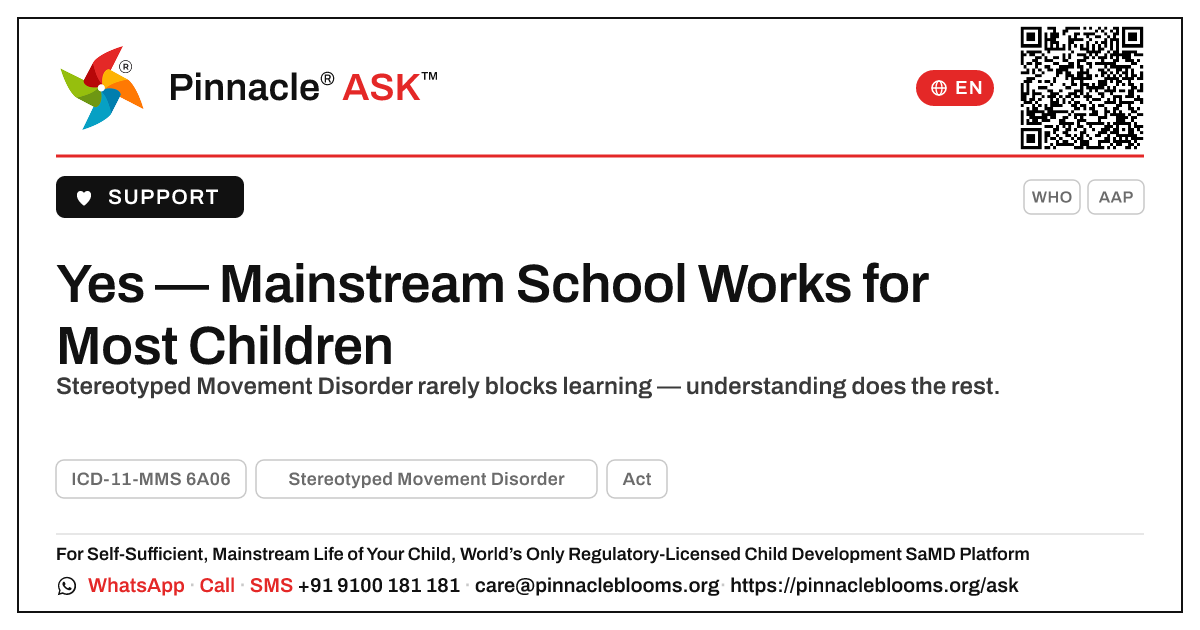
Most children with Stereotyped Movement Disorder (ICD-11 6A06) attend mainstream school successfully — the condition does not affect intelligence or learning. With an understanding teacher, acceptable movement breaks and peer awareness, children thrive. Only self-injurious movements need a closer clinician-led plan.
In this answer 4 sections
Yes — and with the right understanding around them, most children with Stereotyped Movement Disorder thrive in a mainstream classroom.
In short
In most cases, yes. Stereotyped Movement Disorder (ICD-11 6A06) involves repetitive, rhythmic movements — hand-flapping, body-rocking, finger-flicking — that are typically self-soothing and do not affect a child's intelligence or ability to learn. With a few classroom understandings in place, most children attend mainstream school happily alongside their peers. The movements themselves are rarely a barrier; how the environment responds to them matters far more.
What helps in the classroom
Most children need understanding, not exclusion. A few simple supports go a long way:
- A teacher who understands the movements are calming, not disruptive or attention-seeking — so they are not punished or constantly interrupted.
- Acceptable movement breaks — a stretch, a quiet corner, a fidget tool — so your child can self-regulate without feeling singled out.
- A safe response if movements are self-injurious (head-banging, hand-biting): here a clinician's plan to reduce harm is the priority, and this is the one situation needing closer support.
- Peer awareness handled gently, so classmates see difference as ordinary.
Many children's stereotypies lessen when they are engaged, settled and unhurried — so a calm, predictable classroom genuinely helps.
The Pinnacle way
AbilityScore® is part of Pinnacle’s developmental assessment. Diagnosis, where needed, requires an appropriately qualified healthcare professional — never from an online form. From there we can shape a simple school-support note and, where movements are intense or self-injurious, a behaviour and occupational-therapy plan. Learn more about Stereotyped Movement Disorder and how the AbilityScore® works.
Trusted sources
WHO ICD-11 classification of Stereotyped Movement Disorder; American Academy of Pediatrics guidance on supporting children's development in inclusive settings.
Next step — Want a clear picture and a school-ready support plan? Book an assessment at a Pinnacle centre.
This is general information, not a diagnosis — individual assessment and diagnosis require an appropriately qualified healthcare professional.
CONNECT THE ANSWER TO YOUR CHILD’S DAY
Something to notice. Something to discuss.
What to notice
Watch whether the movements are self-soothing (common, manageable) or self-injurious such as head-banging or hand-biting — the latter needs a clinician-led plan. Also note if movements increase sharply when your child is stressed, tired or under-stimulated.
In everyday life
Give your child a small, quiet fidget tool or a regular movement break before homework or busy classroom times — meeting the need calmly often reduces how often the movements appear.
Bring your observations and questions to your child’s professional. Choose activities that suit your child’s comfort, abilities and agreed plan.
Bring your questions to a first visitQuestions families ask
Does Stereotyped Movement Disorder affect my child's ability to learn?
Not in itself. The repetitive movements are usually self-soothing and do not lower intelligence or learning ability. Most children learn at the same pace as peers when teachers understand the movements are calming rather than disruptive.
Will the movements disturb the class?
Usually not. Most stereotypies are quiet and rhythmic, and they often lessen when a child is engaged and settled. A brief, supportive word with the teacher and gentle peer awareness prevents the movements from becoming an issue.
When does my child need extra support at school?
Mainly if the movements are self-injurious — such as head-banging or hand-biting — or if they noticeably interfere with participation. In these cases a clinician can create a behaviour and occupational-therapy plan to reduce harm and support inclusion.
FOLLOW THE SOURCE
References behind this answer.
- Source referenceWHO ICD-11: Stereotyped Movement Disorder (6A06)
- Organisation website · further readingAAP HealthyChildren: supporting children in inclusive settings
References are supplied with this answer. An organisation homepage offers further reading; it does not establish an independent review of this page.
Content attribution: SETU Consortium · Pinnacle Blooms Network.
PEOPLE, TOPICS & DEVELOPMENT
See the connections.
Browse the wider question collections connected with this answer’s audience, developmental area and stage.
FROM UNDERSTANDING TO PURPOSEFUL SUPPORT
One question. Your child’s whole life.
Your child’s self-sufficient, mainstream-included life is the purpose from the beginning. At Pinnacle, that purpose shapes what we understand, the goals we choose, the people we bring together, everyday practice and review.
Connect this question with the right support.
Explore how the relevant service contributes to everyday abilities, then speak with us about your child.
Make the next conversation useful.
Bring the situations you notice at home or school. We’ll explain a suitable service, centre and first visit, including availability and fees, before you decide.
How PinnacleAI® connects the journeyExplore the seven stages
- 1Understand abilities
A starting picture of your child’s capabilities.
- 2Choose meaningful goals
Readiness and a plan shaped around the child.
- 3Bring the right support together
Suitable therapies and people for those goals.
- 4Carry practice into everyday life
Guidance for family, home and school.
- 5Track and correct
Use observations to adjust the plan.
- 6Reassess and review
Decide what to continue, change or do next.
- 7Grow independence and participation
The child’s life gives each step its purpose.
Explore the whole PinnacleAI® system → · Participation at school and in the community →
PINNACLE’S EVIDENCE, OPEN TO YOU
Look at the evidence behind our work.
Read our research, inspect the original regulatory documents and check what each institutional measure means.
General information supports a conversation with an appropriately qualified professional. Advice, goals and support depend on the individual child.