
YOUR QUESTION. A CLEARER NEXT STEP.
Sports and physical play for children born prematurely
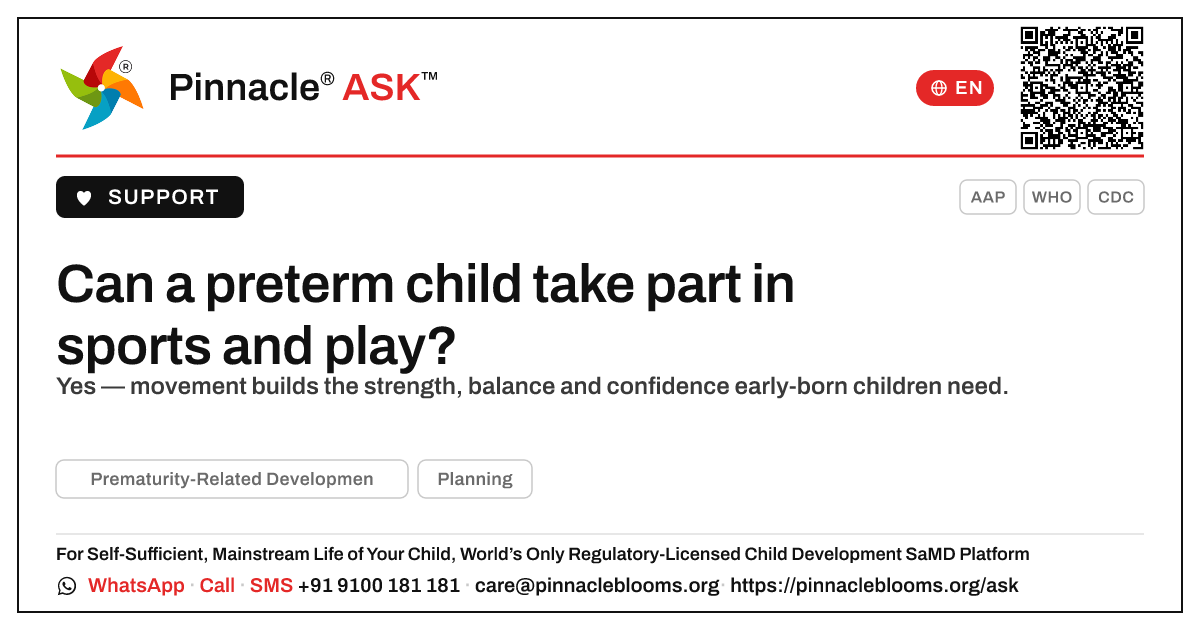
Children with prematurity-related developmental risk can and should take part in sports and physical play, which builds the strength, balance, coordination and confidence that babies born early may develop a little later. The key is to match activities to the child's current stage (using corrected age in early years), build up gently, and check with the care team where there are ongoing medical concerns. AbilityScore® is part of Pinnacle’s developmental assessment. Diagnosis, where needed, requires an appropriately qualified healthcare professional.
In this answer 5 sections
Yes — movement and play are not just allowed, they are some of the very best things for a child born early.
In short
Absolutely yes. A child with prematurity-related developmental risk can — and should — take part in sports and physical play. Movement builds the very strength, balance, coordination and confidence that babies born early sometimes take a little longer to develop. The key is to meet your child where they are right now, choose activities that match their current abilities, and build up gently rather than comparing them to a strict birthday age.
Why play and sport help so much
For children born prematurely, active play does double duty — it is both joyful and therapeutic:
- Builds gross-motor skills — running, climbing, jumping and ball play strengthen the core, legs and balance systems that may have had a slower start.
- Sharpens coordination and planning — catching, kicking and obstacle games train the brain–body connection (motor planning) in a fun, low-pressure way.
- Grows confidence and friendships — team and group play support social skills, turn-taking and self-belief, which matter just as much as physical strength.
- Supports attention and regulation — physical activity helps many children focus better and feel calmer afterwards.
The trick is to think in terms of your child's current stage, not just their age. Children born early are best understood using their corrected age in the early years, and many simply need activities pitched a step gentler to begin with — then they progress beautifully.
Choosing the right activities
- Start with what they enjoy — swimming, cycling with stabilisers, soft-play, dancing and simple ball games are wonderful all-rounders.
- Match the challenge to the skill — if balance is still emerging, choose activities low to the ground first; build height and speed gradually.
- Celebrate effort, not winning — keep it playful so your child stays motivated.
- Check in with your team if unsure — if your child has ongoing breathing, heart, vision or muscle-tone concerns from their early birth, a quick word with your paediatrician or therapist helps you choose safely.
There is rarely a need to hold a child back from movement — far more often, the goal is to find the right movement so they can thrive.
The Pinnacle way
AbilityScore® is part of Pinnacle’s developmental assessment. Diagnosis, where needed, requires an appropriately qualified healthcare professional — never from an app or online form. If you would like clarity on your child's current motor strengths and the activities that will help them most, our therapists build a precise developmental profile and a play-based plan through occupational and physiotherapy support. Learn more about how we support children born early and their families.
Trusted sources
American Academy of Pediatrics (HealthyChildren.org) guidance on physical activity and play for young children; WHO guidance on physical activity for children; CDC developmental milestone and follow-up guidance for preterm infants.
Next step — Want to know which activities will help your early-born child most? Book an assessment with a Pinnacle clinician.
This is general information, not a diagnosis — individual assessment and diagnosis require an appropriately qualified healthcare professional.
CONNECT THE ANSWER TO YOUR CHILD’S DAY
Something to notice. Something to discuss.
What to notice
Watch for unusual breathlessness, blue lips, extreme fatigue, frequent falls beyond expected, persistent reluctance to move, or one-sided weakness or stiffness during play — these warrant a check with your paediatrician or therapist before continuing.
In everyday life
Pick one activity your child genuinely enjoys and keep it playful — celebrate effort and small wins rather than winning, and build height, speed or distance only a little at a time.
Bring your observations and questions to your child’s professional. Choose activities that suit your child’s comfort, abilities and agreed plan.
Bring your questions to a first visitQuestions families ask
Is it safe for a child born prematurely to play sports?
For most children, yes — movement and play are encouraged and beneficial. If your child has ongoing concerns from their early birth, such as breathing, heart, vision or muscle-tone issues, have a quick word with your paediatrician or therapist to choose activities that suit them safely.
Should I use my child's actual age or corrected age when choosing activities?
In the early years, corrected age (age from the original due date) gives a fairer picture of what to expect. Match activities to your child's current stage rather than a strict birthday age, and build up gently.
Which activities are best to start with?
Swimming, dancing, soft-play, cycling with stabilisers and simple ball games are great all-rounders. Begin with activities that match your child's current balance and strength, then increase the challenge gradually as they grow more confident.
FOLLOW THE SOURCE
References behind this answer.
- Organisation website · further readingAAP HealthyChildren — physical activity and play
- Organisation website · further readingWHO — physical activity for children
- Organisation website · further readingCDC — preterm infant follow-up and milestones
References are supplied with this answer. An organisation homepage offers further reading; it does not establish an independent review of this page.
Content attribution: SETU Consortium · Pinnacle Blooms Network.
PEOPLE, TOPICS & DEVELOPMENT
See the connections.
Browse the wider question collections connected with this answer’s audience, developmental area and stage.
FROM UNDERSTANDING TO PURPOSEFUL SUPPORT
One question. Your child’s whole life.
Your child’s self-sufficient, mainstream-included life is the purpose from the beginning. At Pinnacle, that purpose shapes what we understand, the goals we choose, the people we bring together, everyday practice and review.
Connect this question with the right support.
Explore how the relevant service contributes to everyday abilities, then speak with us about your child.
Make the next conversation useful.
Bring the situations you notice at home or school. We’ll explain a suitable service, centre and first visit, including availability and fees, before you decide.
How PinnacleAI® connects the journeyExplore the seven stages
- 1Understand abilities
A starting picture of your child’s capabilities.
- 2Choose meaningful goals
Readiness and a plan shaped around the child.
- 3Bring the right support together
Suitable therapies and people for those goals.
- 4Carry practice into everyday life
Guidance for family, home and school.
- 5Track and correct
Use observations to adjust the plan.
- 6Reassess and review
Decide what to continue, change or do next.
- 7Grow independence and participation
The child’s life gives each step its purpose.
Explore the whole PinnacleAI® system → · Participation at school and in the community →
PINNACLE’S EVIDENCE, OPEN TO YOU
Look at the evidence behind our work.
Read our research, inspect the original regulatory documents and check what each institutional measure means.
General information supports a conversation with an appropriately qualified professional. Advice, goals and support depend on the individual child.