
YOUR QUESTION. A CLEARER NEXT STEP.
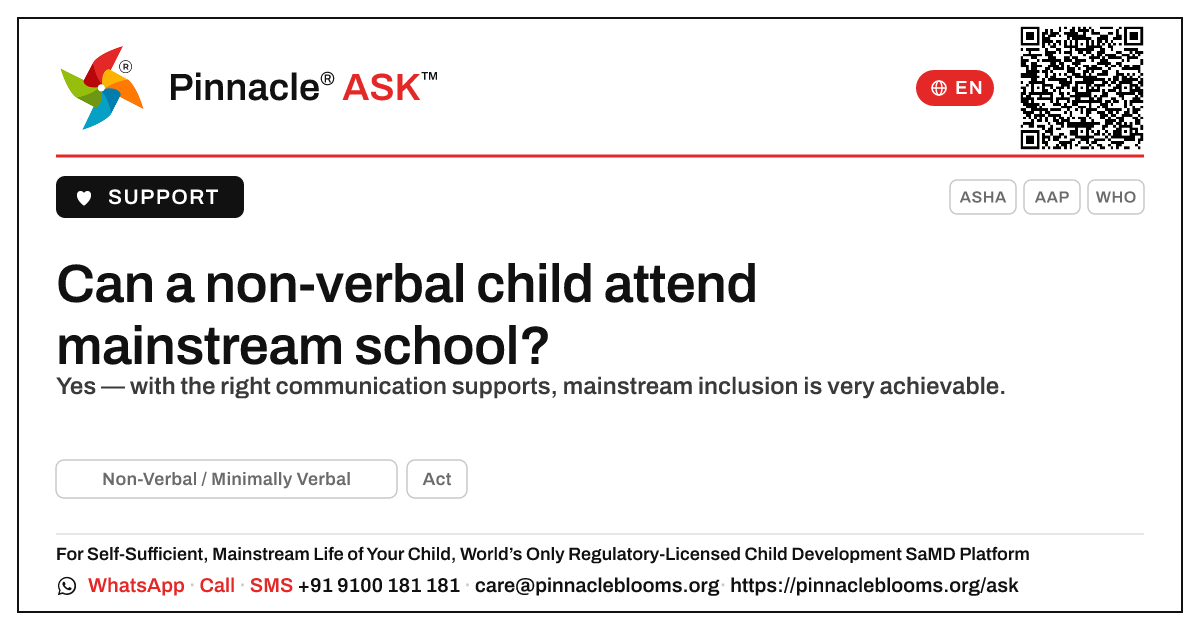
Can a non-verbal or minimally verbal child attend mainstream school?
Yes — children who are non-verbal or minimally verbal can thrive in mainstream school when the right communication supports are in place. AAC (picture systems, communication devices), a communication-friendly classroom and reasonable adjustments matter far more than spoken words. A Pinnacle clinician can map your child's communication profile and build a school-ready plan.
In this answer 4 sections
Yes — being non-verbal or minimally verbal does not close the school gate; the right communication support opens it.
In short
Absolutely — many children who are non-verbal or minimally verbal thrive in mainstream school. Speech is one way to communicate, not the only way. With the right communication supports — gestures, picture systems, or speech-generating devices — and a school willing to make reasonable adjustments, your child can learn, make friends and belong. The key is matching a child's individual communication profile to the right support, not waiting for spoken words to arrive first.
What makes mainstream school work
Children learn and participate through whatever communication channel suits them. With the right scaffolding, mainstream classrooms become genuinely inclusive:
- Augmentative & Alternative Communication (AAC) — picture exchange, communication boards or a tablet-based device lets a child request, answer and join in. Using AAC does not slow spoken language; the evidence shows it often supports it.
- A communication-friendly classroom — visual timetables, predictable routines, and teachers who allow extra time for a child to respond.
- Reasonable adjustments & a support plan — shared between you, the school and your therapy team, reviewed regularly.
- Peer awareness — classmates who understand how their friend communicates become natural allies.
Success depends less on how many words a child speaks and more on whether the environment is set up to receive their communication.
The Pinnacle way
Developmental measurement supports care planning; diagnosis requires an appropriately qualified healthcare professional., under qualified clinician care — never from an app or a form. Our team builds a practical communication profile for your child's non-verbal or minimally verbal presentation, introduces the right AAC through speech therapy, and translates it into a clear starting point you can share with school.
Trusted sources
ASHA guidance on AAC and inclusive communication; WHO ICF framework on participation and environment; AAP healthychildren.org on supporting communication differences.
Next step — Let a Pinnacle clinician map your child's communication strengths and a school-ready support plan. Book an assessment.
This is general information, not a diagnosis — individual assessment and diagnosis require an appropriately qualified healthcare professional.
CONNECT THE ANSWER TO YOUR CHILD’S DAY
Something to notice. Something to discuss.
What to notice
Watch how your child already communicates — pointing, leading you by the hand, gestures, sounds, picture choices. These are real communication skills a school can build on, and they signal readiness for the right AAC support.
In everyday life
Offer choices using two real objects or pictures throughout the day ('milk or water?'). It teaches your child that communicating gets results — the same principle that powers AAC at school.
Bring your observations and questions to your child’s professional. Choose activities that suit your child’s comfort, abilities and agreed plan.
Bring your questions to a first visitQuestions families ask
Does using AAC stop my child from learning to speak?
No. Research consistently shows that AAC — picture systems or speech-generating devices — does not hold back spoken language and often supports it, by reducing frustration and giving your child a reliable way to communicate while speech develops.
Will my child need a special school instead?
Not necessarily. Many non-verbal and minimally verbal children do very well in mainstream school with the right communication supports and reasonable adjustments. The best setting depends on your child's overall profile, which a clinician can help you understand.
How do I get the school on board?
Share a clear communication profile from your therapy team, agree on practical adjustments like visual timetables and AAC use, and set a regular review. A Pinnacle assessment gives you a starting point you can hand directly to the school.
FOLLOW THE SOURCE
References behind this answer.
- Source referenceASHA — Augmentative and Alternative Communication
- Organisation website · further readingAAP healthychildren.org — supporting communication
- Source referenceWHO ICF — participation and environment
References are supplied with this answer. An organisation homepage offers further reading; it does not establish an independent review of this page.
Content attribution: SETU Consortium · Pinnacle Blooms Network.
PEOPLE, TOPICS & DEVELOPMENT
See the connections.
Browse the wider question collections connected with this answer’s audience, developmental area and stage.
FROM UNDERSTANDING TO PURPOSEFUL SUPPORT
One question. Your child’s whole life.
Your child’s self-sufficient, mainstream-included life is the purpose from the beginning. At Pinnacle, that purpose shapes what we understand, the goals we choose, the people we bring together, everyday practice and review.
Connect this question with the right support.
Explore how the relevant service contributes to everyday abilities, then speak with us about your child.
Make the next conversation useful.
Bring the situations you notice at home or school. We’ll explain a suitable service, centre and first visit, including availability and fees, before you decide.
How PinnacleAI® connects the journeyExplore the seven stages
- 1Understand abilities
A starting picture of your child’s capabilities.
- 2Choose meaningful goals
Readiness and a plan shaped around the child.
- 3Bring the right support together
Suitable therapies and people for those goals.
- 4Carry practice into everyday life
Guidance for family, home and school.
- 5Track and correct
Use observations to adjust the plan.
- 6Reassess and review
Decide what to continue, change or do next.
- 7Grow independence and participation
The child’s life gives each step its purpose.
Explore the whole PinnacleAI® system → · Participation at school and in the community →
PINNACLE’S EVIDENCE, OPEN TO YOU
Look at the evidence behind our work.
Read our research, inspect the original regulatory documents and check what each institutional measure means.
General information supports a conversation with an appropriately qualified professional. Advice, goals and support depend on the individual child.