
YOUR QUESTION. A CLEARER NEXT STEP.
Can a Child with Auditory Processing Difficulties Attend Regular School?
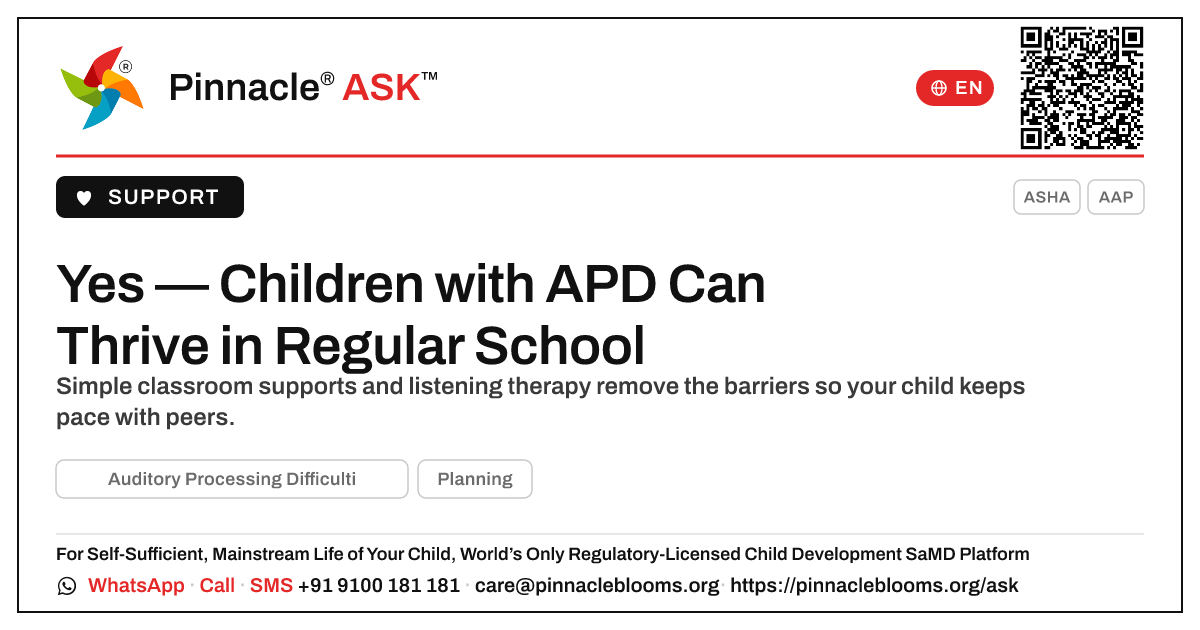
Yes — children with Auditory Processing Difficulties can attend regular school and thrive. APD affects how the brain processes sound, not intelligence. Simple classroom adjustments and listening therapy let most children keep pace with peers. A clinician confirms the picture and shapes the support plan.
In this answer 4 sections
Yes — and with the right support in place, your child can not only attend a regular school, they can flourish there.
In short
Absolutely yes. A child with Auditory Processing Difficulties (APD) can attend a mainstream school. APD is about how the brain makes sense of sounds — not intelligence, and not hearing loss. With simple classroom adjustments and the right therapy, most children keep pace happily with their peers. The goal is never to set your child apart, but to remove the listening barriers so the classroom works for them.
What helps in the classroom
Children with APD hear sounds clearly but find it hard to process them — especially in noisy rooms, when instructions are long, or when several people speak at once. Small, practical supports make a big difference:
- Front-and-centre seating, away from doors, fans and windows that add background noise
- Short, clear instructions — one step at a time, with a pause before the next
- Visual back-up — written steps, gestures, pictures alongside spoken words
- A check-in cue — "Show me what you'll do first" — to confirm understanding kindly
- Quiet space for tests and extra time where helpful
Many of these are good teaching for every child, so they rarely single your child out. Sharing a short note with the class teacher early in the year helps them become your child's quiet ally.
The Pinnacle way
Whether a difficulty is true APD or another listening or language issue can only be confirmed by a qualified clinician — and that is exactly what an assessment is for. At a Pinnacle Blooms Network centre, your child is evaluated against their own AbilityScore® baseline by a clinician; no diagnosis is ever made from an online form. From there, listening and language therapy builds processing skills, and we can help you frame a simple, warm school-support plan. Backed by 25 million+ therapy sessions and 700+ therapists across 70+ centres, the aim is always the same — your child confident and thriving in mainstream school.
Trusted sources
American Speech-Language-Hearing Association (ASHA) on auditory processing and classroom strategies; American Academy of Pediatrics guidance on learning supports; WHO healthy-development frameworks.
Next step — Clarity first, then a plan that fits your child and their classroom. Book an assessment with a Pinnacle clinician.
This is general information, not a diagnosis — individual assessment and diagnosis require an appropriately qualified healthcare professional.
CONNECT THE ANSWER TO YOUR CHILD’S DAY
Something to notice. Something to discuss.
What to notice
Tell the teacher if your child often says "what?", seems to ignore instructions in noisy rooms, tires quickly during listening tasks, or grows frustrated and withdrawn at school — these signal the listening environment needs adjusting, not that mainstream school is wrong.
In everyday life
Before giving instructions at home, gain your child's attention first — say their name, wait for eye contact, then speak in short clear steps. Asking them to repeat it back warmly turns listening into a calm, daily habit.
Bring your observations and questions to your child’s professional. Choose activities that suit your child’s comfort, abilities and agreed plan.
Bring your questions to a first visitQuestions families ask
Does my child need a special school for Auditory Processing Difficulties?
In most cases, no. The great majority of children with APD do well in mainstream school with small adjustments — front seating, clear short instructions and visual back-up — plus listening therapy. A clinician's assessment helps tailor what your individual child needs.
Is Auditory Processing Difficulty the same as hearing loss?
No. Children with APD usually hear sounds perfectly well — the difficulty is in how the brain interprets and makes sense of those sounds, especially in noise. That is why a hearing test alone may look normal, and why a fuller clinical assessment matters.
Will APD affect my child's school marks?
It can, if unsupported — mishearing instructions or struggling in noisy rooms makes learning harder. But with classroom adjustments and therapy that builds processing skills, most children keep pace with their peers and their confidence grows.
FOLLOW THE SOURCE
References behind this answer.
- Source referenceASHA — Understanding auditory processing in children
- Organisation website · further readingAAP HealthyChildren — learning and classroom supports
References are supplied with this answer. An organisation homepage offers further reading; it does not establish an independent review of this page.
Content attribution: SETU Consortium · Pinnacle Blooms Network.
PEOPLE, TOPICS & DEVELOPMENT
See the connections.
Browse the wider question collections connected with this answer’s audience, developmental area and stage.
FROM UNDERSTANDING TO PURPOSEFUL SUPPORT
One question. Your child’s whole life.
Your child’s self-sufficient, mainstream-included life is the purpose from the beginning. At Pinnacle, that purpose shapes what we understand, the goals we choose, the people we bring together, everyday practice and review.
Connect this question with the right support.
Explore how the relevant service contributes to everyday abilities, then speak with us about your child.
Make the next conversation useful.
Bring the situations you notice at home or school. We’ll explain a suitable service, centre and first visit, including availability and fees, before you decide.
How PinnacleAI® connects the journeyExplore the seven stages
- 1Understand abilities
A starting picture of your child’s capabilities.
- 2Choose meaningful goals
Readiness and a plan shaped around the child.
- 3Bring the right support together
Suitable therapies and people for those goals.
- 4Carry practice into everyday life
Guidance for family, home and school.
- 5Track and correct
Use observations to adjust the plan.
- 6Reassess and review
Decide what to continue, change or do next.
- 7Grow independence and participation
The child’s life gives each step its purpose.
Explore the whole PinnacleAI® system → · Participation at school and in the community →
PINNACLE’S EVIDENCE, OPEN TO YOU
Look at the evidence behind our work.
Read our research, inspect the original regulatory documents and check what each institutional measure means.
General information supports a conversation with an appropriately qualified professional. Advice, goals and support depend on the individual child.