
YOUR QUESTION. A CLEARER NEXT STEP.
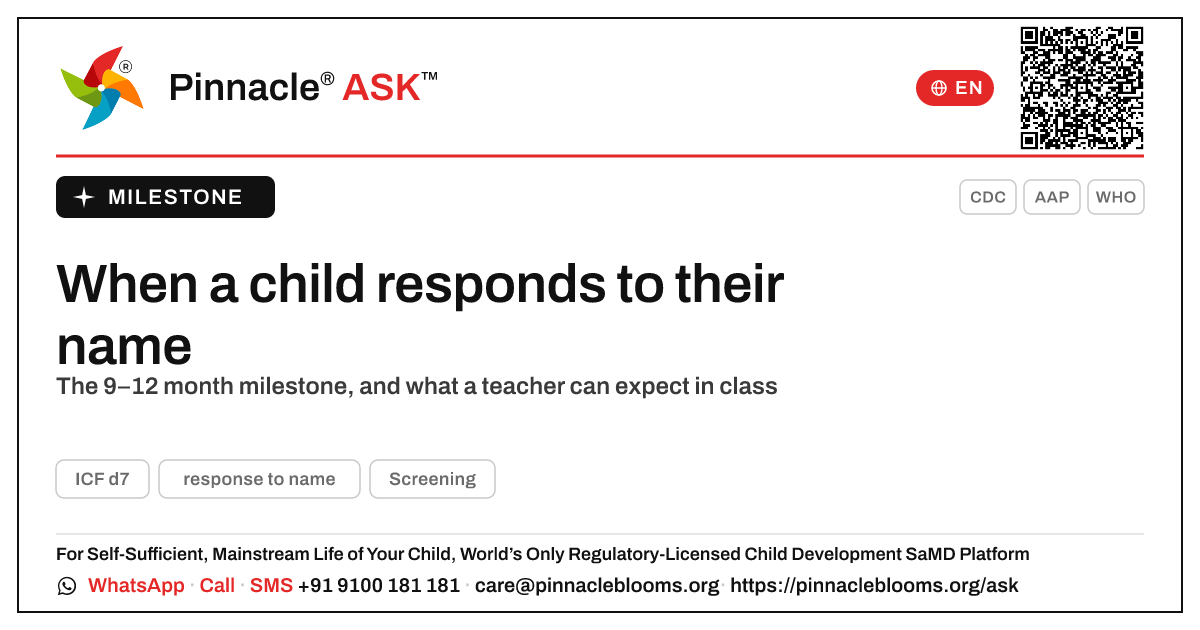
When does a child respond to their name — and what teachers should expect
Most children respond consistently to their name by 9 to 12 months. In class, a teacher can expect a child to orient to their name within a second or two, even mid-activity, with reliability strengthening through the preschool and early-school years. A consistent failure to respond across settings — not a single missed call — is what warrants a gentle parent conversation and a hearing check.
In this answer 4 sections
A child turning towards their name is one of the quietest, most telling signs of social listening — and a teacher often spots its rhythm long before anyone else.
In short
Most children respond consistently to their name by 9 to 12 months, turning, looking up, or pausing when called. By the toddler and early-school years this becomes reliable across noise and distraction. In class, a teacher can reasonably expect a child to orient to their name within a second or two, even mid-activity — though tiredness, deep focus, or a noisy room can soften the response on any given day.
What a teacher can expect in class
- Toddlers (1–2 years): turn or look when named, often pairing it with eye contact or a smile.
- Preschool (3–4 years): respond to their name from across the room, pause an activity, and follow a simple instruction that follows it.
- Early school (5+ years): respond consistently even when absorbed or among background chatter.
A child who rarely responds to their name across settings — at home and in class — especially alongside limited pointing, eye contact, or shared attention, deserves a gentle conversation with parents and a hearing check first. A single missed response is ordinary; a consistent pattern is worth noting calmly, never alarming.
The Pinnacle way
Response to name sits within ICF d7 interpersonal interactions — the foundation of classroom listening and social connection. Any clinical AbilityScore® and any diagnosis are formed only at a Pinnacle Blooms Network centre under qualified clinician care; a teacher's observation is a valued early signal, not a verdict. Where social-communication concerns persist, speech therapy support can begin early and gently.
Trusted sources
Aligned with the CDC "Learn the Signs. Act Early." milestones, the American Academy of Pediatrics developmental guidance, and the WHO ICF framework for interpersonal interactions.
Next step — share your classroom observations with the child's parents and suggest a free developmental check with Pinnacle on WhatsApp: +91 91001 81181.
This is general information, not a diagnosis — individual assessment and diagnosis require an appropriately qualified healthcare professional.
CONNECT THE ANSWER TO YOUR CHILD’S DAY
Something to notice. Something to discuss.
What to notice
Note a child who rarely turns to their name across both home and class, especially with limited pointing, eye contact or shared attention — arrange a hearing check first, then suggest a developmental review. A single missed response is ordinary.
In everyday life
Call the child's name from a step or two away, in their line of sight, and pair it with a warm smile and wait a full two seconds before repeating — this gives genuine response time and tells you more than rapid re-calling.
Bring your observations and questions to your child’s professional. Choose activities that suit your child’s comfort, abilities and agreed plan.
Bring your questions to a first visitQuestions families ask
By what age should a child respond to their name?
Most children respond consistently to their name by 9 to 12 months — turning, looking up, or pausing when called. By preschool age this becomes reliable even across a busy, noisy room.
Is it a problem if my child doesn't always respond in class?
Not on its own. Tiredness, deep focus, or background noise can soften any child's response. A consistent failure to respond across both home and class, especially with limited eye contact or pointing, is what's worth a gentle conversation and a hearing check.
What should a teacher do if a child rarely responds to their name?
Note the pattern calmly, share it with parents, and suggest a hearing check first followed by a developmental review. A teacher's observation is a valued early signal, never a diagnosis.
FOLLOW THE SOURCE
References behind this answer.
- Source referenceCDC Learn the Signs. Act Early. milestones
- Organisation website · further readingAAP HealthyChildren developmental guidance
- Organisation website · further readingWHO ICF interpersonal interactions framework
References are supplied with this answer. An organisation homepage offers further reading; it does not establish an independent review of this page.
Content attribution: SETU Consortium · Pinnacle Blooms Network.
PEOPLE, TOPICS & DEVELOPMENT
See the connections.
Browse the wider question collections connected with this answer’s audience, developmental area and stage.
FROM UNDERSTANDING TO PURPOSEFUL SUPPORT
One question. Your child’s whole life.
Your child’s self-sufficient, mainstream-included life is the purpose from the beginning. At Pinnacle, that purpose shapes what we understand, the goals we choose, the people we bring together, everyday practice and review.
Connect this question with the right support.
Start with your child’s strengths, your observations and what you want everyday life to become.
Make the next conversation useful.
Bring the situations you notice at home or school. We’ll explain a suitable service, centre and first visit, including availability and fees, before you decide.
How PinnacleAI® connects the journeyExplore the seven stages
- 1Understand abilities
A starting picture of your child’s capabilities.
- 2Choose meaningful goals
Readiness and a plan shaped around the child.
- 3Bring the right support together
Suitable therapies and people for those goals.
- 4Carry practice into everyday life
Guidance for family, home and school.
- 5Track and correct
Use observations to adjust the plan.
- 6Reassess and review
Decide what to continue, change or do next.
- 7Grow independence and participation
The child’s life gives each step its purpose.
Explore the whole PinnacleAI® system → · Participation at school and in the community →
PINNACLE’S EVIDENCE, OPEN TO YOU
Look at the evidence behind our work.
Read our research, inspect the original regulatory documents and check what each institutional measure means.
General information supports a conversation with an appropriately qualified professional. Advice, goals and support depend on the individual child.