
YOUR QUESTION. A CLEARER NEXT STEP.
At What Age Does a Child Develop Verbal Reasoning?
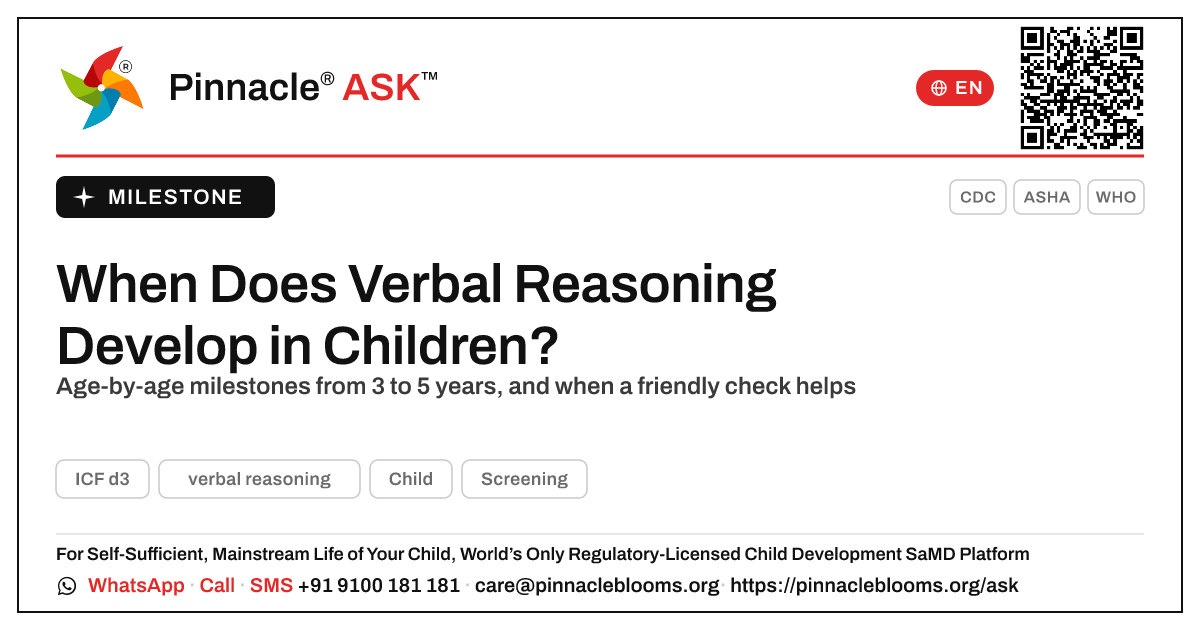
Early verbal reasoning blooms between 3 and 5 years — answering 'what' questions at 3, 'why' questions and simple predictions by 4–5 — and grows through the early school years. The pattern across settings matters more than any single age.
In this answer 5 sections
Verbal reasoning isn't a switch that flips on — it's a quiet skill that grows as your child learns to think out loud with words.
In short
Early verbal reasoning — understanding 'why', solving little problems with words, making simple comparisons — begins to bloom between 3 and 5 years, and grows steadily through the early school years. At 3, expect a child to answer simple 'what' and 'where' questions; by 4–5, many begin reasoning about 'why' and 'what happens next'. There is a wide, normal range, so the pattern matters more than any single birthday.
What grows, and when
- Around 3 years — follows two-step directions, answers simple questions, names what familiar objects are for ('We eat with a spoon').
- Around 4 years — asks and answers 'why' questions, sorts objects by simple categories, retells part of a story.
- Around 5 years — makes basic predictions ('If it rains, we get wet'), explains a simple reason, understands opposites and comparisons.
This sits within the ICF d3 — Communication domain and depends on steady spoken-language growth. Verbal reasoning is built on conversation, so children who talk and listen a lot tend to reason in words sooner.
When to check in
If by 4–5 years your child rarely answers 'why', struggles to follow simple two-step instructions, or finds it hard to explain everyday events — and this shows up at home and in play — a friendly developmental check is a wise, hopeful step. Earlier worries about hearing or unclear speech are always worth raising too.
The Pinnacle way
A clinical AbilityScore® and any diagnosis are formed only at a Pinnacle Blooms Network centre, under qualified clinician care — never from an online read. We explore verbal reasoning as part of a child's whole communication profile, and where helpful, support growth through speech therapy.
Trusted sources
Aligned with WHO ICF communication (d3) domain, CDC 'Learn the Signs. Act Early.' milestones, and ASHA guidance on language development in early childhood.
Next step — if you're curious about where your child stands, book a developmental screen with the Pinnacle team on WhatsApp: +91 91001 81181.
This is general information, not a diagnosis — individual assessment and diagnosis require an appropriately qualified healthcare professional.
CONNECT THE ANSWER TO YOUR CHILD’S DAY
Something to notice. Something to discuss.
What to notice
By 4–5 years, watch for a child who rarely answers 'why', cannot follow simple two-step instructions, or struggles to explain everyday events across both home and play — and raise any hearing or speech-clarity worries early.
In everyday life
Turn daily moments into reasoning practice: ask 'Why do you think the dog is barking?' or 'What happens if we leave the ice cream out?' — then wait, smile, and let them think it through in words.
Bring your observations and questions to your child’s professional. Choose activities that suit your child’s comfort, abilities and agreed plan.
Bring your questions to a first visitQuestions families ask
At what age does verbal reasoning start?
Early verbal reasoning typically begins between 3 and 5 years. At 3, children answer simple questions; by 4–5, many start reasoning about 'why' and 'what happens next'. It then grows steadily through the early school years.
What is verbal reasoning in a child?
It is the ability to think and solve simple problems using words — understanding 'why', making comparisons, predicting outcomes and explaining reasons. It builds on spoken language and falls within the ICF communication domain.
How can I help my child's verbal reasoning at home?
Talk often, ask open 'why' and 'what if' questions, read stories together and pause to wonder aloud. Give your child time to think and answer in their own words — conversation is the best practice.
When should I be concerned about verbal reasoning?
If by 4–5 years your child rarely answers 'why', struggles with two-step instructions, or finds it hard to explain everyday events across home and play, a friendly developmental check is a wise step.
FOLLOW THE SOURCE
References behind this answer.
- Source referenceCDC: Learn the Signs. Act Early. milestones
- Source referenceASHA: Speech and language development
- Organisation website · further readingWHO ICF communication domain (d3)
References are supplied with this answer. An organisation homepage offers further reading; it does not establish an independent review of this page.
Content attribution: SETU Consortium · Pinnacle Blooms Network.
PEOPLE, TOPICS & DEVELOPMENT
See the connections.
Browse the wider question collections connected with this answer’s audience, developmental area and stage.
FROM UNDERSTANDING TO PURPOSEFUL SUPPORT
One question. Your child’s whole life.
Your child’s self-sufficient, mainstream-included life is the purpose from the beginning. At Pinnacle, that purpose shapes what we understand, the goals we choose, the people we bring together, everyday practice and review.
Connect this question with the right support.
Start with your child’s strengths, your observations and what you want everyday life to become.
Make the next conversation useful.
Bring the situations you notice at home or school. We’ll explain a suitable service, centre and first visit, including availability and fees, before you decide.
How PinnacleAI® connects the journeyExplore the seven stages
- 1Understand abilities
A starting picture of your child’s capabilities.
- 2Choose meaningful goals
Readiness and a plan shaped around the child.
- 3Bring the right support together
Suitable therapies and people for those goals.
- 4Carry practice into everyday life
Guidance for family, home and school.
- 5Track and correct
Use observations to adjust the plan.
- 6Reassess and review
Decide what to continue, change or do next.
- 7Grow independence and participation
The child’s life gives each step its purpose.
Explore the whole PinnacleAI® system → · Participation at school and in the community →
PINNACLE’S EVIDENCE, OPEN TO YOU
Look at the evidence behind our work.
Read our research, inspect the original regulatory documents and check what each institutional measure means.
General information supports a conversation with an appropriately qualified professional. Advice, goals and support depend on the individual child.