
YOUR QUESTION. A CLEARER NEXT STEP.
At what age should a child control aggression?
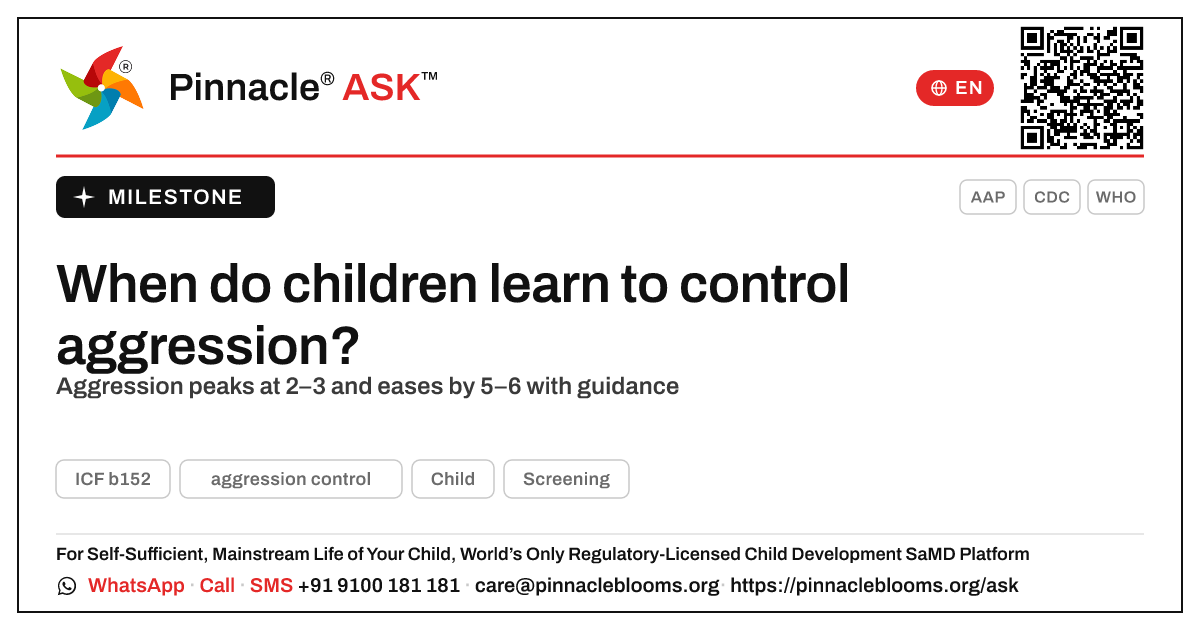
Aggression control develops gradually, not at one fixed age. Hitting and tantrums peak between 2 and 3 years and ease with guidance; by around 5–6 most children can use words and calm down more often than they lash out. Seek a check if intense aggression persists past age 4–5 or comes with other delays.
In this answer 5 sections
Every toddler pushes, grabs and melts down — losing your temper at two is not a behaviour problem, it's a stage of growing.
In short
Aggression control is a skill that develops gradually, not a switch that flips at one age. Most children show frequent hitting, biting and tantrums between 2 and 3 years — this peaks in the toddler years and then steadily eases. By around age 5–6, with patient guidance, most children can pause, use words and recover from frustration more often than they lash out. Wide variation is completely normal.
How aggression control grows
The ability to manage strong feelings (ICF b152, emotional regulation) is built brick by brick:
- 2–3 years — big feelings, small vocabulary. Hitting and tantrums are how a child without words says "I'm overwhelmed." This is expected, not defiant.
- 3–4 years — beginning to name feelings ("I'm cross") and accept simple limits, though meltdowns still happen.
- 4–5 years — more turn-taking, sharing and waiting; physical aggression drops noticeably.
- 5–6 years and up — most children can use words instead of fists more often, and calm down faster with support.
When to seek a developmental check
It's worth a friendly check-in if, after age 4–5, aggression is frequent, intense, hurts others, doesn't ease with consistent guidance, or is paired with delays in speech, play or social connection. Persistent concern is itself a good reason to ask.
The Pinnacle way
A clinical AbilityScore® and any diagnosis are formed only at a Pinnacle Blooms Network centre, under qualified clinician care — never from an online read. Our team supports families through behaviour therapy and warm, practical strategies for aggression control, with 4.95 lakh+ families served across 70+ centres.
Trusted sources
Aligned with WHO ICF (b152), the American Academy of Pediatrics and CDC developmental guidance on social-emotional milestones, and NICE guidance on children's behaviour.
Next step — if your child's aggression worries you, book a developmental check with the Pinnacle team on WhatsApp: +91 91001 81181.
This is general information, not a diagnosis — individual assessment and diagnosis require an appropriately qualified healthcare professional.
CONNECT THE ANSWER TO YOUR CHILD’S DAY
Something to notice. Something to discuss.
What to notice
Watch if, after age 4–5, aggression is frequent, intense, hurts others, doesn't ease with consistent calm guidance, or appears alongside delays in speech, play or social connection.
In everyday life
Name the feeling before the behaviour: "You're angry the tower fell — hands are not for hitting." Naming big feelings teaches a child the words that slowly replace the hitting.
Bring your observations and questions to your child’s professional. Choose activities that suit your child’s comfort, abilities and agreed plan.
Bring your questions to a first visitQuestions families ask
Is it normal for my 2-year-old to hit and bite?
Yes. Between 2 and 3 years, hitting, biting and tantrums are very common — they are how a child with few words shows feeling overwhelmed, not a sign of a bad temperament. With calm, consistent guidance this typically eases over the next couple of years.
By what age should aggression settle down?
Physical aggression usually drops noticeably between 4 and 5 years, and by around 5–6 most children can use words and calm themselves more often than they lash out. Wide variation is normal.
When should I be concerned about my child's aggression?
Consider a developmental check if, after age 4–5, aggression is frequent, intense, hurts others, doesn't respond to consistent guidance, or comes with delays in speech, play or social skills.
FOLLOW THE SOURCE
References behind this answer.
- Organisation website · further readingAAP HealthyChildren — managing temper and aggression in young children
- Organisation website · further readingCDC — social-emotional developmental milestones
- Organisation website · further readingWHO ICF b152 — emotional functions
References are supplied with this answer. An organisation homepage offers further reading; it does not establish an independent review of this page.
Content attribution: SETU Consortium · Pinnacle Blooms Network.
PEOPLE, TOPICS & DEVELOPMENT
See the connections.
Browse the wider question collections connected with this answer’s audience, developmental area and stage.
FROM UNDERSTANDING TO PURPOSEFUL SUPPORT
One question. Your child’s whole life.
Your child’s self-sufficient, mainstream-included life is the purpose from the beginning. At Pinnacle, that purpose shapes what we understand, the goals we choose, the people we bring together, everyday practice and review.
Connect this question with the right support.
Start with your child’s strengths, your observations and what you want everyday life to become.
Make the next conversation useful.
Bring the situations you notice at home or school. We’ll explain a suitable service, centre and first visit, including availability and fees, before you decide.
How PinnacleAI® connects the journeyExplore the seven stages
- 1Understand abilities
A starting picture of your child’s capabilities.
- 2Choose meaningful goals
Readiness and a plan shaped around the child.
- 3Bring the right support together
Suitable therapies and people for those goals.
- 4Carry practice into everyday life
Guidance for family, home and school.
- 5Track and correct
Use observations to adjust the plan.
- 6Reassess and review
Decide what to continue, change or do next.
- 7Grow independence and participation
The child’s life gives each step its purpose.
Explore the whole PinnacleAI® system → · Participation at school and in the community →
PINNACLE’S EVIDENCE, OPEN TO YOU
Look at the evidence behind our work.
Read our research, inspect the original regulatory documents and check what each institutional measure means.
General information supports a conversation with an appropriately qualified professional. Advice, goals and support depend on the individual child.