
YOUR QUESTION. A CLEARER NEXT STEP.
At what age is the PLS-5 used for a child?
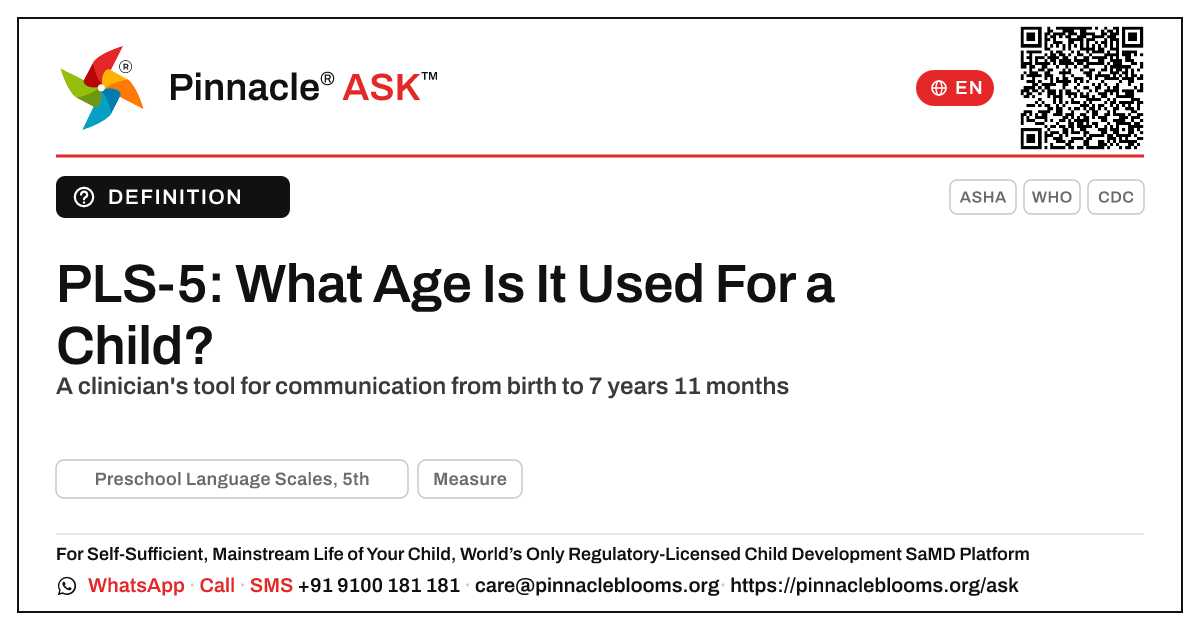
The Preschool Language Scales, 5th Edition (PLS-5) is a clinician-administered assessment used for children from birth (0 months) to 7 years 11 months. It measures two sides of early communication — auditory comprehension (understanding) and expressive communication (use of language). Because it spans the first weeks of life through the early school years, it offers a flexible way to map a young child's communication, but it measures skills rather than diagnosing a condition on its own.
In this answer 5 sections
A friendly question with a precise answer — the PLS-5 is built for the earliest years, from birth right through the preschool stage.
In short
The Preschool Language Scales, 5th Edition (PLS-5) is used for children from birth (0 months) up to 7 years 11 months. It is a clinician-administered tool that looks at two sides of early communication — how well a child understands language (auditory comprehension) and how well they use it (expressive communication). Because it spans the very first weeks of life through the early school years, it is a flexible way to map where a young child's communication is developing.
What the PLS-5 looks at
The PLS-5 is one of the most widely used early-language assessments precisely because it stretches across such a wide age band. For a tiny baby, the clinician observes early communication behaviours — responding to sounds, vocalising, attention to voices and faces. As a child grows into the toddler and preschool years, the same assessment shifts to look at understanding words and instructions, vocabulary, sentence-building, grammar and conversational use. A trained speech-language professional chooses the right starting point for your child's age and gently works through play-based and structured tasks, so the picture reflects what your child can genuinely do.
It is important to remember that the PLS-5 measures communication skills — it does not, on its own, diagnose a condition. It is one valuable piece of a wider developmental picture that a qualified clinician interprets alongside history, observation and other tools.
When it is typically used
A speech-language assessment such as the PLS-5 is often suggested when a parent or professional notices a child's listening or talking is developing more slowly than peers, or when an early review wants a clear baseline. Within the 0–7;11 range, it can be revisited over time to track progress as a child grows and as therapy support takes effect.
The Pinnacle way
This is general information, not a diagnosis — a clinical AbilityScore® and any diagnosis are formed only at a Pinnacle Blooms Network centre, under qualified clinician care, never from an app or form. Our therapists may use validated tools like the PLS-5 alongside their own observation, then build an individualised plan that often draws on speech therapy to support a child's communication.
Trusted sources
ASHA guidance on speech-language assessment in young children; WHO Nurturing Care Framework on early childhood development; CDC developmental milestone guidance on communication.
Next step — If you would like to understand your child's communication and whether a tool like the PLS-5 may help, book a developmental assessment with a Pinnacle Blooms Network speech-language clinician.
CONNECT THE ANSWER TO YOUR CHILD’S DAY
Something to notice. Something to discuss.
What to notice
Slower listening or talking than peers, limited response to voices in infancy, few words or short sentences in toddlers, or difficulty following instructions as a child approaches school.
In everyday life
Talk through your daily routines and pause to let your child respond — naming objects, asking simple questions and waiting builds both understanding and expression at every age within the PLS-5 range.
Bring your observations and questions to your child’s professional. Choose activities that suit your child’s comfort, abilities and agreed plan.
Bring your questions to a first visitQuestions families ask
What age range does the PLS-5 cover?
The PLS-5 is designed for children from birth (0 months) up to 7 years 11 months, making it usable from infancy through the early school years.
Does the PLS-5 diagnose a condition?
No. The PLS-5 measures a child's understanding and use of language. It is one piece of a wider picture that a qualified clinician interprets alongside history and observation; any diagnosis is formed only at a Pinnacle Blooms Network centre under clinician care.
What does the PLS-5 actually measure?
It looks at two areas: auditory comprehension (how well a child understands language) and expressive communication (how well a child uses language), adapted to the child's age.
FOLLOW THE SOURCE
References behind this answer.
- Source referenceASHA — speech and language development in children
- Organisation website · further readingWHO Nurturing Care Framework
- Source referenceCDC developmental milestones
References are supplied with this answer. An organisation homepage offers further reading; it does not establish an independent review of this page.
Content attribution: SETU Consortium · Pinnacle Blooms Network.
PEOPLE, TOPICS & DEVELOPMENT
See the connections.
Browse the wider question collections connected with this answer’s audience, developmental area and stage.
FROM UNDERSTANDING TO PURPOSEFUL SUPPORT
One question. Your child’s whole life.
Your child’s self-sufficient, mainstream-included life is the purpose from the beginning. At Pinnacle, that purpose shapes what we understand, the goals we choose, the people we bring together, everyday practice and review.
Connect this question with the right support.
Explore how the relevant service contributes to everyday abilities, then speak with us about your child.
Make the next conversation useful.
Bring the situations you notice at home or school. We’ll explain a suitable service, centre and first visit, including availability and fees, before you decide.
How PinnacleAI® connects the journeyExplore the seven stages
- 1Understand abilities
A starting picture of your child’s capabilities.
- 2Choose meaningful goals
Readiness and a plan shaped around the child.
- 3Bring the right support together
Suitable therapies and people for those goals.
- 4Carry practice into everyday life
Guidance for family, home and school.
- 5Track and correct
Use observations to adjust the plan.
- 6Reassess and review
Decide what to continue, change or do next.
- 7Grow independence and participation
The child’s life gives each step its purpose.
Explore the whole PinnacleAI® system → · Participation at school and in the community →
PINNACLE’S EVIDENCE, OPEN TO YOU
Look at the evidence behind our work.
Read our research, inspect the original regulatory documents and check what each institutional measure means.
General information supports a conversation with an appropriately qualified professional. Advice, goals and support depend on the individual child.