
YOUR QUESTION. A CLEARER NEXT STEP.
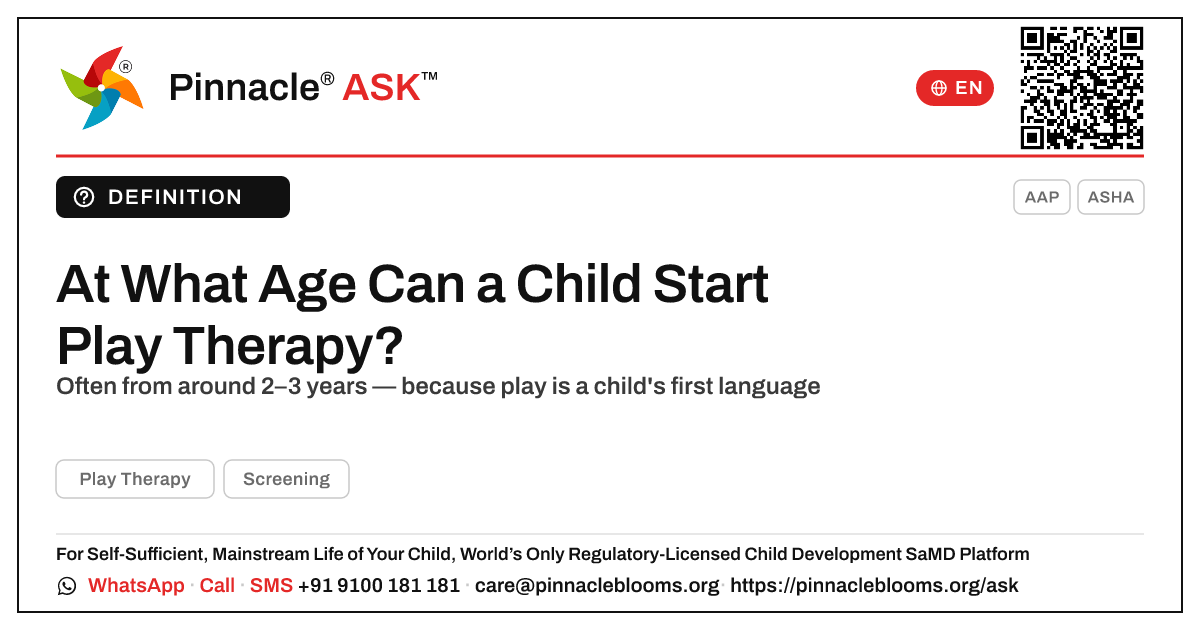
At what age can a child start play therapy?
Play therapy can begin as early as around 2–3 years of age, with approaches gently adapted for toddlers — and even younger children through parent-supported, relationship-based play. There is no single fixed starting age; what matters is the child's developmental stage, not their exact age. A therapist meets the child where they are, using play as the natural language through which children express feelings and build communication. An early developmental check helps decide the right starting point.
In this answer 5 sections
The wonderful truth about play therapy is that play is a child's first language — so a child can begin remarkably early, often as soon as they can engage with toys and a caring grown-up.
In short
Play therapy can begin as early as around 2–3 years of age, and many approaches are gently adapted for toddlers and even older infants through playful, relationship-based work with a parent alongside. There is no single fixed starting age — what matters is the child's developmental stage, not the number on a birthday card. A therapist meets your child exactly where they are, using play as the natural way children explore feelings, build communication and make sense of their world.
How age shapes play therapy
Because play is how young children think, feel and connect, the style of play therapy shifts with age rather than waiting for a particular birthday. For toddlers (roughly 2–3 years), sessions are warm, sensory and often parent-supported — bubbles, soft toys, simple turn-taking — building trust and early communication. For preschoolers and early-school children (around 3–10 years), play therapy comes into its own: pretend play, dolls, sand, art and stories let a child express what words cannot yet carry. Older children and pre-teens may use more structured, talk-and-activity blended approaches. For babies and very young infants, the focus is usually on nurturing parent–child interaction and early development rather than formal play therapy. The right starting point depends on your child's communication, attention, emotional needs and the goals you are working towards together.
When it helps to begin
There is no need to wait for a child to be 'old enough to understand'. If your young child is struggling with big emotions, changes at home, communication, social connection or behaviour, an early developmental check can help decide whether play therapy — or another supportive pathway — fits best. Beginning early simply means meeting your child in their most natural language.
The Pinnacle way
This is general information, not a diagnosis — a clinical AbilityScore® and any diagnosis are formed only at a Pinnacle Blooms Network centre, under qualified clinician care, never from an app or form. Across 70+ centres and 700+ therapists, our team observes how your child plays, communicates and connects, then shapes a warm, individualised plan that may weave together play therapy with other supports.
Trusted sources
The American Academy of Pediatrics and HealthyChildren on the central role of play in healthy child development; ASHA on play-based approaches that support early communication.
Next step — Curious whether play therapy suits your child right now? Book a friendly developmental screen and let our team guide you to the right, gentle starting point.
CONNECT THE ANSWER TO YOUR CHILD’S DAY
Something to notice. Something to discuss.
What to notice
Big emotions a child cannot yet manage, withdrawal or trouble connecting socially, regression after changes at home, communication or behaviour struggles, or a young child who seems overwhelmed — any of these are worth a gentle developmental review to decide if play therapy fits.
In everyday life
Make space for unstructured, child-led play each day — follow your child's lead, name the feelings you see ('you're so excited!'), and join in without correcting. This everyday playful connection is itself the foundation play therapy builds upon.
Bring your observations and questions to your child’s professional. Choose activities that suit your child’s comfort, abilities and agreed plan.
Bring your questions to a first visitQuestions families ask
Is my toddler too young for play therapy?
Not necessarily — play therapy is often adapted for children from around 2–3 years, with warm, parent-supported, sensory play. For babies and very young infants, the focus is usually on nurturing parent–child interaction rather than formal play therapy. A developmental check helps find the right starting point.
Does my child need to be able to talk for play therapy to work?
No. Play therapy works precisely because it uses play — not words — as a child's natural language. This makes it well-suited to young children who are still building communication, allowing them to express feelings through toys, art and pretend play.
Is there an age that is too old for play therapy?
Play therapy can support children through the early-school and pre-teen years, with the style becoming more structured and blended with talk and activities as children grow. The approach simply adapts to your child's developmental stage.
How do I know if play therapy is right for my child?
A friendly developmental screen at a Pinnacle Blooms Network centre helps our clinicians observe how your child plays, communicates and connects, then guide you toward play therapy or another supportive pathway that fits your child's needs.
FOLLOW THE SOURCE
References behind this answer.
- Source referenceHealthyChildren (AAP): the power of play in child development
- Source referenceASHA: developmental milestones and play-based communication
References are supplied with this answer. An organisation homepage offers further reading; it does not establish an independent review of this page.
Content attribution: SETU Consortium · Pinnacle Blooms Network.
PEOPLE, TOPICS & DEVELOPMENT
See the connections.
Browse the wider question collections connected with this answer’s audience, developmental area and stage.
FROM UNDERSTANDING TO PURPOSEFUL SUPPORT
One question. Your child’s whole life.
Your child’s self-sufficient, mainstream-included life is the purpose from the beginning. At Pinnacle, that purpose shapes what we understand, the goals we choose, the people we bring together, everyday practice and review.
Connect this question with the right support.
Start with your child’s strengths, your observations and what you want everyday life to become.
Make the next conversation useful.
Bring the situations you notice at home or school. We’ll explain a suitable service, centre and first visit, including availability and fees, before you decide.
How PinnacleAI® connects the journeyExplore the seven stages
- 1Understand abilities
A starting picture of your child’s capabilities.
- 2Choose meaningful goals
Readiness and a plan shaped around the child.
- 3Bring the right support together
Suitable therapies and people for those goals.
- 4Carry practice into everyday life
Guidance for family, home and school.
- 5Track and correct
Use observations to adjust the plan.
- 6Reassess and review
Decide what to continue, change or do next.
- 7Grow independence and participation
The child’s life gives each step its purpose.
Explore the whole PinnacleAI® system → · Participation at school and in the community →
PINNACLE’S EVIDENCE, OPEN TO YOU
Look at the evidence behind our work.
Read our research, inspect the original regulatory documents and check what each institutional measure means.
General information supports a conversation with an appropriately qualified professional. Advice, goals and support depend on the individual child.