
YOUR QUESTION. A CLEARER NEXT STEP.
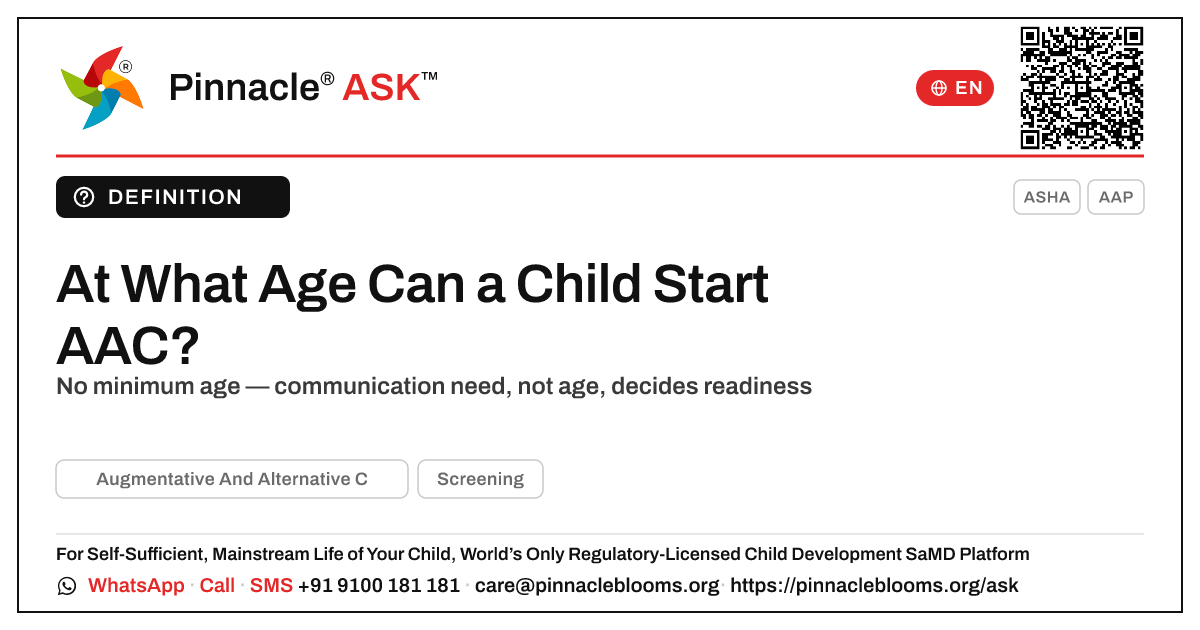
At what age can a child start AAC?
There is no minimum age for AAC — it can begin in the first year of life, decided by communication need rather than age. Gestures, signs, picture cards and speech-generating devices are introduced whenever a child has things to express but limited spoken words. Crucially, early AAC does not delay speech; evidence shows it supports and often encourages spoken language.
In this answer 5 sections
The question is rarely "is my child old enough?" — more often it is "can we give them a way to be heard right now?"
In short
There is no minimum age for augmentative and alternative communication (AAC). It can begin as early as the first year of life — gestures, pointing, simple picture cards, signs and speech-generating devices are all introduced when a child has things to say but limited spoken words to say them with. The principle is simple: communication need, not age, decides readiness. Starting early does not delay speech — the evidence shows AAC supports and often encourages spoken language.
When and why AAC begins
AAC is an umbrella term for every way of communicating that adds to or stands in for speech — from informal unaided methods (gestures, facial expression, sign) to aided methods (picture boards, symbol books, tablets and dedicated speech-generating devices). Because babies naturally communicate long before they talk, AAC can be woven in during infancy and toddlerhood whenever spoken words are slow to emerge or hard to use.
There are no prerequisites a child must "pass" first — your child does not need to prove certain skills before being given a voice. A speech and language therapist matches the method to your child's current abilities and interests, and the system grows with them. Early AAC reduces frustration, supports understanding, builds vocabulary and back-and-forth interaction, and creates a bridge towards speech for many children. It is used across many situations — late talking, motor-speech difficulties, autism, cerebral palsy and more.
When to seek a review
If your child is not using words or word-approximations to communicate by around 18 months, finds speech effortful or unclear, or is becoming frustrated trying to be understood, a speech and language assessment is worthwhile. The earlier a child has a reliable way to express needs and ideas, the more confidently they connect, learn and play.
The Pinnacle way
This is general information, not a diagnosis — a clinical AbilityScore® and any diagnosis are formed only at a Pinnacle Blooms Network centre, under qualified clinician care, never from an app or form. Our speech therapy team chooses and shapes the right AAC method for your child, then coaches the whole family to use it through everyday moments. Explore more on the home of our developmental network.
Trusted sources
The American Speech-Language-Hearing Association (ASHA) on AAC across the lifespan and the absence of age or skill prerequisites; AAP and HealthyChildren guidance on early communication milestones.
Next step — If your young child has plenty to say but few spoken words, book a speech and language review to explore AAC — there is no need to wait.
CONNECT THE ANSWER TO YOUR CHILD’S DAY
Something to notice. Something to discuss.
What to notice
Few or no words or word-approximations by around 18 months, effortful or unclear speech, growing frustration when trying to be understood, or limited back-and-forth communication — any of these is a reason to explore AAC with a speech and language therapist.
In everyday life
Treat communication as a two-way game: when you offer a picture, sign or device button, model using it yourself first (point and say the word as you do it) and pause expectantly — children learn AAC best by seeing the adults around them use it naturally.
Bring your observations and questions to your child’s professional. Choose activities that suit your child’s comfort, abilities and agreed plan.
Bring your questions to a first visitQuestions families ask
Is my child too young to start AAC?
No. There is no minimum age for AAC. Because babies communicate through gestures and expression long before they talk, AAC can be introduced in infancy and toddlerhood whenever a child has more to say than spoken words allow.
Will using AAC stop my child from learning to talk?
No — this is a common worry, but the evidence points the other way. AAC supports understanding, vocabulary and interaction, and for many children it helps speech emerge rather than holding it back.
Does my child need certain skills before starting AAC?
No prerequisites need to be "passed" first. A speech and language therapist matches the AAC method to your child's current abilities and interests, and the system grows alongside them.
FOLLOW THE SOURCE
References behind this answer.
- Source referenceASHA — Augmentative and Alternative Communication
- Source referenceHealthyChildren (AAP) — early communication milestones
References are supplied with this answer. An organisation homepage offers further reading; it does not establish an independent review of this page.
Content attribution: SETU Consortium · Pinnacle Blooms Network.
PEOPLE, TOPICS & DEVELOPMENT
See the connections.
Browse the wider question collections connected with this answer’s audience, developmental area and stage.
FROM UNDERSTANDING TO PURPOSEFUL SUPPORT
One question. Your child’s whole life.
Your child’s self-sufficient, mainstream-included life is the purpose from the beginning. At Pinnacle, that purpose shapes what we understand, the goals we choose, the people we bring together, everyday practice and review.
Connect this question with the right support.
Explore how the relevant service contributes to everyday abilities, then speak with us about your child.
Make the next conversation useful.
Bring the situations you notice at home or school. We’ll explain a suitable service, centre and first visit, including availability and fees, before you decide.
How PinnacleAI® connects the journeyExplore the seven stages
- 1Understand abilities
A starting picture of your child’s capabilities.
- 2Choose meaningful goals
Readiness and a plan shaped around the child.
- 3Bring the right support together
Suitable therapies and people for those goals.
- 4Carry practice into everyday life
Guidance for family, home and school.
- 5Track and correct
Use observations to adjust the plan.
- 6Reassess and review
Decide what to continue, change or do next.
- 7Grow independence and participation
The child’s life gives each step its purpose.
Explore the whole PinnacleAI® system → · Participation at school and in the community →
PINNACLE’S EVIDENCE, OPEN TO YOU
Look at the evidence behind our work.
Read our research, inspect the original regulatory documents and check what each institutional measure means.
General information supports a conversation with an appropriately qualified professional. Advice, goals and support depend on the individual child.