
YOUR QUESTION. A CLEARER NEXT STEP.
If a child isn't showing repetitive behaviours yet
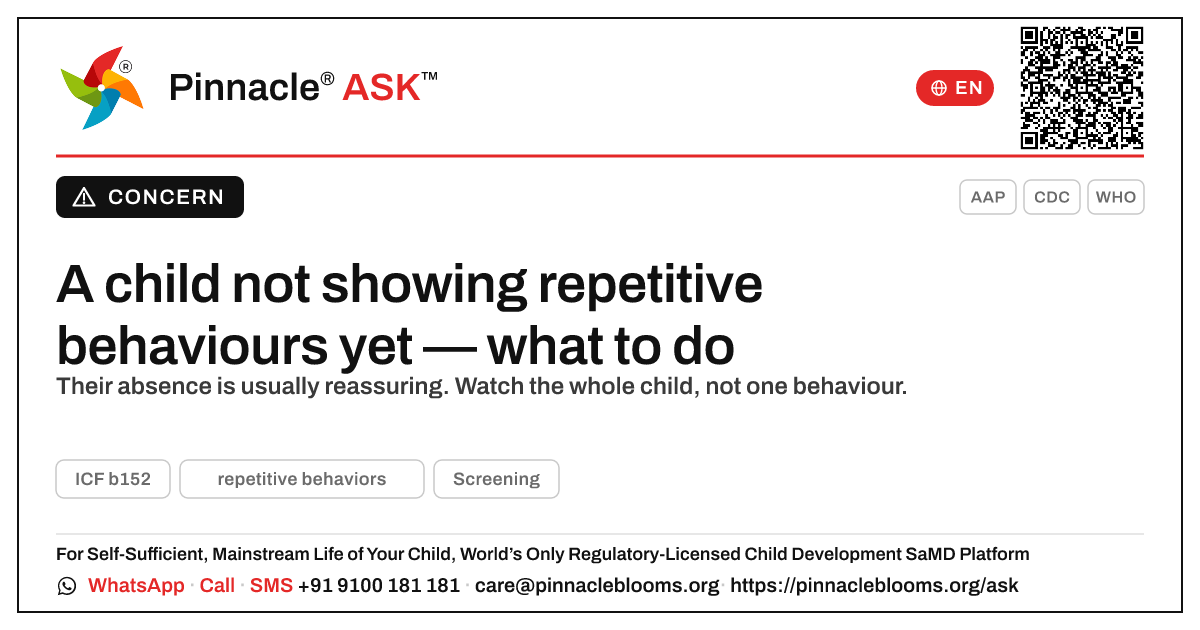
If a child you care for is not yet showing repetitive behaviours, this is usually reassuring rather than a concern — their absence on its own tells us little. Focus instead on the whole picture: communication, social connection, play and motor skills. Seek a gentle developmental check only if several of these areas seem delayed, not because repetitive behaviours are missing.
In this answer 5 sections
If a child in your care isn't showing repetitive behaviours yet, that is most often a calm, reassuring sign — not something to chase or worry about.
In short
Repetitive behaviours — rocking, flapping, lining things up, or repeating words — are common in early childhood, but their absence is not a problem to fix. Many children develop and thrive without showing them at all, and their presence or absence on its own tells us very little. What matters far more is the bigger picture: how the child plays, communicates, connects and explores. Keep watching that whole picture warmly, and seek a gentle developmental check only if other areas seem delayed.
What to watch instead
Rather than looking for repetitive behaviours, notice the strengths that show healthy development at any age:
- Communication — babbling, gestures, first words, or following simple requests as expected for age.
- Social connection — eye contact, shared smiles, responding to their name, pointing to show you things.
- Play and exploration — curiosity, trying new things, pretend play as they grow.
- Motor skills — reaching, sitting, crawling, walking on a typical timeline.
If these are unfolding well, the absence of repetitive movements is simply part of one child's unique, healthy pattern. Seek a developmental review if you notice delays across several of these areas, or if your instinct quietly says something is worth a closer look.
The science, gently
Repetitive behaviours (ICF b152, mental functions involving regulation) sit within a much wider developmental tapestry. They can be ordinary self-soothing, signs of excitement, or — when frequent, intense and paired with other differences — a flag for assessment. On their own, and especially when not present, they are rarely meaningful. Trust the whole child, not a single behaviour.
The Pinnacle way
A clinical AbilityScore® and any diagnosis are formed only at a Pinnacle Blooms Network centre, under qualified clinician care — never from an online checklist. You can read more about repetitive behaviours and, if any area of development needs support, our occupational therapy team can help nurture regulation and play.
Trusted sources
WHO ICF framework for mental functions (b152); American Academy of Pediatrics (healthychildren.org) guidance on developmental monitoring; CDC "Learn the Signs, Act Early" milestone resources.
Next step — Trust what you observe each day. Book a developmental check with a Pinnacle clinician for a calm, whole-picture review of the child's milestones.
This is general information, not a diagnosis — individual assessment and diagnosis require an appropriately qualified healthcare professional.
CONNECT THE ANSWER TO YOUR CHILD’S DAY
Something to notice. Something to discuss.
What to notice
Rather than looking for repetitive behaviours, watch the whole picture: babbling and words, eye contact and shared smiles, responding to name, pointing, curiosity and pretend play, and motor milestones. Seek a developmental review if several of these areas seem delayed or if your instinct says a closer look is wise.
In everyday life
Keep a short phone note of the child's everyday wins — a new word, a shared laugh, a wobbly first step. Tracking strengths gives you and any clinician a clear, reassuring picture of how the whole child is growing.
Bring your observations and questions to your child’s professional. Choose activities that suit your child’s comfort, abilities and agreed plan.
Bring your questions to a first visitQuestions families ask
Is it a problem if a child isn't showing any repetitive behaviours?
No. The absence of repetitive behaviours is not a concern in itself — many children develop and thrive without showing them. What matters is the wider picture of communication, social connection, play and movement.
Should I try to make a child show repetitive behaviours?
Not at all. These behaviours are not milestones to chase. Focus instead on nurturing play, language and connection, and let development unfold naturally.
When should I seek a developmental check?
Arrange a gentle check if you notice delays across several areas — few words, little eye contact, no pointing, or motor delays — or if your parent instinct says a closer look would be wise.
FOLLOW THE SOURCE
References behind this answer.
- Organisation website · further readingAAP HealthyChildren — developmental monitoring
- Source referenceCDC — Learn the Signs, Act Early
- Organisation website · further readingWHO ICF framework (b152)
References are supplied with this answer. An organisation homepage offers further reading; it does not establish an independent review of this page.
Content attribution: SETU Consortium · Pinnacle Blooms Network.
PEOPLE, TOPICS & DEVELOPMENT
See the connections.
Browse the wider question collections connected with this answer’s audience, developmental area and stage.
FROM UNDERSTANDING TO PURPOSEFUL SUPPORT
One question. Your child’s whole life.
Your child’s self-sufficient, mainstream-included life is the purpose from the beginning. At Pinnacle, that purpose shapes what we understand, the goals we choose, the people we bring together, everyday practice and review.
Connect this question with the right support.
Explore how the relevant service contributes to everyday abilities, then speak with us about your child.
Make the next conversation useful.
Bring the situations you notice at home or school. We’ll explain a suitable service, centre and first visit, including availability and fees, before you decide.
How PinnacleAI® connects the journeyExplore the seven stages
- 1Understand abilities
A starting picture of your child’s capabilities.
- 2Choose meaningful goals
Readiness and a plan shaped around the child.
- 3Bring the right support together
Suitable therapies and people for those goals.
- 4Carry practice into everyday life
Guidance for family, home and school.
- 5Track and correct
Use observations to adjust the plan.
- 6Reassess and review
Decide what to continue, change or do next.
- 7Grow independence and participation
The child’s life gives each step its purpose.
Explore the whole PinnacleAI® system → · Participation at school and in the community →
PINNACLE’S EVIDENCE, OPEN TO YOU
Look at the evidence behind our work.
Read our research, inspect the original regulatory documents and check what each institutional measure means.
General information supports a conversation with an appropriately qualified professional. Advice, goals and support depend on the individual child.