
YOUR QUESTION. A CLEARER NEXT STEP.
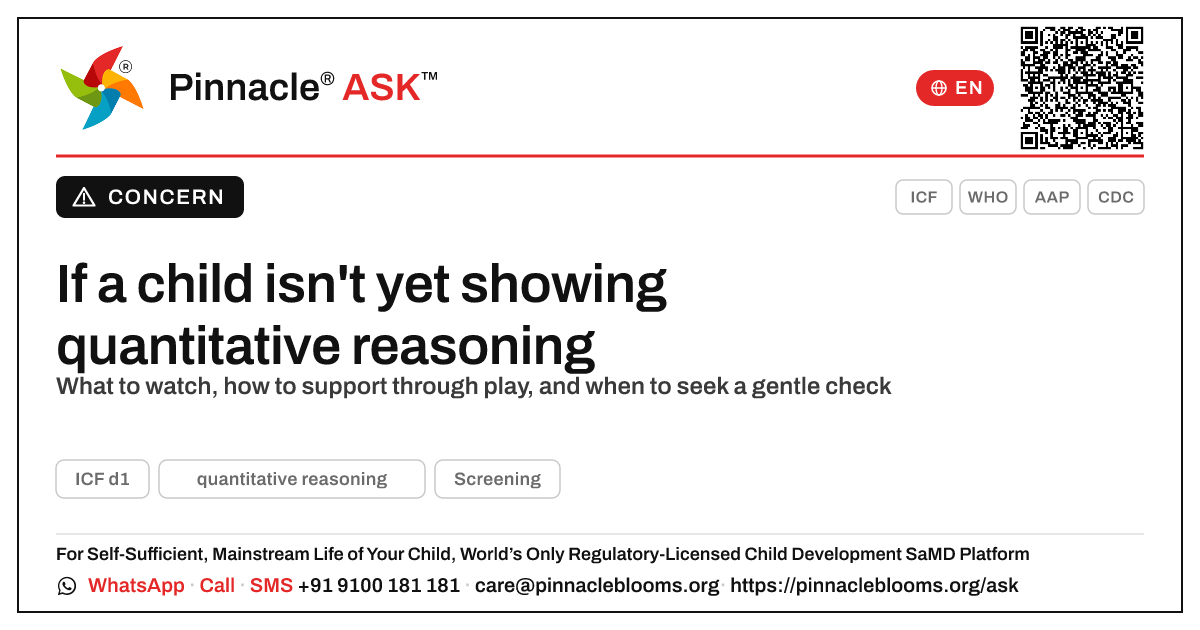
If a child isn't yet showing quantitative reasoning
Quantitative reasoning — counting, comparing, sequencing — develops gradually through everyday play, and children reach each step at their own pace. If a child isn't yet showing it, weave number talk into daily routines, watch how they engage over a few weeks, and arrange a developmental check if the gap is persistent or travels with delays in language, attention or play. This is a reason to support early, never a diagnosis.
In this answer 5 sections
Counting, comparing 'more' and 'less', spotting patterns — number sense grows step by step, and noticing where a child is now is thoughtful, caring observation.
In short
Quantitative reasoning — understanding numbers, quantity, sequence and comparison — develops gradually through everyday play, and children arrive at each step on their own timeline. If a child in your care isn't yet showing it, the loving, practical move is to weave counting and comparing into daily routines, watch how they engage over the next few weeks, and arrange a developmental check if number ideas seem persistently out of step with their age or other learning. This is a reason to look closely and support early — never a diagnosis.
What to watch
Number sense unfolds with rich play and language, so first notice how the child engages, not just what they 'know':
- Everyday number talk — do they join in counting steps, share out snacks 'one for you, one for me', or notice 'I have more'?
- Comparing and sorting — bigger/smaller, full/empty, matching shapes or grouping similar toys.
- Sequence and routine — following 'first, then, last' in daily activities.
- Travelling with other differences — if number struggles come alongside delays in talking, understanding instructions, attention or play, a clinician's gentle look is wise.
Remember that quantitative reasoning leans heavily on language and attention — so a child may simply need more playful exposure, not 'maths drills'. Keep it warm and unpressured.
When to seek a check
If the gap is persistent, widening, or the child seems frustrated or left behind in group learning, arrange a developmental check rather than waiting. What you observe day to day is valuable information for a clinician.
The Pinnacle way
A clinical AbilityScore® and any diagnosis are formed only at a Pinnacle Blooms Network centre, under qualified clinician care — never from an online list. Our team explores how quantitative reasoning connects to language, attention and play, and our special education team builds number sense through games the child genuinely enjoys.
Trusted sources
WHO ICF framework (chapter d1, learning and applying knowledge); American Academy of Pediatrics (healthychildren.org) guidance on early learning and developmental monitoring; CDC 'Learn the Signs, Act Early' milestone resources.
Next step — Trust what you've noticed. Book a developmental assessment with a Pinnacle clinician for a calm, clear picture of the child's early learning.
This is general information, not a diagnosis — individual assessment and diagnosis require an appropriately qualified healthcare professional.
CONNECT THE ANSWER TO YOUR CHILD’S DAY
Something to notice. Something to discuss.
What to notice
Notice whether the child joins in everyday counting, shares 'one for you, one for me', compares more/less or bigger/smaller, sorts and groups, and follows 'first-then-last' sequences. Seek a developmental check if number ideas are persistently out of step with age, the gap is widening, or they come alongside delays in talking, understanding instructions, attention or play.
In everyday life
Turn routines into number play — count the stairs as you climb, share out snacks 'one for you, one for me', or ask 'who has more?' at the table. Keep it playful and pressure-free; rich exposure matters more than drills.
Bring your observations and questions to your child’s professional. Choose activities that suit your child’s comfort, abilities and agreed plan.
Bring your questions to a first visitQuestions families ask
At what age should a child show quantitative reasoning?
Number sense emerges gradually — early steps like noticing 'more' and 'less' or counting along begin in the toddler and preschool years and keep growing through early school. There's a wide healthy range, so focus on steady progress and how the child engages, rather than a single deadline. A clinician can place a child's skills in the right age context for you.
Is not showing number skills a sign of a learning problem?
Not on its own. Many children simply need more playful exposure to counting and comparing. It deserves a developmental check when the gap is persistent or widening, or when it travels with delays in language, attention or following instructions — but this is a reason to look closely and support early, never a diagnosis.
How can I help build quantitative reasoning at home?
Weave numbers into daily life — count stairs, sort socks by colour, compare cup sizes, share snacks equally, and use words like more, less, bigger and first-then-last. Keep it light and game-like; children learn number sense best through enjoyable, repeated everyday play, not formal drills.
FOLLOW THE SOURCE
References behind this answer.
- Source referenceICF d1
- Source referenceWHO ICF — learning and applying knowledge (chapter d1)
- Organisation website · further readingAAP — early learning and developmental monitoring
- Source referenceCDC — Learn the Signs, Act Early milestones
References are supplied with this answer. An organisation homepage offers further reading; it does not establish an independent review of this page.
Content attribution: SETU Consortium · Pinnacle Blooms Network.
PEOPLE, TOPICS & DEVELOPMENT
See the connections.
Browse the wider question collections connected with this answer’s audience, developmental area and stage.
FROM UNDERSTANDING TO PURPOSEFUL SUPPORT
One question. Your child’s whole life.
Your child’s self-sufficient, mainstream-included life is the purpose from the beginning. At Pinnacle, that purpose shapes what we understand, the goals we choose, the people we bring together, everyday practice and review.
Connect this question with the right support.
Start with your child’s strengths, your observations and what you want everyday life to become.
Make the next conversation useful.
Bring the situations you notice at home or school. We’ll explain a suitable service, centre and first visit, including availability and fees, before you decide.
How PinnacleAI® connects the journeyExplore the seven stages
- 1Understand abilities
A starting picture of your child’s capabilities.
- 2Choose meaningful goals
Readiness and a plan shaped around the child.
- 3Bring the right support together
Suitable therapies and people for those goals.
- 4Carry practice into everyday life
Guidance for family, home and school.
- 5Track and correct
Use observations to adjust the plan.
- 6Reassess and review
Decide what to continue, change or do next.
- 7Grow independence and participation
The child’s life gives each step its purpose.
Explore the whole PinnacleAI® system → · Participation at school and in the community →
PINNACLE’S EVIDENCE, OPEN TO YOU
Look at the evidence behind our work.
Read our research, inspect the original regulatory documents and check what each institutional measure means.
General information supports a conversation with an appropriately qualified professional. Advice, goals and support depend on the individual child.