
YOUR QUESTION. A CLEARER NEXT STEP.
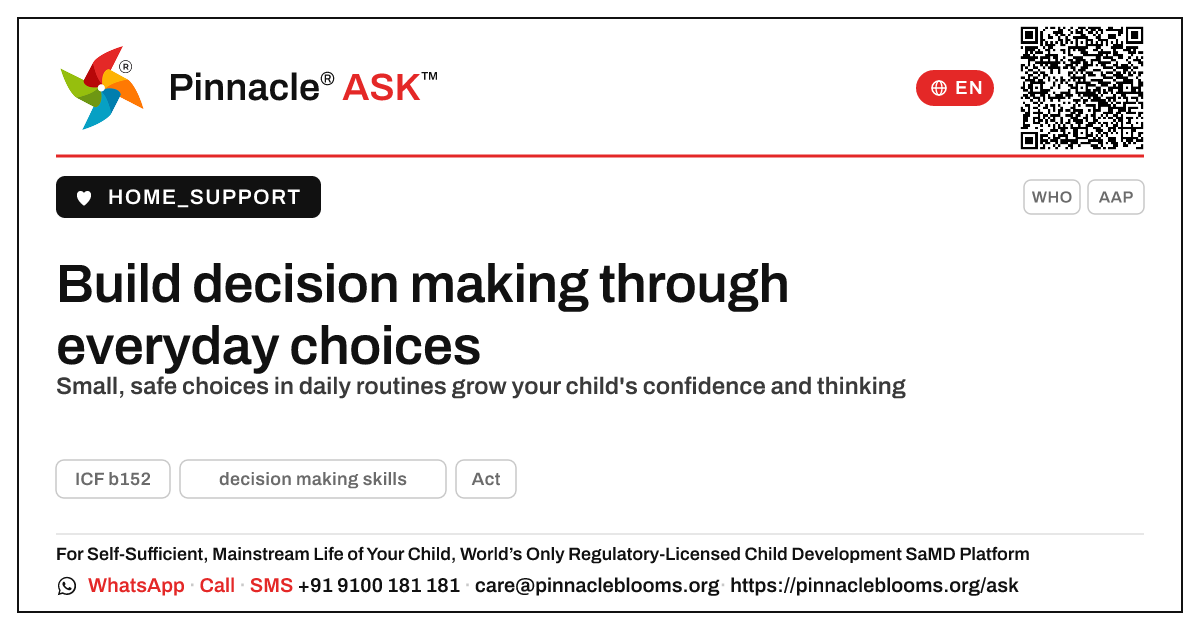
Helping your child practise decision making in daily routines
Help a child practise decision making by offering small, safe two-option choices within everyday routines — meals, dressing, play, bedtime. Give thinking time, honour the choice they make, and talk through the outcome afterwards. This low-pressure daily practice builds confidence and the brain pathways for weighing options.
In this answer 5 sections
Every small choice your child makes today — which cup, which song, which sock first — is quiet practice for the big decisions of tomorrow.
In short
You can build decision making skills gently by weaving small, real choices into ordinary routines — meals, dressing, play and bedtime. Start with two clear options, give your child time to choose, and let the choice stand. This everyday rhythm grows confidence, thinking and self-control without any pressure.
How to help during daily routines
Offer two-option choices. "Red cup or blue cup?" "Banana or apple?" Two choices feel safe and doable, where five can overwhelm. As your child grows, widen to three.
Build choosing into the day:
- Morning — which shirt, which breakfast, which way to walk to the gate
- Play — which game first, where to sit, what to build
- Bedtime — which story, which soft toy, lights bright or dim
Pause and wait. Count slowly to ten in your head. Decision making needs thinking time, and silence is your child's room to think.
Honour the choice. If they pick the blue cup, use the blue cup. Following through teaches that their decisions matter and have real, safe results.
Talk it through afterwards. "You chose the park — was that fun?" Naming the choice and its outcome helps your child connect deciding with what happens next.
The science, simply
Decision making (ICF b152) is a higher mental function that develops through repeated, low-stakes practice. Each safe choice strengthens the brain pathways for weighing options, predicting outcomes and tolerating the small discomfort of not getting everything. Routines make this powerful because the structure is familiar, so your child can spend their thinking energy on the choosing itself.
The Pinnacle way
Developmental measurement supports care planning; diagnosis requires an appropriately qualified healthcare professional., under the care of a qualified clinician — this home guidance supports everyday growth, it does not assess or diagnose. If choices feel consistently distressing or overwhelming for your child, our team can help. Explore occupational therapy, learn how the AbilityScore® gives a clear developmental picture, or read more about decision making skills.
Trusted sources
Guided by the WHO ICF framework (b152, higher-level cognitive functions) and child-development guidance from the American Academy of Pediatrics and its HealthyChildren resources on supporting independence and choice in young children.
Next step — start with one two-option choice at tomorrow's breakfast, or message our team on WhatsApp at +91 91001 81181 to find your nearest Pinnacle centre.
This is general information, not a diagnosis — individual assessment and diagnosis require an appropriately qualified healthcare professional.
CONNECT THE ANSWER TO YOUR CHILD’S DAY
Something to notice. Something to discuss.
What to notice
If your child seems consistently distressed, frozen or overwhelmed by even simple two-option choices, or avoids choosing altogether across settings, mention it at a developmental check rather than waiting.
In everyday life
At one routine each day, pause and offer just two choices — "this or that?" — then count slowly to ten and let your child decide without rushing or steering.
Bring your observations and questions to your child’s professional. Choose activities that suit your child’s comfort, abilities and agreed plan.
Bring your questions to a first visitQuestions families ask
At what age can my child start making choices?
Even toddlers around 18 months to 2 years can begin with simple two-option choices, like which cup or which fruit. Keep options few and concrete, and widen them gradually as your child grows and shows they can manage more.
What if my child keeps changing their mind?
That is normal early learning. Gently hold a friendly boundary — "you picked the apple, we'll have the banana tomorrow" — so your child experiences that choices have outcomes. Over time this steadies their decision making.
Should I let my child choose everything?
No — children feel safest when adults hold the big decisions and offer choices within those. You decide it's bath time; your child chooses which toy comes in. This balance grows independence without overwhelm.
FOLLOW THE SOURCE
References behind this answer.
- Organisation website · further readingWHO ICF — higher-level cognitive functions (b152)
- Organisation website · further readingAAP HealthyChildren — supporting independence and choices
- Organisation website · further readingAmerican Academy of Pediatrics — early development
References are supplied with this answer. An organisation homepage offers further reading; it does not establish an independent review of this page.
Content attribution: SETU Consortium · Pinnacle Blooms Network.
PEOPLE, TOPICS & DEVELOPMENT
See the connections.
Browse the wider question collections connected with this answer’s audience, developmental area and stage.
FROM UNDERSTANDING TO PURPOSEFUL SUPPORT
One question. Your child’s whole life.
Your child’s self-sufficient, mainstream-included life is the purpose from the beginning. At Pinnacle, that purpose shapes what we understand, the goals we choose, the people we bring together, everyday practice and review.
Connect this question with the right support.
Start with your child’s strengths, your observations and what you want everyday life to become.
Make the next conversation useful.
Bring the situations you notice at home or school. We’ll explain a suitable service, centre and first visit, including availability and fees, before you decide.
How PinnacleAI® connects the journeyExplore the seven stages
- 1Understand abilities
A starting picture of your child’s capabilities.
- 2Choose meaningful goals
Readiness and a plan shaped around the child.
- 3Bring the right support together
Suitable therapies and people for those goals.
- 4Carry practice into everyday life
Guidance for family, home and school.
- 5Track and correct
Use observations to adjust the plan.
- 6Reassess and review
Decide what to continue, change or do next.
- 7Grow independence and participation
The child’s life gives each step its purpose.
Explore the whole PinnacleAI® system → · Participation at school and in the community →
PINNACLE’S EVIDENCE, OPEN TO YOU
Look at the evidence behind our work.
Read our research, inspect the original regulatory documents and check what each institutional measure means.
General information supports a conversation with an appropriately qualified professional. Advice, goals and support depend on the individual child.