
YOUR QUESTION. A CLEARER NEXT STEP.
Successful adults who grew up non-verbal or minimally verbal
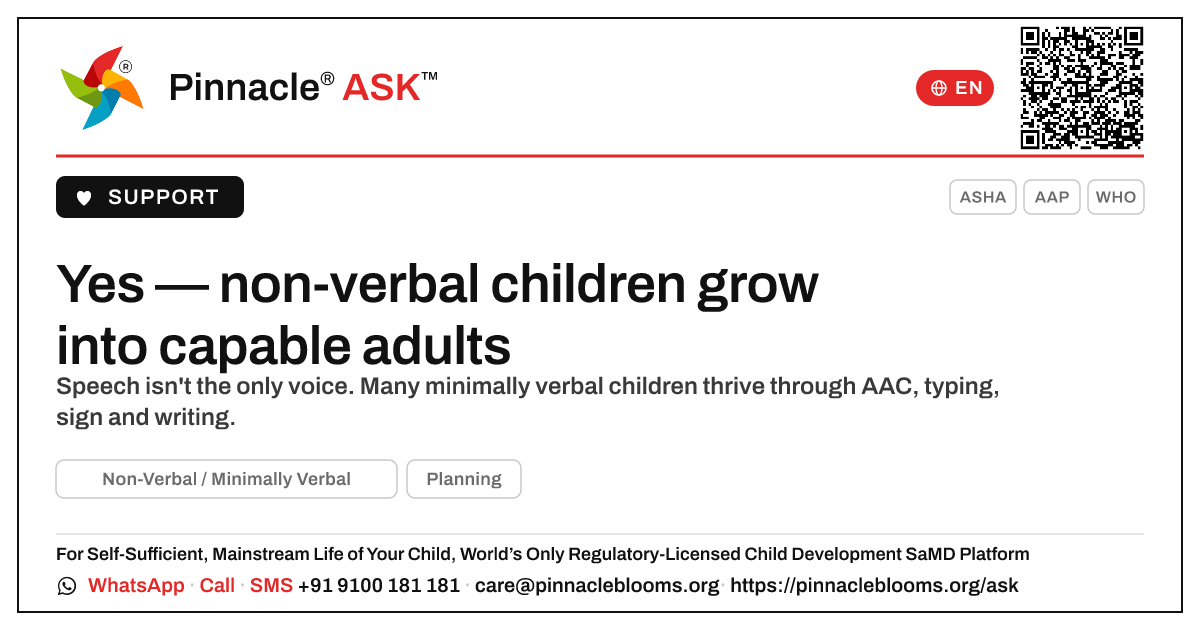
Yes — many children who were non-verbal or minimally verbal grow into capable, thriving adults who communicate through speech, typing, devices, sign or writing, and go on to study, work and build relationships. Being non-verbal does not mean having nothing to say or limited intelligence; the key is offering reliable, respectful communication channels early. AbilityScore® is part of Pinnacle’s developmental assessment. Diagnosis, where needed, requires an appropriately qualified healthcare professional.
In this answer 5 sections
Yes — many people who spoke few or no words as children have grown into confident, capable adults who communicate, work, create and lead in their own ways.
In short
Absolutely yes. Being non-verbal or minimally verbal in childhood does not mean a child has nothing to say or limited intelligence — it means spoken words are not yet their easiest path to communication. Many such children grow into thriving adults: some develop speech later, many become fluent communicators through typing, devices, sign or writing, and they go on to study, work, build relationships and contribute richly. The key is recognising early that communication is far bigger than speech and supporting every channel a child has.
What the journey can look like
Non-verbal and minimally verbal presentations cover a wide range, and so do the outcomes. What real-life stories and research tell us:
- Communication finds a way. Many adults who were minimally verbal as children communicate beautifully through AAC (augmentative and alternative communication) — speech-generating devices, tablets, picture systems, typing or sign. Some are published writers, advocates and speakers who type or use a device.
- Speech can still emerge. A meaningful number of children gain spoken language later than peers, including beyond the early years. Late does not mean never.
- Intelligence is not measured by speech. A child who cannot yet talk may understand far more than they can express. Honouring this — presuming competence — changes everything.
- Adult lives are full and varied. Employment, creative work, friendships, independent and supported living — minimally verbal adults are found across all of these, often when communication support started early and never stopped.
The single biggest predictor of a strong future is not whether speech arrives by a certain birthday — it is whether a child is given reliable, respectful ways to communicate now, and people who listen.
How support builds this future
Early, consistent communication support — building speech where it can grow, and offering AAC so a child is never left voiceless while they wait — gives children the tools to express needs, learn, connect and grow in confidence. Communication and independence skills together open the door to the adult lives families hope for.
The Pinnacle way
AbilityScore® is part of Pinnacle’s developmental assessment. Diagnosis, where needed, requires an appropriately qualified healthcare professional — never from an app or online form. Across 70+ centres and 700+ therapists, we begin by understanding exactly how your child communicates today and what will help most, through a clinician-administered structured assessment, then build a plan that grows every channel of communication via speech and language therapy — including AAC where it helps. The goal is always the same: a child who can be heard, and a future full of possibility.
Trusted sources
American Speech-Language-Hearing Association guidance on AAC and minimally verbal communicators; American Academy of Pediatrics (HealthyChildren.org) on supporting communication development; WHO Nurturing Care Framework on early support and participation.
Next step — Want to give your child every way to be heard? Book a communication assessment with a Pinnacle clinician.
This is general information, not a diagnosis — individual assessment and diagnosis require an appropriately qualified healthcare professional.
CONNECT THE ANSWER TO YOUR CHILD’S DAY
Something to notice. Something to discuss.
What to notice
Notice and celebrate every way your child already communicates — gestures, sounds, eye gaze, pointing, leading you by the hand or reaching for a device. Watch for whether they have a reliable, respected way to express needs and choices each day; if not, that is what to build first.
In everyday life
Presume competence — talk to your child about everything, just as you would any child, and give them a real way to respond (a picture, a device, a sign). Pause and truly wait for any reply; being listened to is the foundation of communication.
Bring your observations and questions to your child’s professional. Choose activities that suit your child’s comfort, abilities and agreed plan.
Bring your questions to a first visitQuestions families ask
Does being non-verbal mean my child has low intelligence?
No. Speech and intelligence are different things. Many non-verbal and minimally verbal people understand far more than they can express in words, and go on to demonstrate strong abilities through typing, devices or writing. Presuming competence — assuming your child understands and has things to say — matters enormously.
Can a child who is non-verbal still learn to talk later?
Sometimes, yes. A meaningful number of children gain spoken language later than peers, including beyond the early years. At the same time, supportive communication tools like AAC are offered now so a child is never left voiceless while speech may or may not develop — late does not mean never, and AAC does not stop speech from emerging.
What is AAC and will it stop my child from speaking?
AAC means augmentative and alternative communication — picture boards, speech-generating devices, tablets, typing or sign. Research consistently shows AAC supports communication and does not prevent speech from developing; many children use AAC alongside whatever spoken words they have. It gives a child a reliable voice today.
Where do I start if my child is minimally verbal?
Begin with a clinician-administered assessment at a Pinnacle Blooms Network centre to understand how your child communicates now and what will help most. From there, a speech and language therapy plan can build every communication channel — including AAC where it helps — so your child can be heard.
FOLLOW THE SOURCE
References behind this answer.
- Source referenceASHA — Augmentative and Alternative Communication (AAC)
- Source referenceAAP HealthyChildren — supporting communication development
- Organisation website · further readingWHO Nurturing Care Framework
References are supplied with this answer. An organisation homepage offers further reading; it does not establish an independent review of this page.
Content attribution: SETU Consortium · Pinnacle Blooms Network.
PEOPLE, TOPICS & DEVELOPMENT
See the connections.
Browse the wider question collections connected with this answer’s audience, developmental area and stage.
FROM UNDERSTANDING TO PURPOSEFUL SUPPORT
One question. Your child’s whole life.
Your child’s self-sufficient, mainstream-included life is the purpose from the beginning. At Pinnacle, that purpose shapes what we understand, the goals we choose, the people we bring together, everyday practice and review.
Connect this question with the right support.
Start with your child’s strengths, your observations and what you want everyday life to become.
Make the next conversation useful.
Bring the situations you notice at home or school. We’ll explain a suitable service, centre and first visit, including availability and fees, before you decide.
How PinnacleAI® connects the journeyExplore the seven stages
- 1Understand abilities
A starting picture of your child’s capabilities.
- 2Choose meaningful goals
Readiness and a plan shaped around the child.
- 3Bring the right support together
Suitable therapies and people for those goals.
- 4Carry practice into everyday life
Guidance for family, home and school.
- 5Track and correct
Use observations to adjust the plan.
- 6Reassess and review
Decide what to continue, change or do next.
- 7Grow independence and participation
The child’s life gives each step its purpose.
Explore the whole PinnacleAI® system → · Participation at school and in the community →
PINNACLE’S EVIDENCE, OPEN TO YOU
Look at the evidence behind our work.
Read our research, inspect the original regulatory documents and check what each institutional measure means.
General information supports a conversation with an appropriately qualified professional. Advice, goals and support depend on the individual child.