
YOUR QUESTION. A CLEARER NEXT STEP.
Are there successful adults who grew up with Fine Motor Delay?
Yes — many successful adults grew up with a fine motor delay. A delay in the small hand and finger movements describes where a child is today, not their future; with adaptable brains, supportive practice and occupational therapy, children build fluent hand skills and thrive in every field. AbilityScore® is part of Pinnacle’s developmental assessment. Diagnosis, where needed, requires an appropriately qualified healthcare professional.
In this answer 5 sections
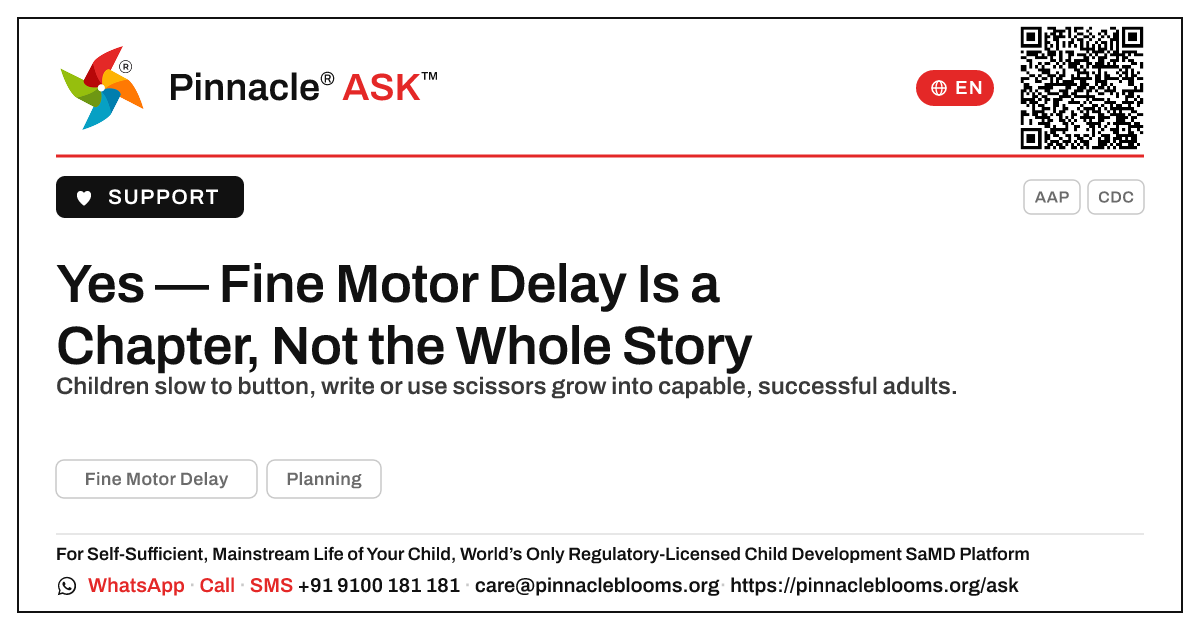
Yes — children who learn to button, write and tie laces a little later go on to become surgeons, artists, engineers and parents themselves.
In short
Absolutely yes. A fine motor delay in childhood — when the small hand and finger movements take longer to develop — does not set a ceiling on a child's future. With the right support, the brain and hands keep building skill, and countless adults who were once slow to hold a pencil, do up buttons or use scissors now thrive in careers, creativity and everyday life. A delay describes where a child is today, not who they will become.
Why a delay is not a destiny
Fine motor skills — the precise control of hands and fingers — develop along a wide, individual timeline. A delay simply means these skills are emerging more slowly, often for very fixable reasons: hand-muscle strength still building, coordination maturing, or fewer chances to practise.
- The brain is remarkably adaptable. Children's nervous systems are built to rewire and strengthen with practice — which is exactly why targeted therapy and everyday play make such a difference.
- Skill, not speed, is what lasts. Many adults reach full, fluent hand control simply on their own timeline; the early lag rarely leaves any lasting mark on capability.
- Strengths grow alongside. Children who find handwriting hard often shine in spoken language, problem-solving, sport or creativity — and adapt brilliantly to tools (keyboards, voice, assistive devices) that play to their strengths.
- Support compounds over time. Occupational therapy, purposeful play and patient practice steadily turn effort into ease, so skills that once felt hard become automatic.
The honest, hopeful truth is this: a fine motor delay is one chapter, not the whole story.
When a check helps
It is worth a developmental check if your child is well behind peers in tasks like grasping, scribbling, stacking, using cutlery or doing up buttons; if one hand is much weaker than the other; if skills seem to slip backwards; or if frustration around these tasks is affecting their confidence. Earlier support means easier, faster progress — and more enjoyment along the way.
The Pinnacle way
AbilityScore® is part of Pinnacle’s developmental assessment. Diagnosis, where needed, requires an appropriately qualified healthcare professional — never from an app or online form. Across 70+ centres in 4 states and 25 million+ therapy sessions, our therapists build each child's hand skills through playful, occupational therapy tailored to their own pace, beginning with a clear developmental profile. The goal is always the same: confident, capable hands for a confident future.
Trusted sources
American Academy of Pediatrics (HealthyChildren.org) guidance on motor milestones and developmental variation; CDC developmental milestone resources; American Occupational Therapy guidance on paediatric fine motor development.
Next step — Curious where your child stands today? Book a developmental assessment with a Pinnacle clinician.
This is general information, not a diagnosis — individual assessment and diagnosis require an appropriately qualified healthcare professional.
CONNECT THE ANSWER TO YOUR CHILD’S DAY
Something to notice. Something to discuss.
What to notice
Watch for being well behind peers in grasping, scribbling, stacking, using cutlery or buttoning; one hand much weaker than the other; skills slipping backwards; or frustration around hand tasks knocking your child's confidence.
In everyday life
Build hand strength through play, not pressure — let your child squeeze playdough, thread large beads, peel stickers, or pinch tweezers to pick up pom-poms. Small, fun, daily practice strengthens the very muscles handwriting needs.
Bring your observations and questions to your child’s professional. Choose activities that suit your child’s comfort, abilities and agreed plan.
Bring your questions to a first visitQuestions families ask
Can a child with fine motor delay grow up to have a normal career?
Yes. A fine motor delay describes a child's current pace of hand-skill development, not a lasting limit. With support and practice, children build fluent hand control and go on to careers across every field — including those needing fine dexterity.
Does fine motor delay mean my child is less intelligent?
No. Fine motor skills and intelligence are separate. Many bright, capable children simply develop hand control more slowly, and often show real strengths in language, reasoning, sport or creativity.
Will my child catch up?
Most children make strong progress, especially with playful practice and occupational therapy when needed. The brain is highly adaptable in childhood, so skills that feel hard now often become automatic with time and support.
When should I get my child checked?
Consider a developmental check if your child is well behind peers in grasping, drawing, stacking, using cutlery or buttoning, if one hand is much weaker, if skills slip backwards, or if frustration is affecting confidence. Earlier support means easier progress.
FOLLOW THE SOURCE
References behind this answer.
- Organisation website · further readingAAP HealthyChildren.org — developmental milestones and variation
- Source referenceCDC — developmental milestones
References are supplied with this answer. An organisation homepage offers further reading; it does not establish an independent review of this page.
Content attribution: SETU Consortium · Pinnacle Blooms Network.
PEOPLE, TOPICS & DEVELOPMENT
See the connections.
Browse the wider question collections connected with this answer’s audience, developmental area and stage.
FROM UNDERSTANDING TO PURPOSEFUL SUPPORT
One question. Your child’s whole life.
Your child’s self-sufficient, mainstream-included life is the purpose from the beginning. At Pinnacle, that purpose shapes what we understand, the goals we choose, the people we bring together, everyday practice and review.
Connect this question with the right support.
Explore how the relevant service contributes to everyday abilities, then speak with us about your child.
Make the next conversation useful.
Bring the situations you notice at home or school. We’ll explain a suitable service, centre and first visit, including availability and fees, before you decide.
How PinnacleAI® connects the journeyExplore the seven stages
- 1Understand abilities
A starting picture of your child’s capabilities.
- 2Choose meaningful goals
Readiness and a plan shaped around the child.
- 3Bring the right support together
Suitable therapies and people for those goals.
- 4Carry practice into everyday life
Guidance for family, home and school.
- 5Track and correct
Use observations to adjust the plan.
- 6Reassess and review
Decide what to continue, change or do next.
- 7Grow independence and participation
The child’s life gives each step its purpose.
Explore the whole PinnacleAI® system → · Participation at school and in the community →
PINNACLE’S EVIDENCE, OPEN TO YOU
Look at the evidence behind our work.
Read our research, inspect the original regulatory documents and check what each institutional measure means.
General information supports a conversation with an appropriately qualified professional. Advice, goals and support depend on the individual child.