
YOUR QUESTION. A CLEARER NEXT STEP.
Can children with Conduct-Dissocial Disorder become successful adults?
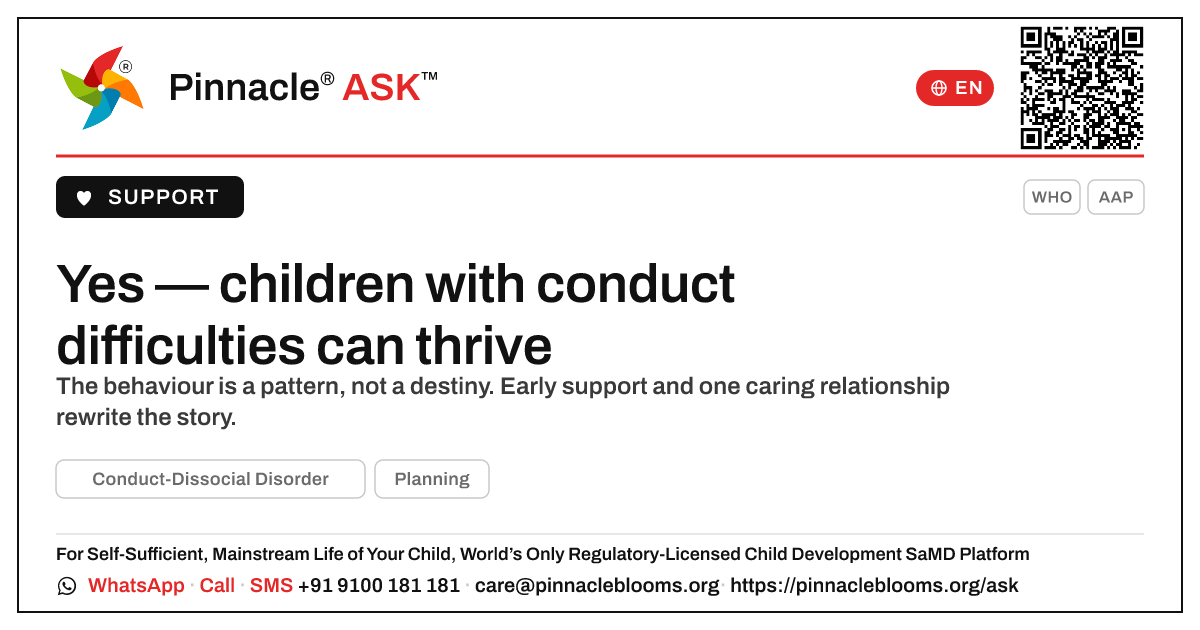
Yes — many children who showed Conduct-Dissocial Disorder grow into successful, contributing adults. The behaviour is a pattern at one point in time, not a fixed destiny; early understanding, consistent warm support and at least one caring relationship strongly improve long-term outcomes. AbilityScore® is part of Pinnacle’s developmental assessment. Diagnosis, where needed, requires an appropriately qualified healthcare professional.
In this answer 5 sections
Yes — a difficult childhood does not seal a child's fate. With the right understanding and support, children who once struggled with conduct difficulties go on to lead full, contributing, successful lives.
In short
Absolutely yes. Conduct-Dissocial Disorder describes a pattern of behaviour at one point in time — not a life sentence, and not who your child truly is. Many children who showed these difficulties grow into capable, warm, employed and respected adults, especially when they receive early understanding, consistent support and at least one steady, caring relationship. The behaviour is something a child does, not a fixed truth about who they will become.
What the science actually shows
Research on childhood conduct difficulties is genuinely hopeful, and it matters that parents hear this clearly:
- Most children do not carry these difficulties into adulthood. A large proportion of children with conduct difficulties show meaningful improvement as they mature, particularly with support, structure and a sense of belonging.
- One caring, stable relationship is protective. Decades of resilience research point to the same powerful factor — a child who has at least one adult who believes in them does dramatically better.
- Strengths often hide inside the struggle. The drive, intensity, courage and willingness to challenge that can look like "trouble" in childhood frequently become leadership, entrepreneurship, advocacy and determination in adulthood when channelled well.
- Early support changes the trajectory. The earlier a child receives understanding-based help — addressing underlying frustration, communication gaps, learning needs, trauma or unmet emotional needs — the better the long-term outcome.
So when you ask "are there successful adults?" — yes, and there are many. The story is still being written.
What helps a child reach that future
- Look beneath the behaviour — conduct difficulties often signal something underneath: difficulty communicating, learning struggles, big emotions without the tools to manage them, or experiences that have left a child feeling unsafe.
- Consistent, warm boundaries — predictability and calm limits, paired with real warmth, help a child feel secure enough to change.
- Build the missing skills — emotional regulation, problem-solving, social communication and a sense of competence can all be taught and strengthened over time.
- Support the whole family — parents need backing too; coaching reduces conflict at home and helps everyone find a calmer rhythm.
The Pinnacle way
AbilityScore® is part of Pinnacle’s developmental assessment. Diagnosis, where needed, requires an appropriately qualified healthcare professional — never from an app, a checklist or an online form. Our clinicians look at the whole child — strengths as much as struggles — to understand what is driving the behaviour and build a plan around your child's real potential. Begin with a clear understanding of your child's profile, explore behaviour and emotional-regulation support, and see how we walk alongside families at every step.
Trusted sources
WHO ICD-11 framing of conduct-dissocial disorder as a behavioural pattern; American Academy of Pediatrics (HealthyChildren.org) guidance on child behaviour and resilience; WHO Nurturing Care framework on the protective power of responsive caregiving.
Next step — Want to understand your child's strengths and build a hopeful plan? Book a developmental assessment with a Pinnacle clinician.
This is general information, not a diagnosis — individual assessment and diagnosis require an appropriately qualified healthcare professional.
CONNECT THE ANSWER TO YOUR CHILD’S DAY
Something to notice. Something to discuss.
What to notice
Watch for whether your child has at least one steady, trusting relationship, whether the behaviour is easing or escalating over time, and any underlying drivers — communication gaps, learning struggles, big unmanaged emotions or distressing experiences — that support can address.
In everyday life
Catch and name one positive thing your child does each day, however small — consistent warmth alongside calm boundaries helps a child feel secure enough to grow and change.
Bring your observations and questions to your child’s professional. Choose activities that suit your child’s comfort, abilities and agreed plan.
Bring your questions to a first visitQuestions families ask
Does Conduct-Dissocial Disorder in childhood last into adulthood?
Not for most children. A large proportion show meaningful improvement as they mature, especially with early understanding, consistent support and a stable caring relationship. The childhood pattern is not a fixed life sentence.
What is the single biggest protective factor?
At least one steady, caring adult who believes in the child. Resilience research consistently shows that this one relationship dramatically improves long-term outcomes.
Can the traits behind the behaviour ever be a strength?
Often, yes. Intensity, drive, courage and a willingness to challenge can become leadership, determination and advocacy in adulthood when understood and channelled well.
What should we do now to help our child's future?
Seek early support that looks beneath the behaviour, build emotional and social skills, keep warm consistent boundaries, and get coaching for the family. Starting with a clinician-led assessment helps shape the right plan.
FOLLOW THE SOURCE
References behind this answer.
- Organisation website · further readingWHO ICD-11: conduct-dissocial disorder as a behavioural pattern
- Organisation website · further readingAAP HealthyChildren.org: child behaviour and resilience
- Organisation website · further readingWHO Nurturing Care: responsive caregiving as protection
References are supplied with this answer. An organisation homepage offers further reading; it does not establish an independent review of this page.
Content attribution: SETU Consortium · Pinnacle Blooms Network.
PEOPLE, TOPICS & DEVELOPMENT
See the connections.
Browse the wider question collections connected with this answer’s audience, developmental area and stage.
FROM UNDERSTANDING TO PURPOSEFUL SUPPORT
One question. Your child’s whole life.
Your child’s self-sufficient, mainstream-included life is the purpose from the beginning. At Pinnacle, that purpose shapes what we understand, the goals we choose, the people we bring together, everyday practice and review.
Connect this question with the right support.
Start with your child’s strengths, your observations and what you want everyday life to become.
Make the next conversation useful.
Bring the situations you notice at home or school. We’ll explain a suitable service, centre and first visit, including availability and fees, before you decide.
How PinnacleAI® connects the journeyExplore the seven stages
- 1Understand abilities
A starting picture of your child’s capabilities.
- 2Choose meaningful goals
Readiness and a plan shaped around the child.
- 3Bring the right support together
Suitable therapies and people for those goals.
- 4Carry practice into everyday life
Guidance for family, home and school.
- 5Track and correct
Use observations to adjust the plan.
- 6Reassess and review
Decide what to continue, change or do next.
- 7Grow independence and participation
The child’s life gives each step its purpose.
Explore the whole PinnacleAI® system → · Participation at school and in the community →
PINNACLE’S EVIDENCE, OPEN TO YOU
Look at the evidence behind our work.
Read our research, inspect the original regulatory documents and check what each institutional measure means.
General information supports a conversation with an appropriately qualified professional. Advice, goals and support depend on the individual child.