
YOUR QUESTION. A CLEARER NEXT STEP.
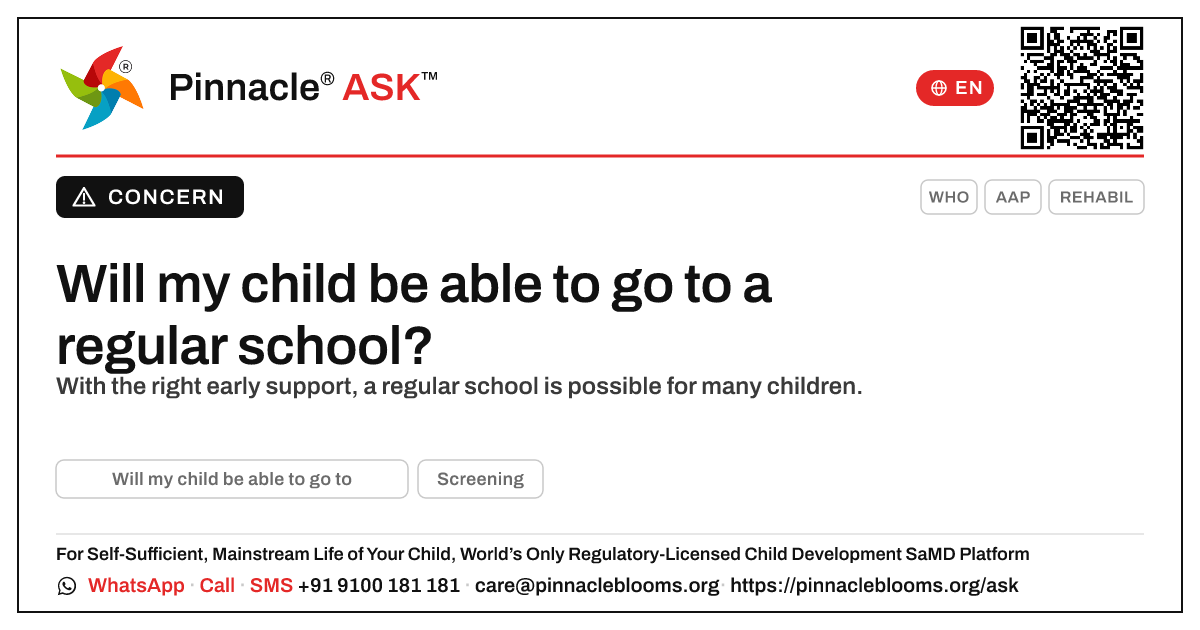
Will my child be able to go to a regular school?
For most children with developmental differences, a regular school is very possible with the right understanding and support, and inclusive education is a recognised right in India. What matters most is starting early to build communication, learning, attention and self-help skills, and matching the school to your child's strengths. No online answer can predict your child's path — but a clinician's clear picture of where they are now is the first step towards school readiness.
In this answer 5 sections
The question every parent carries quietly — and the honest answer is that a great many children do, and many more thrive with the right support around them.
In short
For most children with developmental differences, the answer is yes — with the right understanding and support, a regular school is very possible, and inclusive education is a recognised right in India under the RPwD Act. What matters far more than a single prediction is starting early, building your child's communication, learning and self-help skills, and matching the school to your child's strengths. No online answer can tell you the path for your child — but a clear picture of where they are now is the first step towards school readiness.
What shapes the answer
School readiness is not one switch — it is a set of growing skills, and almost all of them respond beautifully to early support:
- Communication — being able to express needs, follow simple instructions and connect with peers and teachers.
- Attention and play — staying with a task, sitting in a group, and learning alongside other children.
- Self-help — toileting, eating, managing belongings — the everyday independence that helps a child settle into a classroom.
- Learning foundations — early pre-academic skills that build towards reading, numbers and writing.
Many children attend mainstream schools with reasonable accommodations — a shadow or learning support assistant, an individualised plan, small adjustments to how lessons are presented. Others flourish in inclusive settings designed around varied learners. The right answer is the one shaped around your child, not around a label.
How early support changes the path
The earlier a child's strengths and needs are understood, the more the developing brain can build on therapy, play and practice. Speech, occupational and behavioural support, started early, often make the difference between struggling at the classroom door and walking through it ready. School readiness is something we build towards — together, step by step.
The Pinnacle way
A clinical AbilityScore® and any diagnosis are formed only at a Pinnacle Blooms Network centre, under qualified clinician care — never from an online answer. Our clinicians map your child's communication, learning and independence skills, then build a school-readiness plan around their strengths. Explore how our speech therapy and occupational therapy teams help children prepare for the classroom, and start here to understand your child's path.
Trusted sources
World Health Organization guidance on inclusive early childhood development and nurturing care; American Academy of Pediatrics (healthychildren.org) on developmental support and school readiness; Rehabilitation Council of India (rehabcouncil.nic.in) on inclusive education and the rights of children with disabilities in India.
Next step — You don't have to guess. Book a developmental assessment with a Pinnacle clinician to understand your child's strengths and map a calm, clear path towards school.
This is general information, not a diagnosis — individual assessment and diagnosis require an appropriately qualified healthcare professional.
CONNECT THE ANSWER TO YOUR CHILD’S DAY
Something to notice. Something to discuss.
What to notice
Look at how your child communicates needs, follows simple instructions, attends to a task, plays alongside others, and manages everyday self-help like toileting and eating. These growing skills shape school readiness far more than any single label — and all respond well to early support.
In everyday life
Build little classroom moments at home: sitting together for a short story, taking turns in a game, or following a two-step instruction. These gentle, playful routines grow the very skills that help a child settle into school.
Bring your observations and questions to your child’s professional. Choose activities that suit your child’s comfort, abilities and agreed plan.
Bring your questions to a first visitQuestions families ask
Can a child with a developmental delay attend a regular school?
Very often, yes. Many children with developmental differences attend mainstream schools with reasonable accommodations such as a learning support assistant or an individualised plan. Inclusive education is a recognised right in India under the RPwD Act. Early support to build communication, attention and self-help skills greatly improves school readiness.
What skills make a child ready for school?
School readiness is a set of growing skills: communicating needs and following instructions, attending to a task and playing in a group, everyday independence like toileting and eating, and early pre-academic foundations. Almost all of these respond well to early therapy and play-based support.
How early should I start preparing my child for school?
The earlier the better. The developing brain builds powerfully on early therapy, play and practice, so starting now — rather than waiting — gives your child the strongest foundation. A clinician can map your child's strengths and shape a school-readiness plan around them.
FOLLOW THE SOURCE
References behind this answer.
- Organisation website · further readingWHO nurturing care framework for early childhood development
- Organisation website · further readingAAP guidance on developmental support and school readiness
- Organisation website · further readingRehabilitation Council of India — inclusive education
References are supplied with this answer. An organisation homepage offers further reading; it does not establish an independent review of this page.
Content attribution: SETU Consortium · Pinnacle Blooms Network.
PEOPLE, TOPICS & DEVELOPMENT
See the connections.
Browse the wider question collections connected with this answer’s audience, developmental area and stage.
FROM UNDERSTANDING TO PURPOSEFUL SUPPORT
One question. Your child’s whole life.
Your child’s self-sufficient, mainstream-included life is the purpose from the beginning. At Pinnacle, that purpose shapes what we understand, the goals we choose, the people we bring together, everyday practice and review.
Connect this question with the right support.
Explore how the relevant service contributes to everyday abilities, then speak with us about your child.
Make the next conversation useful.
Bring the situations you notice at home or school. We’ll explain a suitable service, centre and first visit, including availability and fees, before you decide.
How PinnacleAI® connects the journeyExplore the seven stages
- 1Understand abilities
A starting picture of your child’s capabilities.
- 2Choose meaningful goals
Readiness and a plan shaped around the child.
- 3Bring the right support together
Suitable therapies and people for those goals.
- 4Carry practice into everyday life
Guidance for family, home and school.
- 5Track and correct
Use observations to adjust the plan.
- 6Reassess and review
Decide what to continue, change or do next.
- 7Grow independence and participation
The child’s life gives each step its purpose.
Explore the whole PinnacleAI® system → · Participation at school and in the community →
PINNACLE’S EVIDENCE, OPEN TO YOU
Look at the evidence behind our work.
Read our research, inspect the original regulatory documents and check what each institutional measure means.
General information supports a conversation with an appropriately qualified professional. Advice, goals and support depend on the individual child.