
YOUR QUESTION. A CLEARER NEXT STEP.
Can my child with special needs join a regular school?
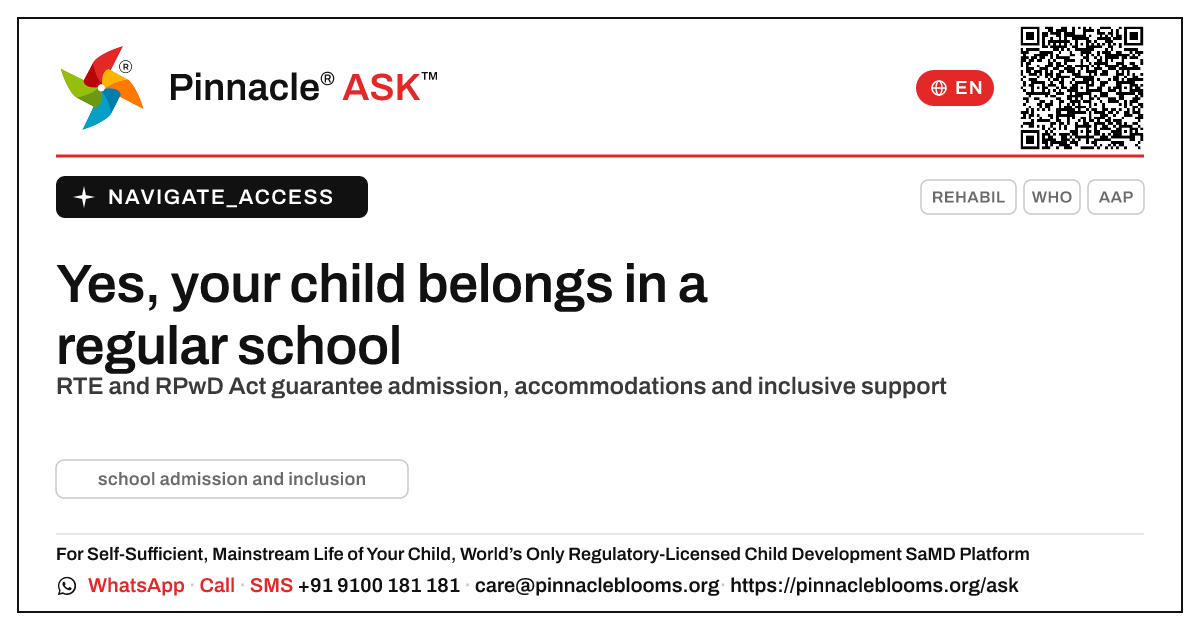
Yes — under India's RTE Act and the RPwD Act 2016, a child with special needs has a legal right to admission in a regular neighbourhood school and to reasonable accommodations, an IEP and resource support. Schools cannot refuse on grounds of disability. A clinician-prepared developmental profile helps the school plan effective support.
In this answer 4 sections
Yes — and not as a favour, but as your child's right under Indian law.
In short
Yes. Your child with special needs can be admitted to a regular neighbourhood school and is legally entitled to support there. The Right to Education (RTE) Act and the Rights of Persons with Disabilities (RPwD) Act, 2016 together guarantee free admission, reasonable accommodations and inclusive education up to age 18 — schools cannot refuse a child on grounds of disability. The goal is not to make your child fit the school, but to make the school work for your child.
What inclusion actually means
Inclusive education means your child learns alongside peers in the same classroom, with support built around them — not in a separate room. In practice this can include:
- Reasonable accommodations — extra time, scribes, seating, sensory breaks, modified assessment.
- An Individualised Education Plan (IEP) describing goals, supports and how progress is tracked.
- Special educators and resource support that many schools are mandated to provide or arrange.
- A disability certificate (UDID), which strengthens entitlements and eases admission, though admission cannot be denied for lack of one.
Many families do best with a clear developmental profile in hand — it turns a vague "my child needs help" into a specific, actionable list the school can deliver against. That same profile guides whether your child also benefits from therapy support running alongside school.
The Pinnacle way
AbilityScore® is part of Pinnacle’s developmental assessment. Diagnosis, where needed, requires an appropriately qualified healthcare professional — never from an online form. With that structured assessment, our team can prepare the developmental summary and recommendations a school needs to plan accommodations, and support you through school admission and inclusion. To understand the baseline that shapes those recommendations, see how the AbilityScore is established. Across 70+ centres in 4 states, 4.95 lakh+ families have walked this path with us.
Trusted sources
Rehabilitation Council of India guidance on the RPwD Act and inclusive education; WHO and UNICEF nurturing-care guidance on participation and inclusion; AAP healthychildren.org guidance on supporting children in school settings.
Next step — Bring your concerns to a Pinnacle clinician who can build the developmental profile your school needs. Book an assessment.
This is general information, not a diagnosis — individual assessment and diagnosis require an appropriately qualified healthcare professional.
CONNECT THE ANSWER TO YOUR CHILD’S DAY
Something to notice. Something to discuss.
What to notice
Watch how your child copes once admitted: are accommodations actually being used, is your child participating and progressing, and is the IEP reviewed regularly? Persistent distress, exclusion from activities, or no support plan are signs to raise with the school and seek a developmental review.
In everyday life
Keep one folder with your child's developmental summary, any disability (UDID) certificate and the school's written accommodation plan. Walking into admission meetings with documents in hand changes the whole conversation.
Bring your observations and questions to your child’s professional. Choose activities that suit your child’s comfort, abilities and agreed plan.
Bring your questions to a first visitQuestions families ask
Can a school legally refuse to admit my child because of a disability?
No. Under the RTE Act and the Rights of Persons with Disabilities Act, 2016, schools cannot deny admission to a child on grounds of disability. Inclusive education up to age 18 is a legal entitlement, and refusal can be formally challenged.
Do I need a disability certificate before applying?
Admission cannot be denied for not having one, but a UDID disability certificate strengthens your child's entitlements and makes accommodations easier to arrange. A clinician-prepared developmental profile is also valuable for planning support.
What kind of support can my child receive in a regular school?
Reasonable accommodations such as extra time, a scribe, modified assessment, sensory breaks and seating; an Individualised Education Plan (IEP) with tracked goals; and access to special educators or resource support that schools are expected to arrange.
FOLLOW THE SOURCE
References behind this answer.
- Organisation website · further readingRehabilitation Council of India — RPwD Act and inclusive education
- Organisation website · further readingWHO/UNICEF Nurturing Care Framework — participation and inclusion
- Organisation website · further readingAAP healthychildren.org — supporting children at school
References are supplied with this answer. An organisation homepage offers further reading; it does not establish an independent review of this page.
Content attribution: SETU Consortium · Pinnacle Blooms Network.
PEOPLE, TOPICS & DEVELOPMENT
See the connections.
Browse the wider question collections connected with this answer’s audience, developmental area and stage.
FROM UNDERSTANDING TO PURPOSEFUL SUPPORT
One question. Your child’s whole life.
Your child’s self-sufficient, mainstream-included life is the purpose from the beginning. At Pinnacle, that purpose shapes what we understand, the goals we choose, the people we bring together, everyday practice and review.
Connect this question with the right support.
Explore how the relevant service contributes to everyday abilities, then speak with us about your child.
Make the next conversation useful.
Bring the situations you notice at home or school. We’ll explain a suitable service, centre and first visit, including availability and fees, before you decide.
How PinnacleAI® connects the journeyExplore the seven stages
- 1Understand abilities
A starting picture of your child’s capabilities.
- 2Choose meaningful goals
Readiness and a plan shaped around the child.
- 3Bring the right support together
Suitable therapies and people for those goals.
- 4Carry practice into everyday life
Guidance for family, home and school.
- 5Track and correct
Use observations to adjust the plan.
- 6Reassess and review
Decide what to continue, change or do next.
- 7Grow independence and participation
The child’s life gives each step its purpose.
Explore the whole PinnacleAI® system → · Participation at school and in the community →
PINNACLE’S EVIDENCE, OPEN TO YOU
Look at the evidence behind our work.
Read our research, inspect the original regulatory documents and check what each institutional measure means.
General information supports a conversation with an appropriately qualified professional. Advice, goals and support depend on the individual child.