
YOUR QUESTION. A CLEARER NEXT STEP.
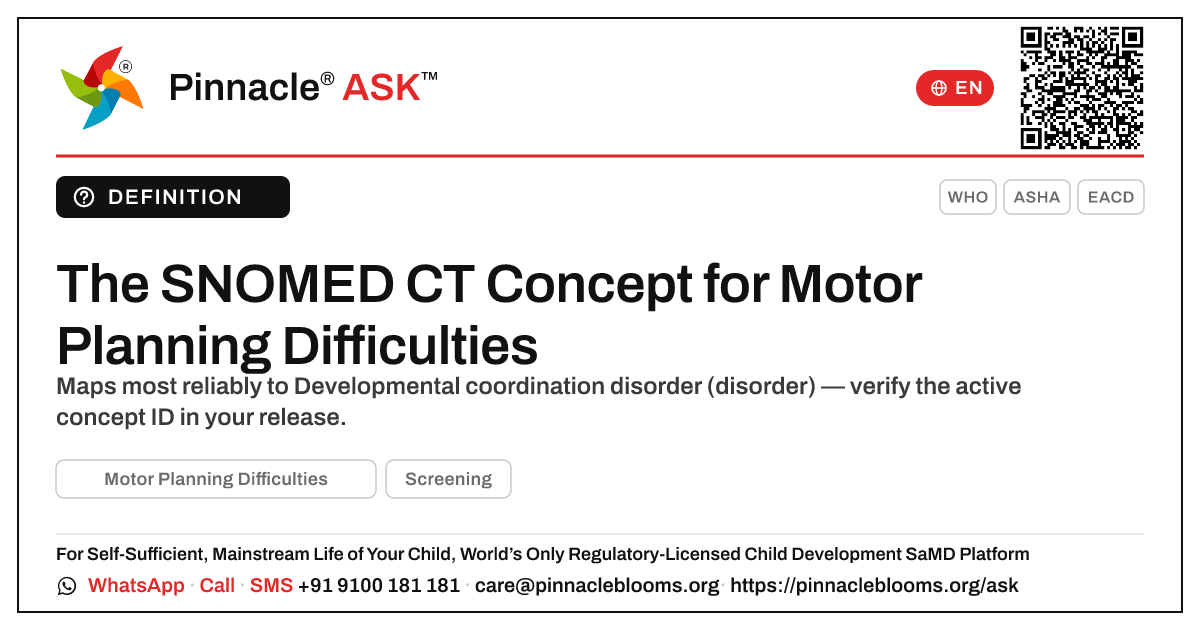
SNOMED CT Concept for Motor Planning Difficulties
There is no SNOMED CT concept titled exactly 'Motor Planning Difficulties.' The clinically appropriate mapping is Developmental coordination disorder (disorder), which encompasses praxis/dyspraxia presentations; specific praxis deficits may also be coded under Dyspraxia/apraxia. Always confirm the active concept ID in your current SNOMED CT release.
In this answer 5 sections
A code that maps cleanly to a clinical record is what turns an observation about a child's coordination into a shared, trackable concept.
In short
There is no single SNOMED CT concept literally titled "Motor Planning Difficulties." The clinically appropriate concept depends on what is being captured: the closest established entity is Developmental coordination disorder (disorder) within SNOMED CT, which encompasses the praxis and motor-planning impairments commonly labelled dyspraxia. Where the presentation is specifically a praxis deficit, clinicians may also document it as Dyspraxia (disorder) / apraxia-related findings. Always confirm the active concept ID and hierarchy in your current SNOMED CT release rather than relying on a remembered code.
The clinical picture
"Motor planning difficulty" is a descriptive term, not a formal nosological label — it denotes impaired praxis: the capacity to conceive, organise and execute a novel, goal-directed sequence of movements. In SNOMED CT this maps most reliably to:
- Developmental coordination disorder — when motor planning and coordination are below expected for age and materially affect daily function, in the absence of a general medical or neurological cause.
- Dyspraxia / apraxia concepts — when the praxis component is the documented focus, distinguishing developmental from acquired forms.
For cross-walking to ICD-11, the corresponding entity is Developmental motor coordination disorder (foundation code under neurodevelopmental disorders). Verify both the SNOMED CT concept ID and any ICD map within your jurisdiction's current edition, as concept IDs are release-dependent and the SNOMED CT–ICD map is maintained separately.
When to refer
Refer when motor planning concerns are persistent across settings, interfere with self-care, handwriting, dressing or play, and are not explained by a primary neurological, visual or intellectual cause. Co-occurring speech, attention or sensory-processing concerns warrant a combined developmental assessment rather than an isolated motor referral.
The Pinnacle way
Developmental measurement supports care planning; diagnosis requires an appropriately qualified healthcare professional., under qualified clinician care — never from a code, a form or an app. Our clinicians link the documented SNOMED CT concept to a structured, clinician-administered functional profile so motor planning is measured the same way each visit. Explore occupational therapy for praxis and coordination support, or start at our network overview.
Trusted sources
WHO ICD-11 (Developmental motor coordination disorder); SNOMED International concept hierarchies for developmental coordination disorder and dyspraxia; ASHA and EACD guidance on motor and praxis development.
Next step — Confirm the active concept in your SNOMED CT release, then refer for a combined developmental assessment where motor planning concerns persist.
This is general information, not a diagnosis — individual assessment and diagnosis require an appropriately qualified healthcare professional.
CONNECT THE ANSWER TO YOUR CHILD’S DAY
Something to notice. Something to discuss.
What to notice
Persistent difficulty organising novel movement sequences across settings — self-care, handwriting, dressing, play — not explained by a primary neurological, visual or intellectual cause, especially with co-occurring speech, attention or sensory concerns.
In everyday life
When documenting, anchor to function: note the specific praxis tasks affected and their daily impact, so the chosen SNOMED CT concept reflects real-world functioning rather than a single label.
Bring your observations and questions to your child’s professional. Choose activities that suit your child’s comfort, abilities and agreed plan.
Bring your questions to a first visitQuestions families ask
Is there a SNOMED CT concept named exactly 'Motor Planning Difficulties'?
No. It is a descriptive clinical term. The closest established SNOMED CT entity is Developmental coordination disorder (disorder), which encompasses the praxis and motor-planning impairments often labelled dyspraxia. Confirm the active concept ID in your current release.
How does this map to ICD-11?
The corresponding ICD-11 entity is Developmental motor coordination disorder, listed under neurodevelopmental disorders. The SNOMED CT–ICD map is maintained separately, so verify the current cross-walk for your jurisdiction.
When should I document dyspraxia versus developmental coordination disorder?
Use Developmental coordination disorder when below-age coordination materially affects daily function without a general medical cause. Document dyspraxia/apraxia concepts when the praxis component is the specific focus, distinguishing developmental from acquired forms.
FOLLOW THE SOURCE
References behind this answer.
- Organisation website · further readingWHO ICD-11 — Developmental motor coordination disorder
- Organisation website · further readingASHA — motor and praxis development guidance
- Organisation website · further readingEACD — developmental coordination disorder consensus
References are supplied with this answer. An organisation homepage offers further reading; it does not establish an independent review of this page.
Content attribution: SETU Consortium · Pinnacle Blooms Network.
PEOPLE, TOPICS & DEVELOPMENT
See the connections.
Browse the wider question collections connected with this answer’s audience, developmental area and stage.
FROM UNDERSTANDING TO PURPOSEFUL SUPPORT
One question. Your child’s whole life.
Your child’s self-sufficient, mainstream-included life is the purpose from the beginning. At Pinnacle, that purpose shapes what we understand, the goals we choose, the people we bring together, everyday practice and review.
Connect this question with the right support.
Explore how the relevant service contributes to everyday abilities, then speak with us about your child.
Make the next conversation useful.
Bring the situations you notice at home or school. We’ll explain a suitable service, centre and first visit, including availability and fees, before you decide.
How PinnacleAI® connects the journeyExplore the seven stages
- 1Understand abilities
A starting picture of your child’s capabilities.
- 2Choose meaningful goals
Readiness and a plan shaped around the child.
- 3Bring the right support together
Suitable therapies and people for those goals.
- 4Carry practice into everyday life
Guidance for family, home and school.
- 5Track and correct
Use observations to adjust the plan.
- 6Reassess and review
Decide what to continue, change or do next.
- 7Grow independence and participation
The child’s life gives each step its purpose.
Explore the whole PinnacleAI® system → · Participation at school and in the community →
PINNACLE’S EVIDENCE, OPEN TO YOU
Look at the evidence behind our work.
Read our research, inspect the original regulatory documents and check what each institutional measure means.
General information supports a conversation with an appropriately qualified professional. Advice, goals and support depend on the individual child.