
YOUR QUESTION. A CLEARER NEXT STEP.
What if my child isn't showing tiptoe walking?
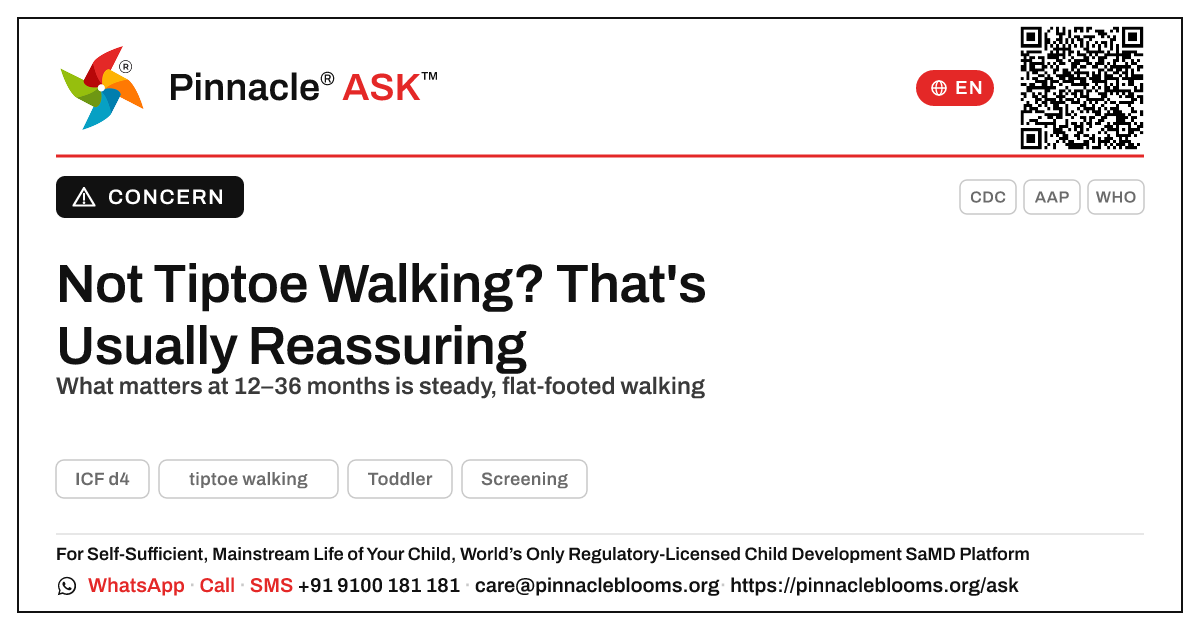
Tiptoe walking is not a milestone your child needs to reach — many toddlers never tiptoe, and that is completely typical. Between 12 and 36 months, what matters is steady, flat-footed walking, not toe-walking. A child not showing tiptoe walking is almost always doing exactly what we'd hope. Concern relates to persistent toe-walking beyond age 2–3 or to not walking at all by 18 months, not to its absence.
In this answer 5 sections
If your toddler isn't tiptoe walking, take a breath — for most children this simply isn't a milestone to chase at all.
In short
Tiptoe walking is not a milestone your child needs to reach. Many toddlers never walk on their toes, and that is completely typical and healthy. What matters between 12 and 36 months is that your child is walking on flat feet, steadily and with growing confidence — not whether they ever tiptoe. So a child who isn't showing tiptoe walking is, in almost every case, doing exactly what we'd hope.
What to watch at 12–36 months
Healthy walking at this age looks like:
- First independent steps by around 12–18 months, becoming steadier through the second year.
- Flat-footed, heel-to-toe walking most of the time — this is the typical, desirable pattern.
- Climbing, squatting and running emerging as balance grows.
Gentle flags that deserve a clinician's calm look are not about missing tiptoeing — they are the opposite:
- Persistent tiptoe walking beyond age 2–3, especially if your child cannot put heels flat or it's combined with tight calves.
- Not walking at all by 18 months, or a loss of a skill once had.
- Stiffness, frequent falling, or favouring one side of the body.
If your child simply walks normally on flat feet and doesn't tiptoe, there is nothing to act on here.
The science
Occasional toe-walking is common as toddlers experiment with movement, and most outgrow it. Its absence is reassuring — flat, heel-strike walking is the mature, efficient pattern we look for. Concern arises only with persistent toe-walking, not its absence, so you can let this worry go.
The Pinnacle way
A clinical AbilityScore® and any diagnosis are formed only at a Pinnacle Blooms Network centre, under qualified clinician care — never from an online list. If you'd like reassurance about how your child walks, our physiotherapy team can review gait gently through play. You can also read more about tiptoe walking and what it means.
Trusted sources
CDC "Learn the Signs, Act Early" milestone guidance on toddler walking; American Academy of Pediatrics (healthychildren.org) notes that occasional toe-walking is common and usually resolves; WHO ICF mobility framework (d4).
Next step — If your toddler walks happily on flat feet, simply enjoy it. For any niggle about gait or balance, book a developmental check with a Pinnacle clinician.
This is general information, not a diagnosis — individual assessment and diagnosis require an appropriately qualified healthcare professional.
CONNECT THE ANSWER TO YOUR CHILD’S DAY
Something to notice. Something to discuss.
What to notice
Not tiptoe walking is reassuring, not concerning. Watch instead for not walking at all by 18 months, persistent toe-walking beyond age 2–3 (especially if heels can't go flat or calves are tight), stiffness, frequent falling, favouring one side, or loss of a skill once had.
In everyday life
Let your toddler walk barefoot on safe, varied surfaces — grass, sand, smooth floor. This builds natural flat-footed balance and gives you an easy, everyday view of how steadily they move.
Bring your observations and questions to your child’s professional. Choose activities that suit your child’s comfort, abilities and agreed plan.
Bring your questions to a first visitQuestions families ask
Is it bad if my toddler never walks on tiptoe?
Not at all. Tiptoe walking is not a milestone children must reach. Flat-footed, steady walking is the healthy pattern we look for, so its absence is reassuring.
When is tiptoe walking actually a concern?
Concern relates to persistent toe-walking beyond age 2–3 — especially if your child cannot put their heels flat or has tight calves — not to the absence of toe-walking.
What walking milestones matter at 12–36 months?
Look for first independent steps by around 12–18 months, growing steadiness, flat heel-to-toe walking, and emerging climbing and running. If your child isn't walking at all by 18 months, arrange a check.
FOLLOW THE SOURCE
References behind this answer.
- Source referenceCDC — Learn the Signs, Act Early milestones
- Organisation website · further readingAAP — toddler walking and toe-walking guidance
- Organisation website · further readingWHO ICF mobility domain (d4)
References are supplied with this answer. An organisation homepage offers further reading; it does not establish an independent review of this page.
Content attribution: SETU Consortium · Pinnacle Blooms Network.
PEOPLE, TOPICS & DEVELOPMENT
See the connections.
Browse the wider question collections connected with this answer’s audience, developmental area and stage.
FROM UNDERSTANDING TO PURPOSEFUL SUPPORT
One question. Your child’s whole life.
Your child’s self-sufficient, mainstream-included life is the purpose from the beginning. At Pinnacle, that purpose shapes what we understand, the goals we choose, the people we bring together, everyday practice and review.
Connect this question with the right support.
Start with your child’s strengths, your observations and what you want everyday life to become.
Make the next conversation useful.
Bring the situations you notice at home or school. We’ll explain a suitable service, centre and first visit, including availability and fees, before you decide.
How PinnacleAI® connects the journeyExplore the seven stages
- 1Understand abilities
A starting picture of your child’s capabilities.
- 2Choose meaningful goals
Readiness and a plan shaped around the child.
- 3Bring the right support together
Suitable therapies and people for those goals.
- 4Carry practice into everyday life
Guidance for family, home and school.
- 5Track and correct
Use observations to adjust the plan.
- 6Reassess and review
Decide what to continue, change or do next.
- 7Grow independence and participation
The child’s life gives each step its purpose.
Explore the whole PinnacleAI® system → · Participation at school and in the community →
PINNACLE’S EVIDENCE, OPEN TO YOU
Look at the evidence behind our work.
Read our research, inspect the original regulatory documents and check what each institutional measure means.
General information supports a conversation with an appropriately qualified professional. Advice, goals and support depend on the individual child.