
YOUR QUESTION. A CLEARER NEXT STEP.
Early Signs of ODD in a 2-Year-Old
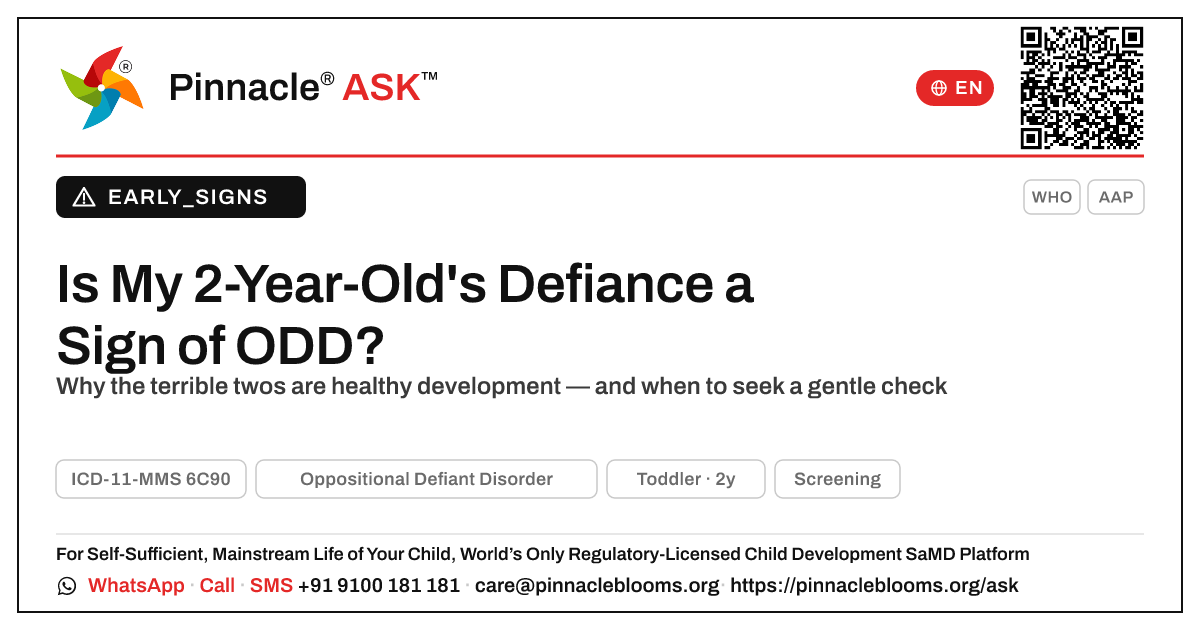
Oppositional Defiant Disorder is not a meaningful diagnosis in a 2-year-old, so there is no signs list to give. Tantrums, saying "no", refusing and big emotional storms are normal toddler development as autonomy grows and self-regulation is still forming. Observe gently, set warm limits, and arrange a general developmental check if you have any wider concerns about speech, play or mood.
In this answer 5 sections
Every two-year-old says "no", melts down and tests limits — so it's natural to wonder when strong-willed becomes something more.
In short
At two, what looks like "defiance" is almost always healthy, on-time development — not Oppositional Defiant Disorder (ODD). Tantrums, saying "no", refusing, and big emotional storms are the normal work of a toddler learning autonomy with a brain that cannot yet self-soothe. ODD (ICD-11 6C90) is a pattern recognised in older children, not a meaningful diagnosis for a two-year-old, so there is no validated signs list to give at this age. What matters now is gentle observation, warm limit-setting, and a general developmental check if anything worries you.
What is actually normal at two
The so-called "terrible twos" are a developmental milestone, not a warning sign. Expect:
- Frequent "no" and refusals — your toddler is discovering she is a separate person with her own will.
- Big tantrums — crying, kicking, going limp or lying on the floor, several times a day, especially when tired or hungry.
- Limit-testing — doing the very thing you just asked her not to, then watching your face.
- Difficulty with transitions and sharing — these skills are barely emerging at this age.
A two-year-old's brain has not yet built the wiring for impulse control or emotional regulation — that grows slowly over years. So these behaviours are signs of a developing child, not a behavioural disorder.
When to seek a general check (not an ODD label)
Book a routine developmental check if you notice things that sit outside typical toddler behaviour, such as:
- Very few or no words by two, or loss of words/skills she once had
- Little eye contact, pointing, or shared joy and back-and-forth play
- Tantrums so frequent, long and intense that she cannot be soothed at all, or that involve hurting herself or others
- Concerns about hearing, sleep, feeding or sudden changes in mood and behaviour
These point not to ODD but to general development — sometimes speech, hearing, sensory or attention areas — that a clinician can look at as a whole. ODD itself is only meaningfully assessed in later childhood, when patterns of mood and behaviour can be seen across settings over six months or more.
The Pinnacle way
At Pinnacle Blooms Network, we meet your toddler where she is — celebrating the spirited two-year-old in front of you while gently checking that every area of development is on track. If you'd like reassurance, a developmental screening looks at the whole child, and we can share calm, practical parenting strategies for tantrums and limits. A clinical AbilityScore® and any diagnosis are formed only at a Pinnacle Blooms Network centre under qualified clinician care — nothing here is a diagnosis, and Oppositional Defiant Disorder is not a label applied at this age. Across 70+ centres in 4 states and 4.95 lakh+ families served, our aim is steady, strengths-first reassurance.
Trusted sources
Aligned with WHO ICD-11 (6C90, Oppositional defiant disorder), and with American Academy of Pediatrics and HealthyChildren.org guidance on toddler temper tantrums and healthy emotional development.
Next step — if your toddler's behaviour worries you, book a friendly developmental screen with our clinical team on WhatsApp at +91 91001 81181, and let's understand her together.
This is general information, not a diagnosis — individual assessment and diagnosis require an appropriately qualified healthcare professional.
CONNECT THE ANSWER TO YOUR CHILD’S DAY
Something to notice. Something to discuss.
What to notice
Most defiance at two is healthy development. Seek a general check, not an ODD label, if there are few words by two, lost skills, little eye contact or shared play, or tantrums so intense she cannot be soothed at all.
In everyday life
Name the feeling before the rule: "You're so cross — let's breathe, then try again." Offering two small choices ("red cup or blue cup?") gives a toddler the sense of control she craves and heads off many stand-offs.
Bring your observations and questions to your child’s professional. Choose activities that suit your child’s comfort, abilities and agreed plan.
Bring your questions to a first visitQuestions families ask
Can a 2-year-old be diagnosed with Oppositional Defiant Disorder?
No. ODD is a pattern recognised in older children, seen across settings over six months or more. At two, defiance and tantrums are typical development, so a meaningful ODD diagnosis is not made at this age.
How much tantruming is normal for a two-year-old?
Several tantrums a day, especially around tiredness, hunger or transitions, is well within normal range. What's worth a check is when tantrums are so long and intense she cannot be soothed at all, or involve hurting herself or others.
When should I see someone about my toddler's behaviour?
Arrange a general developmental check if you notice few or no words by two, lost skills, little eye contact or shared play, or sudden changes in mood. A clinician looks at the whole child rather than the behaviour alone.
FOLLOW THE SOURCE
References behind this answer.
- Source referenceWHO ICD-11: Oppositional defiant disorder
- Source referenceHealthyChildren.org: toddler behaviour and discipline
- Organisation website · further readingAmerican Academy of Pediatrics: early childhood development
References are supplied with this answer. An organisation homepage offers further reading; it does not establish an independent review of this page.
Content attribution: SETU Consortium · Pinnacle Blooms Network.
PEOPLE, TOPICS & DEVELOPMENT
See the connections.
Browse the wider question collections connected with this answer’s audience, developmental area and stage.
FROM UNDERSTANDING TO PURPOSEFUL SUPPORT
One question. Your child’s whole life.
Your child’s self-sufficient, mainstream-included life is the purpose from the beginning. At Pinnacle, that purpose shapes what we understand, the goals we choose, the people we bring together, everyday practice and review.
Connect this question with the right support.
Start with your child’s strengths, your observations and what you want everyday life to become.
Make the next conversation useful.
Bring the situations you notice at home or school. We’ll explain a suitable service, centre and first visit, including availability and fees, before you decide.
How PinnacleAI® connects the journeyExplore the seven stages
- 1Understand abilities
A starting picture of your child’s capabilities.
- 2Choose meaningful goals
Readiness and a plan shaped around the child.
- 3Bring the right support together
Suitable therapies and people for those goals.
- 4Carry practice into everyday life
Guidance for family, home and school.
- 5Track and correct
Use observations to adjust the plan.
- 6Reassess and review
Decide what to continue, change or do next.
- 7Grow independence and participation
The child’s life gives each step its purpose.
Explore the whole PinnacleAI® system → · Participation at school and in the community →
PINNACLE’S EVIDENCE, OPEN TO YOU
Look at the evidence behind our work.
Read our research, inspect the original regulatory documents and check what each institutional measure means.
General information supports a conversation with an appropriately qualified professional. Advice, goals and support depend on the individual child.