
YOUR QUESTION. A CLEARER NEXT STEP.
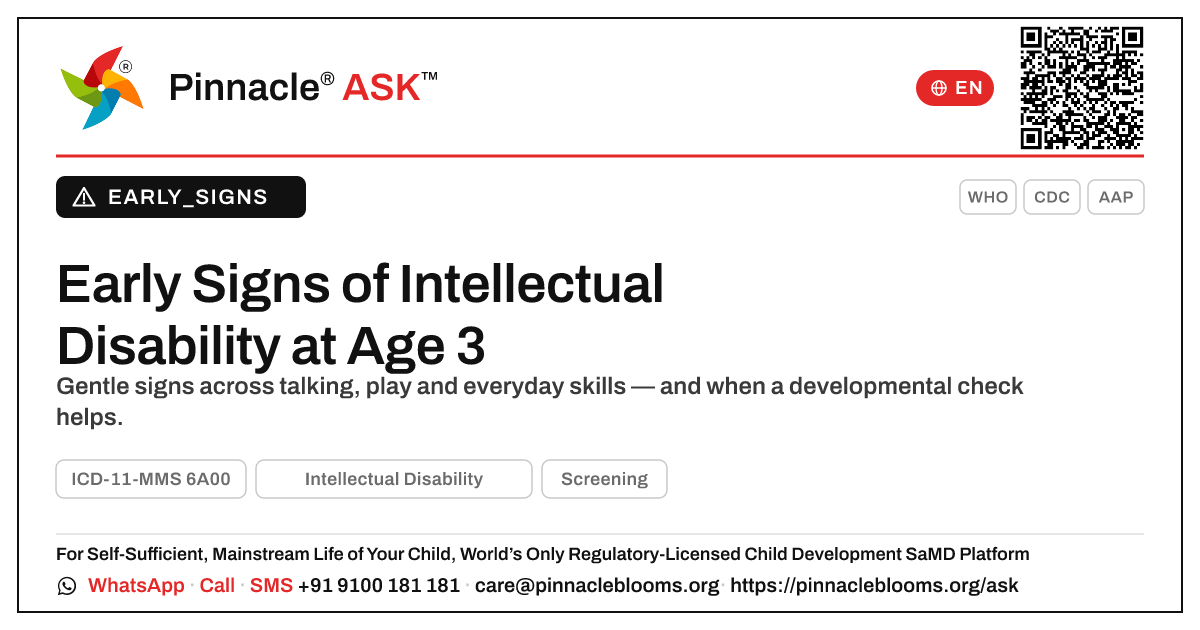
Early Signs of Intellectual Disability in a 3-Year-Old Girl
In a 3-year-old, possible signs of intellectual disability are delays across several areas together — slower talking and understanding, slower learning of everyday skills like feeding and dressing, and difficulty with play and simple problem-solving. A single delay is rarely a worry; a pattern across domains deserves a developmental check. Only a qualified clinician can confirm.
In this answer 5 sections
Every three-year-old grows at her own pace — but when learning, talking and everyday skills lag together, a gentle check brings clarity and calm.
In short
In a 3-year-old, signs that may point towards intellectual disability are delays across several areas at once — slower talking and understanding, slower learning of everyday skills like feeding or dressing, and difficulty with play and problem-solving expected for her age. One isolated delay is rarely a worry; it is a pattern of delay across domains that deserves a developmental check. Only a qualified clinician can confirm anything — this is about noticing early, not labelling.
Gentle signs worth noticing at 3
Communication & understanding
- Few words, or not joining two words together yet
- Difficulty following simple two-step instructions ("pick up the cup and give it to me")
- Trouble understanding everyday questions or naming familiar objects
Thinking & play
- Little pretend or imaginative play compared with peers
- Difficulty with simple puzzles, sorting or matching by colour or shape
- Slower to learn cause-and-effect (how a toy works)
Everyday (adaptive) skills
- Needing much more help than peers with feeding, drinking from a cup, or dressing
- Not yet attempting simple self-care she sees other children manage
Across the board
- Slower to reach several milestones together — not just one area
- Any loss of skills she once had should always prompt a prompt check
Girls are sometimes quieter and easier to overlook, so trust your instinct if something feels behind.
When to seek a developmental check
At 3, delays in several areas together are the meaningful signal — far more than any single missed milestone. "Wait and see" is not the best approach when the pattern persists across home and playgroup. A timely developmental assessment sorts out whether this is a delay that catches up with support, or something that benefits from structured therapy now. The earlier the support, the better young brains respond.
The Pinnacle way
At Pinnacle Blooms Network, Developmental measurement supports care planning; diagnosis requires an appropriately qualified healthcare professional., under qualified clinician care — never from an online list. Our clinician-administered AbilityScore® builds an objective, multi-domain picture of your daughter's strengths and needs, and we shape support — including speech therapy — around her. Backed by 4.95 lakh+ families served across 70+ centres in 4 states, your first step is simply a conversation.
Trusted sources
Guided by WHO ICD-11 (6A00, disorders of intellectual development), the CDC "Learn the Signs. Act Early." milestones, the Indian Academy of Pediatrics, and the American Academy of Pediatrics.
Next step — book a developmental check or reach our team on WhatsApp at +91 91001 81181 to understand your daughter's profile with warmth and clarity.
This is general information, not a diagnosis — individual assessment and diagnosis require an appropriately qualified healthcare professional.
CONNECT THE ANSWER TO YOUR CHILD’S DAY
Something to notice. Something to discuss.
What to notice
Watch for delays appearing together across talking, play and self-care rather than one isolated area. Seek a prompt check if she loses skills she once had, or if delays persist across home and playgroup despite encouragement.
In everyday life
Play a simple two-step game daily — "give me the ball, then clap." Following the sequence builds and reveals understanding; note gently over a few weeks whether she's gradually getting it.
Bring your observations and questions to your child’s professional. Choose activities that suit your child’s comfort, abilities and agreed plan.
Bring your questions to a first visitQuestions families ask
Can intellectual disability really be identified at age 3?
At 3, clinicians look at patterns of delay across several areas rather than giving a firm label. A formal picture forms over time with a qualified clinician — early checks help guide support, not to rush a diagnosis.
My daughter is just a late talker — should I worry?
A single delay, like talking, is common and often catches up. The signal worth checking is when several areas lag together — understanding, play and everyday skills alongside speech. A developmental check brings clarity.
Are girls harder to spot?
Sometimes. Girls can be quieter and more cooperative, so delays may be overlooked. Trust your instinct — if her development feels behind her peers across areas, a gentle check is worthwhile.
What happens at a developmental check?
A clinician observes how your daughter communicates, plays, solves problems and manages everyday tasks, using a structured AbilityScore® assessment. It builds an objective profile of her strengths and needs to guide any support.
FOLLOW THE SOURCE
References behind this answer.
- Source referenceWHO ICD-11 · Disorders of intellectual development
- Source referenceCDC — Learn the Signs. Act Early.
- Organisation website · further readingAmerican Academy of Pediatrics (HealthyChildren.org)
References are supplied with this answer. An organisation homepage offers further reading; it does not establish an independent review of this page.
Content attribution: SETU Consortium · Pinnacle Blooms Network.
PEOPLE, TOPICS & DEVELOPMENT
See the connections.
Browse the wider question collections connected with this answer’s audience, developmental area and stage.
FROM UNDERSTANDING TO PURPOSEFUL SUPPORT
One question. Your child’s whole life.
Your child’s self-sufficient, mainstream-included life is the purpose from the beginning. At Pinnacle, that purpose shapes what we understand, the goals we choose, the people we bring together, everyday practice and review.
Connect this question with the right support.
Start with your child’s strengths, your observations and what you want everyday life to become.
Make the next conversation useful.
Bring the situations you notice at home or school. We’ll explain a suitable service, centre and first visit, including availability and fees, before you decide.
How PinnacleAI® connects the journeyExplore the seven stages
- 1Understand abilities
A starting picture of your child’s capabilities.
- 2Choose meaningful goals
Readiness and a plan shaped around the child.
- 3Bring the right support together
Suitable therapies and people for those goals.
- 4Carry practice into everyday life
Guidance for family, home and school.
- 5Track and correct
Use observations to adjust the plan.
- 6Reassess and review
Decide what to continue, change or do next.
- 7Grow independence and participation
The child’s life gives each step its purpose.
Explore the whole PinnacleAI® system → · Participation at school and in the community →
PINNACLE’S EVIDENCE, OPEN TO YOU
Look at the evidence behind our work.
Read our research, inspect the original regulatory documents and check what each institutional measure means.
General information supports a conversation with an appropriately qualified professional. Advice, goals and support depend on the individual child.