
YOUR QUESTION. A CLEARER NEXT STEP.
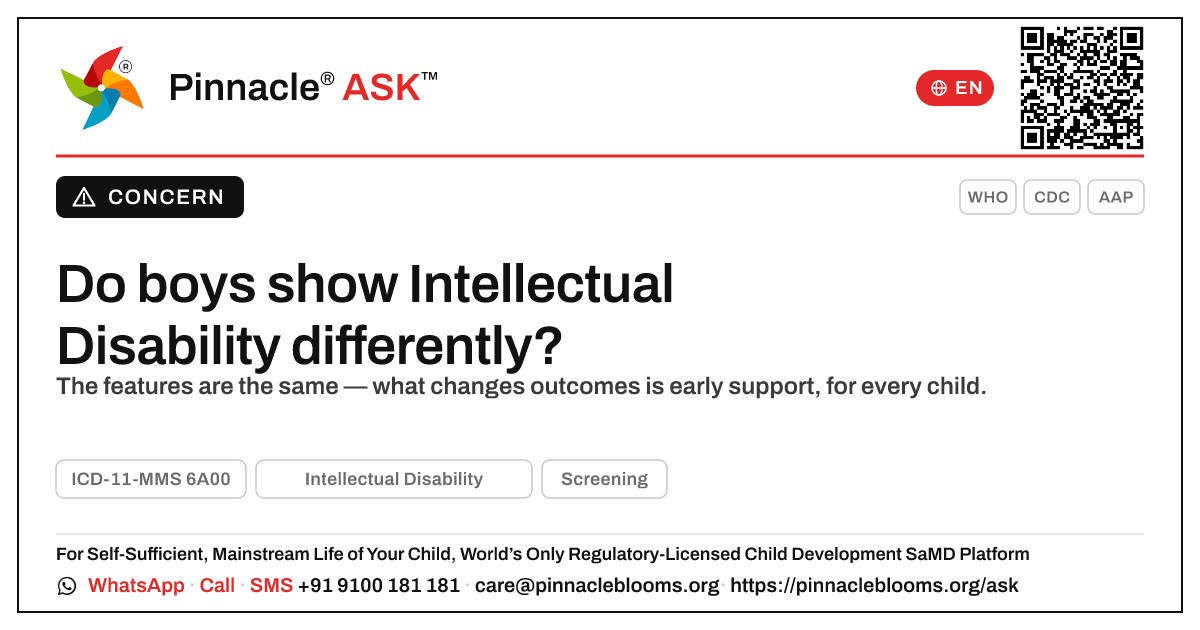
Do boys show Intellectual Disability differently?
Intellectual disability is diagnosed somewhat more often in boys, partly because some causes (like Fragile X) sit on the X chromosome. But the core features — difficulty with learning, reasoning and everyday skills — are the same for boys and girls, and so is the help that works: early, individualised support. Only a clinician can confirm a diagnosis.
In this answer 5 sections
If your son is finding learning and everyday skills harder than you expected, the worry is real — and there is a clear, hopeful path forward.
In short
Intellectual disability (ICD-11 6A00) affects how a child learns, reasons and manages everyday tasks, and it is diagnosed slightly more often in boys than girls. But the core features — difficulties with learning, problem-solving and adaptive skills like dressing, communicating and managing daily routines — are essentially the same regardless of sex. There is no separate "boy version". What differs is partly biology (some genetic causes, such as Fragile X, are carried on the X chromosome and so affect boys more) and partly recognition — boys are sometimes flagged earlier because difficulties are noticed sooner.
What this means for your son
The building blocks doctors and therapists watch are the same for every child:
- Learning & thinking — taking longer to understand new ideas, follow multi-step instructions, or remember routines
- Communication — words and understanding arriving later than expected for age
- Everyday skills — needing more help than peers with self-care, play and managing daily tasks
- Social understanding — finding it harder to read situations or solve everyday problems
A single delay is common and often catches up. A pattern that persists across several of these areas is the real reason to check. Sex does not change what helps — early, individualised support changes outcomes for every child.
When to seek a check
If, by your son's age, you notice persistent difficulty across learning, communication and self-care together — not one skill alone — a developmental check is the kind and sensible next step. Earlier support means more of his potential is unlocked.
The Pinnacle way
Developmental measurement supports care planning; diagnosis requires an appropriately qualified healthcare professional., under qualified clinician care — never from an online form or article. Our clinicians look for the cause first, measure your son against his own AbilityScore® baseline, and build a plan around his strengths. With 4.95 lakh+ families served across 70+ centres, the aim is always the same: your child learning, growing and thriving. Explore developmental therapy or simply start with a check.
Trusted sources
WHO ICD-11 (6A00, Disorders of intellectual development); CDC Learn the Signs. Act Early. milestone guidance; Indian Academy of Pediatrics; American Academy of Pediatrics (HealthyChildren.org).
Next step — The kindest thing to do with worry is check. Book a developmental assessment with a Pinnacle clinician.
This is general information, not a diagnosis — individual assessment and diagnosis require an appropriately qualified healthcare professional.
CONNECT THE ANSWER TO YOUR CHILD’S DAY
Something to notice. Something to discuss.
What to notice
Seek a check sooner if your son shows persistent difficulty across several areas together — learning, communication and self-care — rather than one skill alone, or if he loses skills he once had.
In everyday life
Break everyday tasks into small, repeated steps and celebrate each one — "first socks, then shoes". Consistent, patient practice in real routines builds independence powerfully, whatever your child's pace.
Bring your observations and questions to your child’s professional. Choose activities that suit your child’s comfort, abilities and agreed plan.
Bring your questions to a first visitQuestions families ask
Is intellectual disability really more common in boys?
It is diagnosed somewhat more often in boys. Part of this is biology — some genetic causes, such as Fragile X syndrome, are carried on the X chromosome and so more often affect boys. Part is recognition, as difficulties are sometimes noticed earlier in boys.
Do the signs look different in boys than girls?
No. The core features — slower learning and reasoning, and difficulty with everyday adaptive skills like communication and self-care — are essentially the same regardless of sex. There is no separate set of signs for boys.
Does my son need a different kind of support because he's a boy?
No. Support is built around each individual child's strengths and needs, not their sex. Early, individualised therapy improves outcomes for every child. A clinician tailors the plan after assessment.
Can a diagnosis be made from an online checklist?
No. Developmental measurement supports care planning; diagnosis requires an appropriately qualified healthcare professional. under qualified clinician care. Online information helps you decide to check — it never replaces an assessment.
FOLLOW THE SOURCE
References behind this answer.
- Source referenceWHO ICD-11 — Disorders of intellectual development
- Source referenceCDC — Learn the Signs. Act Early.
- Organisation website · further readingAmerican Academy of Pediatrics — HealthyChildren.org
References are supplied with this answer. An organisation homepage offers further reading; it does not establish an independent review of this page.
Content attribution: SETU Consortium · Pinnacle Blooms Network.
PEOPLE, TOPICS & DEVELOPMENT
See the connections.
Browse the wider question collections connected with this answer’s audience, developmental area and stage.
FROM UNDERSTANDING TO PURPOSEFUL SUPPORT
One question. Your child’s whole life.
Your child’s self-sufficient, mainstream-included life is the purpose from the beginning. At Pinnacle, that purpose shapes what we understand, the goals we choose, the people we bring together, everyday practice and review.
Connect this question with the right support.
Start with your child’s strengths, your observations and what you want everyday life to become.
Make the next conversation useful.
Bring the situations you notice at home or school. We’ll explain a suitable service, centre and first visit, including availability and fees, before you decide.
How PinnacleAI® connects the journeyExplore the seven stages
- 1Understand abilities
A starting picture of your child’s capabilities.
- 2Choose meaningful goals
Readiness and a plan shaped around the child.
- 3Bring the right support together
Suitable therapies and people for those goals.
- 4Carry practice into everyday life
Guidance for family, home and school.
- 5Track and correct
Use observations to adjust the plan.
- 6Reassess and review
Decide what to continue, change or do next.
- 7Grow independence and participation
The child’s life gives each step its purpose.
Explore the whole PinnacleAI® system → · Participation at school and in the community →
PINNACLE’S EVIDENCE, OPEN TO YOU
Look at the evidence behind our work.
Read our research, inspect the original regulatory documents and check what each institutional measure means.
General information supports a conversation with an appropriately qualified professional. Advice, goals and support depend on the individual child.