
Autism Spectrum
Validated outcome measures for studying autism in early childhood
Early-childhood autism research uses a layered set of validated measures: diagnostic-standard tools (ADOS-2, ADI-R), screeners (M-CHAT-R/F), adaptive and developmental batteries (Vineland-3, Mullen, Bayley-4), and core-symptom endpoints (SRS-2, RBS-R). Selection depends on whether the construct is diagnosis, severity, adaptive function or treatment response, and on alignment with ICD-11 6A02.
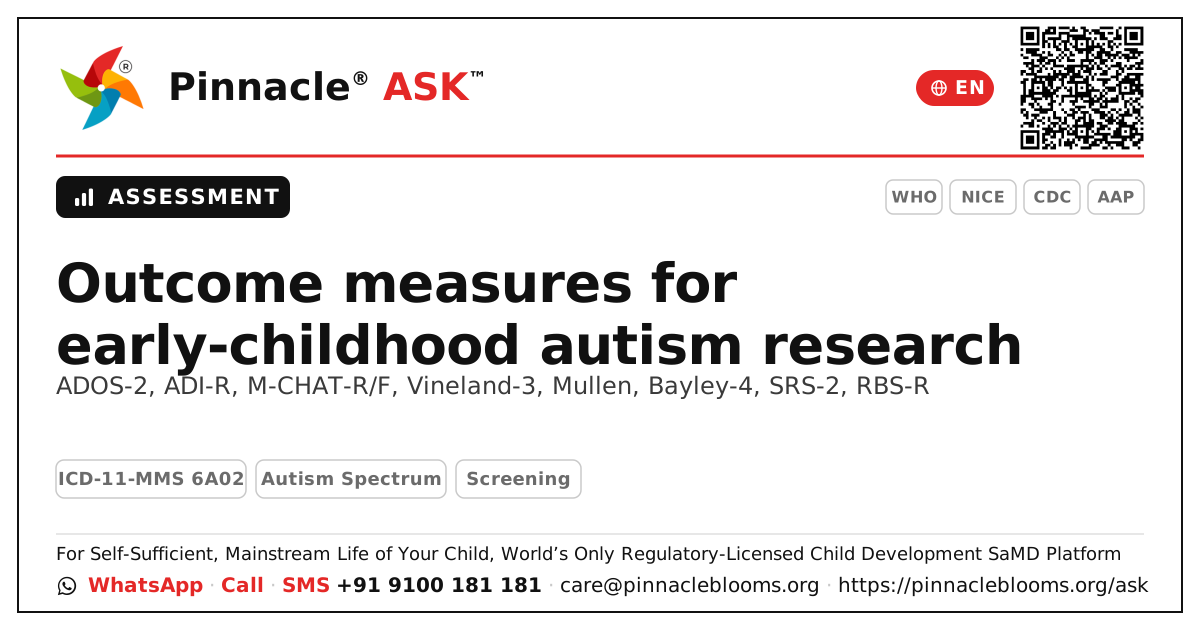
For researchers studying early-childhood autism, the choice of outcome measure is the difference between a finding that replicates and one that drifts.
In short
Early-childhood autism research draws on a layered toolkit: diagnostic-standard observational and interview measures (ADOS-2, ADI-R), screening instruments (M-CHAT-R/F), adaptive and developmental batteries (Vineland-3, Mullen Scales of Early Learning, Bayley-4), and core-symptom and quality-of-life endpoints (SRS-2, RBS-R, and parent-reported function). Selection depends on whether the construct of interest is diagnosis, symptom severity, adaptive functioning, or treatment response — and on alignment with ICD-11 6A02 functioning dimensions.The measurement landscape
Diagnostic-standard observation and history- ADOS-2 (Autism Diagnostic Observation Schedule, 2nd ed.) — semi-structured observation with a Toddler Module and comparison scores usable as a continuous severity index across timepoints.
- ADI-R (Autism Diagnostic Interview–Revised) — structured caregiver interview anchoring developmental history.
Screening and case-finding
- M-CHAT-R/F — validated parent-report screen for 16–30 months, widely used to define research cohorts and surveillance samples.
Adaptive behaviour and developmental level
- Vineland Adaptive Behaviour Scales, 3rd ed. — the dominant adaptive-functioning outcome in early-intervention trials.
- Mullen Scales of Early Learning and Bayley Scales of Infant and Toddler Development (Bayley-4) — cognitive and developmental quotients for very young children.
Core symptoms, repetitive behaviour and function
- SRS-2 (Social Responsiveness Scale) — dimensional social-communication trait measure.
- RBS-R (Repetitive Behaviour Scale–Revised) for restricted, repetitive behaviour; caregiver-reported quality-of-life and family-impact measures increasingly used as patient-centred endpoints.
Good practice triangulates a clinician-rated instrument, a performance-based developmental measure, and a caregiver-report measure, and reports psychometrics (reliability, sensitivity to change, minimal clinically important difference) for the specific age band studied. Mapping endpoints to the WHO ICD-11 6A02 framework and the ICF functioning model improves cross-study comparability.
The Pinnacle way
A clinical AbilityScore® and any diagnosis are formed only at a Pinnacle Blooms Network centre, under qualified clinician care — never from a form, app or self-report. For research partnerships, our structured, clinician-administered assessment runs alongside established gold-standard instruments, supporting calibrated, repeatable measurement of change across Autism Spectrum intervention pathways and our therapy programmes. Across 25 million+ therapy sessions and 12 validated studies, this multi-measure governance is what keeps outcomes trustworthy.Trusted sources
WHO ICD-11 6A02 defines the autism spectrum construct that research endpoints should map to. NICE CG128 outlines recognition and diagnostic pathways informing instrument choice. CDC developmental surveillance and the American Academy of Pediatrics (HealthyChildren.org) describe screening context, while NIMHANS provides Indian clinical resources for measure selection in local cohorts.Next step — Planning an early-childhood autism study? Partner with the SETU research team at Pinnacle to align outcome measures and assessment governance.
This is general information, not a diagnosis — a clinical AbilityScore® and any diagnosis are formed only at a Pinnacle Blooms Network centre under qualified clinician care.
What to watch
Report age-band-specific psychometrics — reliability, sensitivity to change and minimal clinically important difference — rather than assuming a measure validated in school-age children transfers to toddlers.
Try this at home
Triangulate at least three sources: one clinician-rated instrument, one performance-based developmental measure, and one caregiver-report measure for a defensible outcome profile.
Trusted sources
Developed by SETU Consortium · Pinnacle Blooms Network · Last reviewed 2026-06-10 · reviewed every 365 days
This is general information, not a diagnosis. A clinical AbilityScore® and any diagnosis are formed only at a Pinnacle Blooms Network centre, under qualified clinician care.
Frequently asked
Which measure is the diagnostic gold standard for young children?
The ADOS-2, paired with the ADI-R caregiver interview, is the most widely accepted diagnostic-standard combination; the ADOS-2 Toddler Module extends use to very young children, and its comparison score can serve as a continuous severity index across timepoints.
Which screening tool is best for defining a research cohort?
The M-CHAT-R/F is the most validated parent-report screen for ages 16–30 months and is commonly used for case-finding and surveillance samples, though it is a screen rather than a diagnostic instrument.
What is the most common outcome measure in early-intervention trials?
The Vineland Adaptive Behaviour Scales, 3rd edition, is the dominant adaptive-functioning endpoint, often combined with developmental batteries such as the Mullen Scales of Early Learning or Bayley-4.
How should outcome measures map to ICD-11?
Endpoints should align with the functioning dimensions described under ICD-11 6A02 and the WHO ICF model, which improves comparability and interpretation across studies and jurisdictions.