
Early-Words
Which ICF domain does Early-Words map to?
In the WHO ICF, Early-Words maps primarily to the Activities and Participation component — Chapter 3 Communication (d3), specifically Speaking (d330) — describing what a child does when producing spoken words. It is underpinned by the Body Functions domain of Mental functions of language (b167). Classifying it at the activity level keeps the focus on functional communication in real-life contexts, shaped by responsive caregiving and language-rich environments.
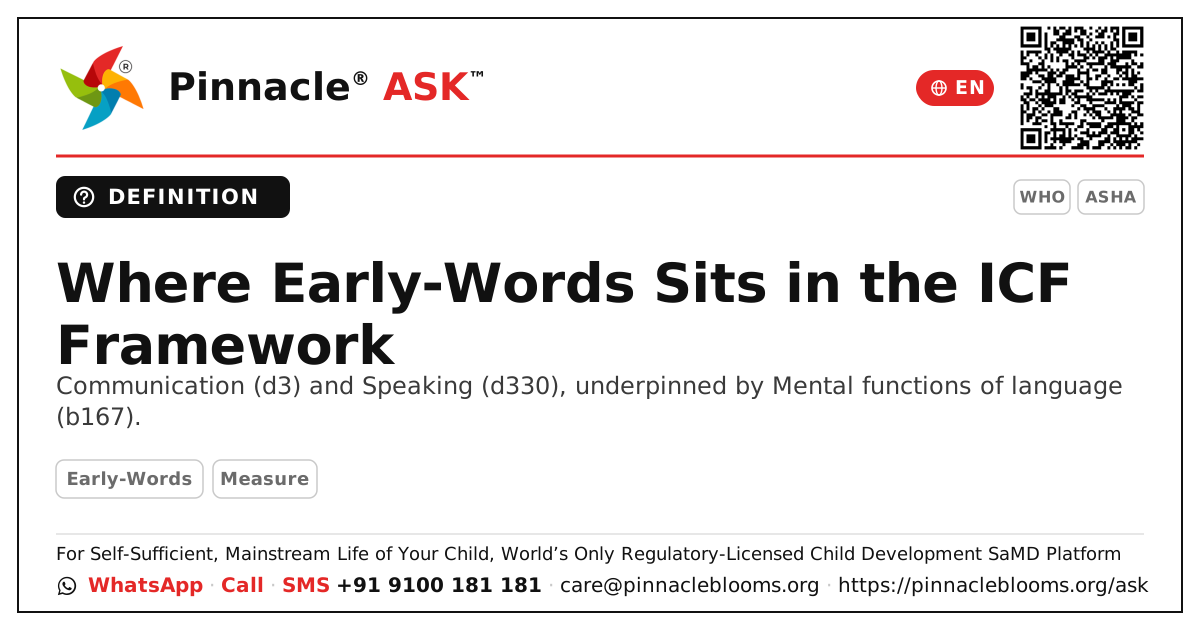
Early-Words — a toddler's first meaningful spoken vocabulary — sits squarely within the ICF's communication domain of functioning.
In short
In the WHO International Classification of Functioning, Disability and Health (ICF), Early-Words maps primarily to the Activities and Participation component, specifically Chapter 3 — Communication (d3), and within it the producing-messages strand of speaking (d330). In early childhood it also draws on the underpinning Body Functions domain of mental functions of language (b167). In plain terms: Early-Words is an activity-level communication construct, observed as what a child actually does when expressing meaning through spoken words, not merely an internal capacity.The science: locating Early-Words in the ICF architecture
The ICF separates Body Functions and Structures (the physiological and anatomical substrate) from Activities and Participation (execution of tasks and involvement in life situations). Expressive early vocabulary is best classified at the Activities and Participation level because it describes performance — the child producing words to request, name, comment and connect — rather than an isolated bodily function.Within d3 Communication, the most precise codes are d330 Speaking (producing spoken words, phrases and longer messages) and, for the receptive partner skills that scaffold first words, d310 Communicating with — receiving — spoken messages. The cognitive-linguistic foundation is captured in Body Functions under b167 Mental functions of language (recognising and using signs, symbols and other components of a language). For the youngest children, the ICF Children & Youth derivative (ICF-CY) offers developmentally calibrated qualifiers that better reflect emergent communication.
This mapping matters for measurement: framing Early-Words as an Activities and Participation construct keeps the focus on functional communication in real contexts — and reminds clinicians that environmental and personal contextual factors (responsive caregiving, language-rich routines) directly shape observed performance.
Why this framing helps
Classifying Early-Words functionally — rather than as a discrete deficit — lets teams describe a child's communication along a continuum, set participation-oriented goals, and track change in everyday settings. It aligns expressive-vocabulary observations with a globally shared vocabulary for functioning, supporting interoperable records and research.The Pinnacle way
This is general classificatory information, not a diagnosis — a clinical AbilityScore® and any diagnosis are formed only at a Pinnacle Blooms Network centre, under qualified clinician care, never from an app or form. Our clinicians map a child's [communication](/) profile to functional ICF domains and, where indicated, build an individualised plan that may draw on speech therapy to grow first words in everyday contexts.Trusted sources
WHO ICF browser entries for Communication (d3), Speaking (d330) and Mental functions of language (b167); the WHO ICF framework overview; ASHA guidance on early language and the ICF in paediatric practice.Next step — To map your child's Early-Words profile against functional ICF communication domains and set participation-focused goals, book a developmental communication review at a Pinnacle Blooms Network centre.
What to watch
Whether a toddler produces meaningful spoken words to request, name and comment in everyday routines, and how often communication succeeds across different settings and partners — performance, not a single internal capacity.
Try this at home
Name and expand during daily routines — say the word for what your child reaches for, then add one more ('cup… your cup'), giving real contexts where first words can be used and reinforced.
Trusted sources
Developed by SETU Consortium · Pinnacle Blooms Network · Last reviewed 2026-06-10 · reviewed every 365 days
This is general information, not a diagnosis. A clinical AbilityScore® and any diagnosis are formed only at a Pinnacle Blooms Network centre, under qualified clinician care.
Frequently asked
Which ICF component does Early-Words belong to?
Primarily the Activities and Participation component, because expressive early vocabulary describes what a child does in real situations rather than an isolated bodily function. The relevant chapter is Communication (d3), with Speaking (d330) the closest code.
Does Early-Words also relate to Body Functions?
Yes. The cognitive-linguistic foundation is captured under Body Functions as Mental functions of language (b167). The ICF deliberately links body functions with the activities they enable, so both levels are relevant when describing first words.
Why not classify Early-Words purely as a Body Function?
Because first words are best understood as observable functional communication in context — requesting, naming, commenting — which is the Activities and Participation level. Contextual factors such as responsive caregiving and language-rich routines directly shape this performance.
Is there a paediatric version of the ICF for young children?
Yes. The ICF Children & Youth derivative (ICF-CY) offers developmentally calibrated qualifiers that better reflect emergent communication in early childhood, while sharing the same domain architecture as the parent ICF.