
safety awareness
Is poor safety awareness a developmental red flag?
Persistent difficulty acquiring age-appropriate safety awareness can be a clinical red flag, but rarely alone — it is best interpreted as a marker within a broader developmental profile spanning cognition, language, executive function and social cognition. Refer when the deficit is disproportionate to age, persists across settings, or co-occurs with other delays. A single incident is not a flag; pattern, breadth and disproportion are the discriminators. Pair referral with hearing and vision checks.
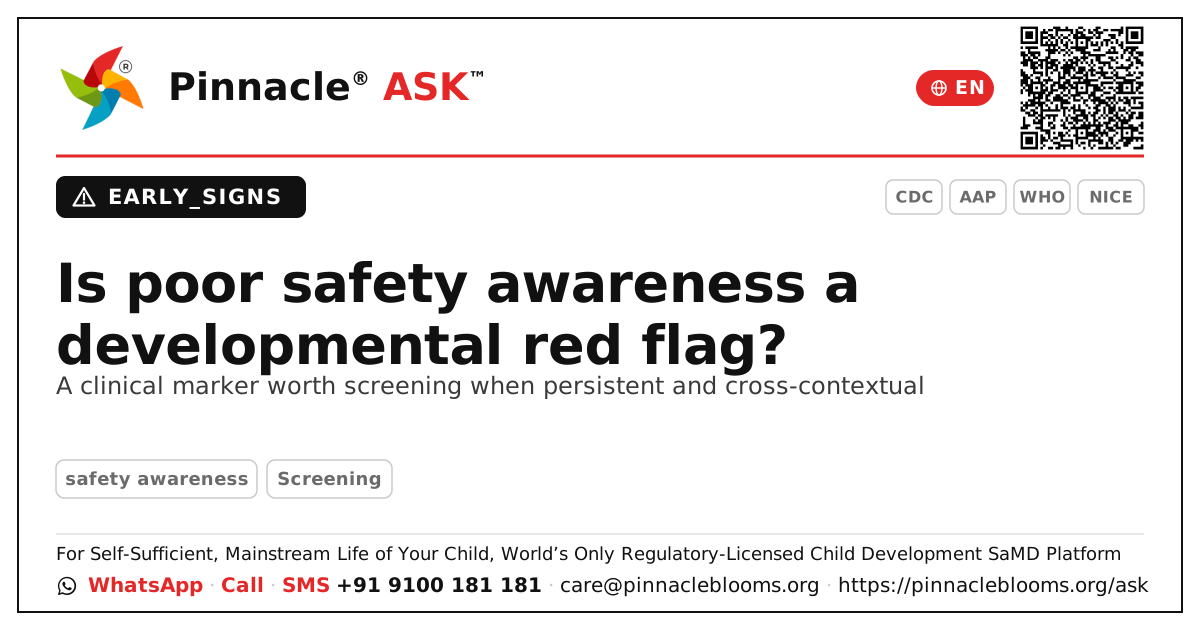
Safety awareness is a developmental composite — and when it lags persistently, it often points to something worth screening rather than to carelessness alone.
In short
Yes — persistent difficulty acquiring age-appropriate safety awareness can be a meaningful red flag, but rarely in isolation. It is best read as a marker within a broader developmental profile (cognition, language comprehension, executive function, sensory processing or social cognition). When the deficit is disproportionate to age, persists across settings, or co-occurs with other delays, a developmental referral is warranted.What to watch (clinical markers)
Safety awareness emerges progressively — proximity-seeking and stranger wariness in infancy, hazard inhibition in toddlerhood, road and stranger-danger comprehension by school age. Flag for referral when you observe:- Disproportionate hazard naivety for chronological/developmental age — repeated road, height, water or hot-surface incidents without learned avoidance.
- Failure to learn from consequence — absent error-based adjustment, suggesting executive-function or cognitive involvement.
- Reduced social referencing — not checking a caregiver's face in novel/ambiguous situations (relevant to ASD screening).
- Impulsivity and absent inhibitory control disproportionate to peers (ADHD-spectrum consideration).
- Receptive-language gaps that impair comprehension of warnings or rules.
- Elopement or wandering with no apparent danger appraisal.
The discriminator is pattern over time and across domains — a single incident is not a flag; persistence, breadth and disproportion are.
The science & when to refer
Safety awareness draws on intact cognition, executive maturation, language and social cognition; deficits frequently index underlying neurodevelopmental conditions rather than a standalone skill gap. Refer for structured developmental assessment when difficulty is persistent, cross-contextual, or clustered with other concerns — do not wait for a discrete milestone failure. Pair referral with a hearing and vision check.The Pinnacle way
A clinical AbilityScore® and any diagnosis are formed only at a Pinnacle Blooms Network centre under qualified clinician care — a clinician-administered structured assessment, never a home judgement. Explore safety awareness, our occupational therapy pathway, and how the AbilityScore® is calculated. Across 70+ centres in 4 states, 700+ therapists and 4.95 lakh+ families served, we work strengths-first.Trusted sources
Aligned with AAP and CDC developmental surveillance guidance, WHO ICD-11 neurodevelopmental frameworks, and NICE referral principles for developmental concern.Next step — refer any child with persistent, cross-setting safety-awareness concern for a developmental screen; partner with our clinical team on WhatsApp at +91 91001 81181.
This is general information, not a diagnosis — a clinical AbilityScore® and any diagnosis are formed only at a Pinnacle Blooms Network centre under qualified clinician care.
What to watch
Disproportionate hazard naivety for age, failure to learn from consequence, reduced social referencing, marked impulsivity/absent inhibition, receptive-language gaps affecting warnings, and elopement without danger appraisal — flagged by persistence and breadth across settings.
Try this at home
Distinguish a single incident from a pattern: document whether hazard naivety persists across settings and over months, and whether it clusters with language, attention or social-cognition concerns before referring.
Trusted sources
Developed by SETU Consortium · Pinnacle Blooms Network · Last reviewed 2026-06-10 · reviewed every 540 days
This is general information, not a diagnosis. A clinical AbilityScore® and any diagnosis are formed only at a Pinnacle Blooms Network centre, under qualified clinician care.
Frequently asked
Is poor safety awareness alone enough to refer?
Rarely. It is most meaningful as a marker within a broader profile. Refer when the deficit is disproportionate to age, persists across settings, or clusters with language, executive-function or social-cognition concerns.
What conditions does poor safety awareness commonly index?
It can reflect ADHD-spectrum impulsivity, ASD-related reduced social referencing, intellectual or cognitive difficulty, or receptive-language gaps that impair comprehension of warnings — hence a structured developmental assessment is the appropriate route.
Should hearing and vision be checked first?
Yes — sensory deficits can mimic or worsen apparent hazard naivety, so pair any developmental referral with hearing and vision screening.