
Bruininks-Oseretsky Test of Motor Proficiency, 2nd ed.
At what age is the BOT-2 used for a child?
The Bruininks-Oseretsky Test of Motor Proficiency, 2nd edition (BOT-2) is a clinician-administered motor assessment designed for children and young people aged 4 to 21 years. It measures both fine-motor and gross-motor skills, helping a therapist understand where a child needs support and providing a baseline to track progress. It is not used for children under four, whose motor development is assessed with other tools.
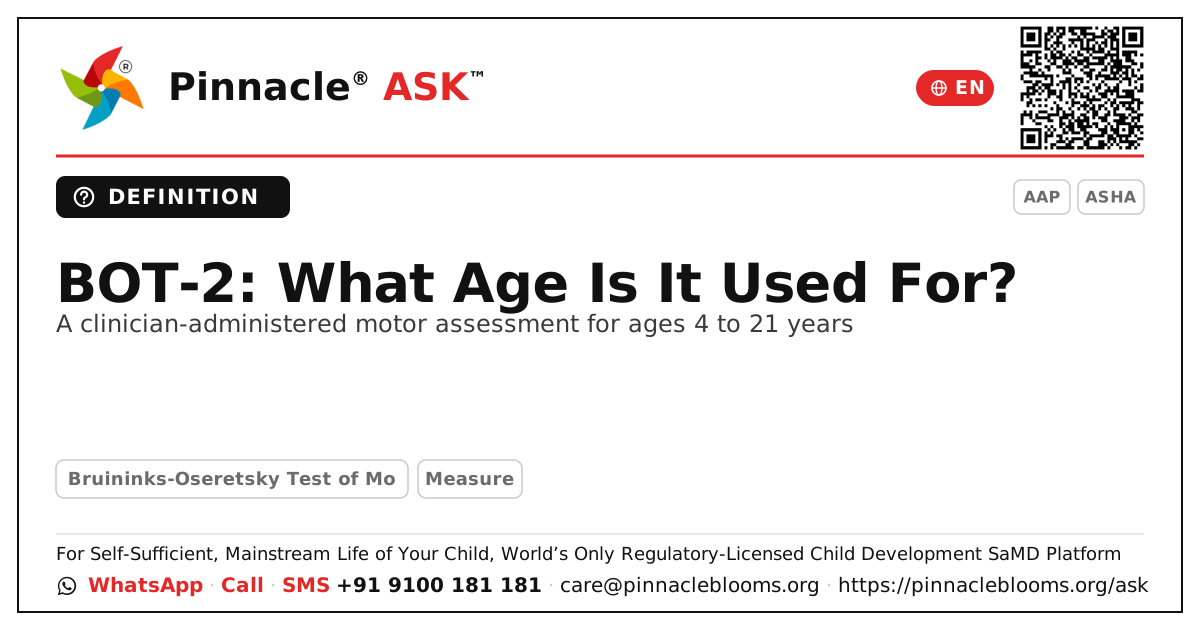
A single, gentle question — how old does a child need to be for the BOT-2? — has a clear and reassuring answer.
In short
The Bruininks-Oseretsky Test of Motor Proficiency, 2nd edition (BOT-2) is designed for children and young people aged 4 to 21 years. It is a structured, clinician-administered assessment of motor skills — covering both fine-motor (hand and finger control) and gross-motor (balance, coordination, strength) abilities. It is not used for babies or toddlers under four, as motor skills at those younger ages are best looked at with other tools.What the BOT-2 actually looks at
The BOT-2 gives a detailed picture of how a child's body and hands work together. It explores areas such as fine-motor precision (drawing, cutting), manual dexterity, bilateral coordination, balance, running speed and agility, upper-limb coordination and strength. Because it spans the wide 4-to-21 age range, the same well-validated assessment can follow a child's motor development across early childhood, school years and into young adulthood. A clinician chooses between the full form and a shorter screening form depending on what your child needs, and tasks are presented as engaging, achievable activities rather than a test to pass or fail.When it is helpful
A motor assessment like the BOT-2 may be suggested when a child finds physical tasks effortful compared with peers — clumsiness, difficulty with handwriting, trouble with balance or sports, or delays in coordination. It helps a therapist understand where the support is best placed, and it gives a clear baseline to measure progress against over time. It is one piece of a wider developmental picture, never used in isolation.The Pinnacle way
This is general information, not a diagnosis — a clinical AbilityScore® and any diagnosis are formed only at a Pinnacle Blooms Network centre, under qualified clinician care, never from an app or form. Where a motor assessment such as the BOT-2 is helpful, our therapists fold the findings into a whole-child plan that may include occupational therapy to build coordination, confidence and everyday independence.Trusted sources
The American Academy of Pediatrics and HealthyChildren guidance on motor development and developmental milestones; ASHA and allied-health resources on standardised assessment in paediatric therapy.Next step — If you have noticed your child finding coordination, balance or handwriting harder than expected, book a developmental review to see whether a motor assessment would help.
What to watch
Clumsiness or frequent tripping, difficulty with handwriting or cutting, trouble with balance and sports, or motor coordination that seems noticeably behind peers from around age four onwards.
Try this at home
Build motor confidence through play — balancing games, threading beads, ball catching and drawing all strengthen the very skills a motor assessment looks at, without any pressure.
Trusted sources
Developed by SETU Consortium · Pinnacle Blooms Network · Last reviewed 2026-06-10 · reviewed every 365 days
This is general information, not a diagnosis. A clinical AbilityScore® and any diagnosis are formed only at a Pinnacle Blooms Network centre, under qualified clinician care.
Frequently asked
What is the age range for the BOT-2?
The BOT-2 is designed for children and young people aged 4 to 21 years. It is not used for babies or toddlers under four, whose motor development is best assessed with other age-appropriate tools.
What does the BOT-2 measure?
It measures both fine-motor skills, such as hand and finger control, drawing and dexterity, and gross-motor skills, such as balance, coordination, running, agility and strength.
Is the BOT-2 a diagnosis?
No. The BOT-2 is one structured, clinician-administered assessment that contributes to a wider developmental picture. Any diagnosis is formed only at a Pinnacle Blooms Network centre under qualified clinician care.